 Ship Crew Agency
Maritime Editorial Team
In This Article
- What Is PSC Detention?
- Why Crew Documents Matter in PSC Inspections
- What Crew Document Problems Can Create PSC Risk?
- The Manning Agency’s Role in Certificate Compliance
- 1. Pre-Screening Crew Documents Before Shortlisting
- 2. Matching Certificates With Rank and Vessel Requirement
- 3. Checking STCW Certificate Validity
- 4. Supporting Medical Fitness Certificate Readiness
- 5. Coordinating Flag-State and Company-Specific Documents
- 6. Reducing Last-Minute Joining Delays
- Certificate Compliance Checklist for Shipowners and Crew Managers
- How ShipCrewAgency Supports Certificate Compliance
- Why Certificate Compliance Should Start Before the Crew Joins
- A Practical Process to Reduce PSC Detention Risk From Crew Documents
- Step 1: Define the exact crew requirement
- Step 2: Screen certificates before interview
- Step 3: Match documents to role
- Step 4: Confirm medical and travel readiness
- Step 5: Keep a replacement pipeline ready
- What Shipowners Should Ask Their Manning Agency
- Final Thoughts
- FAQ
- What is PSC detention?
- Can crew document issues cause PSC detention?
- What crew documents should be checked before a seafarer joins a vessel?
- How can a manning agency help with certificate compliance?
- Does ShipCrewAgency help with Bangladeshi seafarer documentation checks?
For shipowners, vessel operators, and crew managers, the goal is simple: make sure every seafarer joining the vessel has the right documents for the right rank, vessel type, flag requirement, and trading area.
A professional manning agency cannot guarantee that a vessel will avoid Port State Control issues. No agency can honestly promise that. But the right crewing partner can help reduce certificate-related risks by screening seafarer documents before shortlisting, checking certificate validity, coordinating missing paperwork, and supporting cleaner onboarding.
That is where certificate compliance becomes more than an admin task. It becomes part of operational risk control.
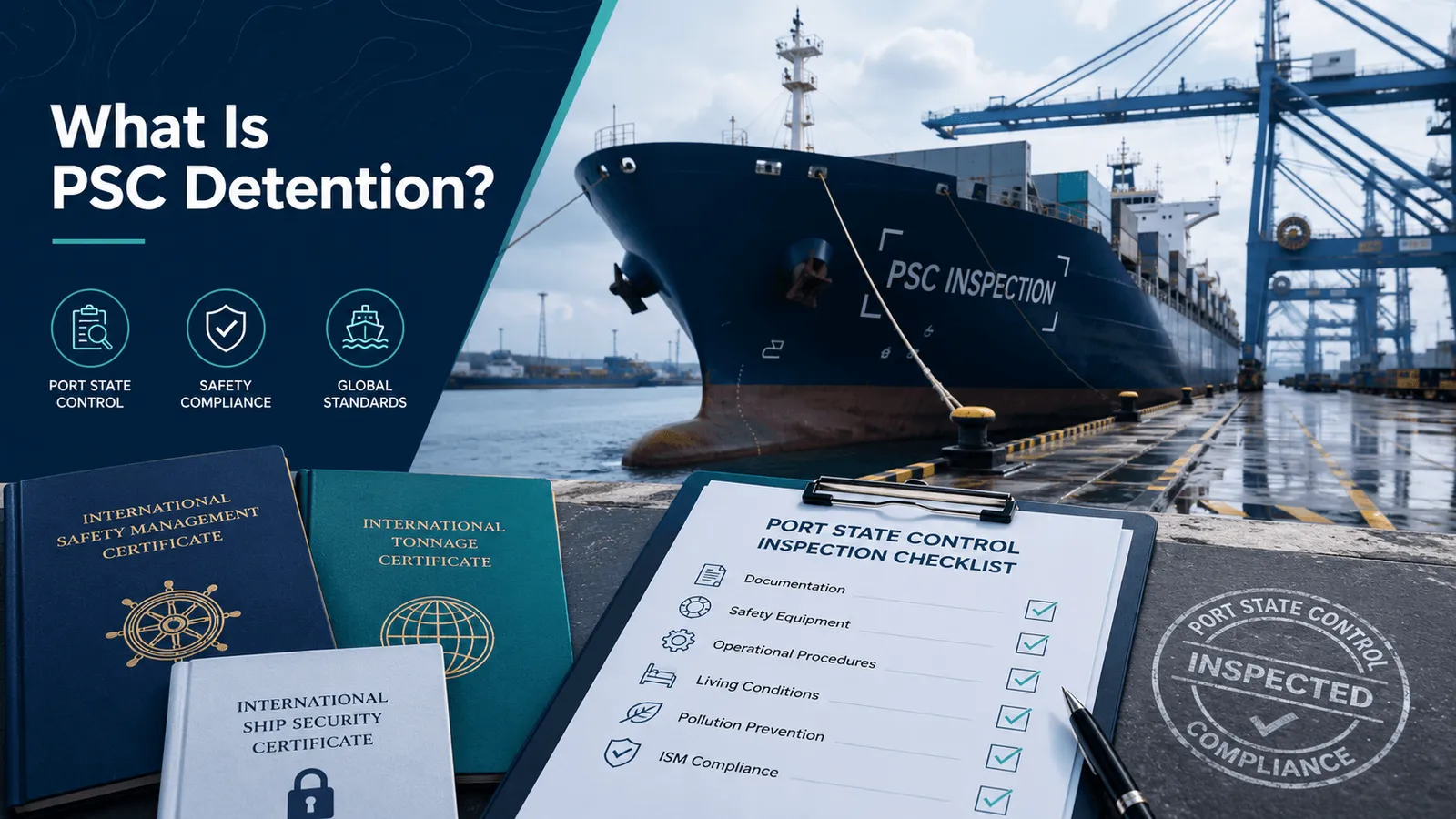
Image: Port State Control inspection concept showing vessel documents being reviewed near a cargo ship.
What Is PSC Detention?
Port State Control, often called PSC, is the inspection system used by port authorities to check foreign ships visiting their ports. These inspections help confirm whether a vessel meets applicable international safety, security, labour, and environmental standards.
The IMO explains that port States may inspect foreign ships under IMO conventions, and where deficiencies are found, ships may be delayed or detained until corrective action is taken. The IMO also notes that the flag State has the primary responsibility for ensuring ship standards, while PSC acts as a second line of defence against substandard shipping. (International Maritime Organization)
In simple terms, PSC detention means the vessel is not allowed to sail until serious deficiencies are corrected and accepted by the relevant authority.
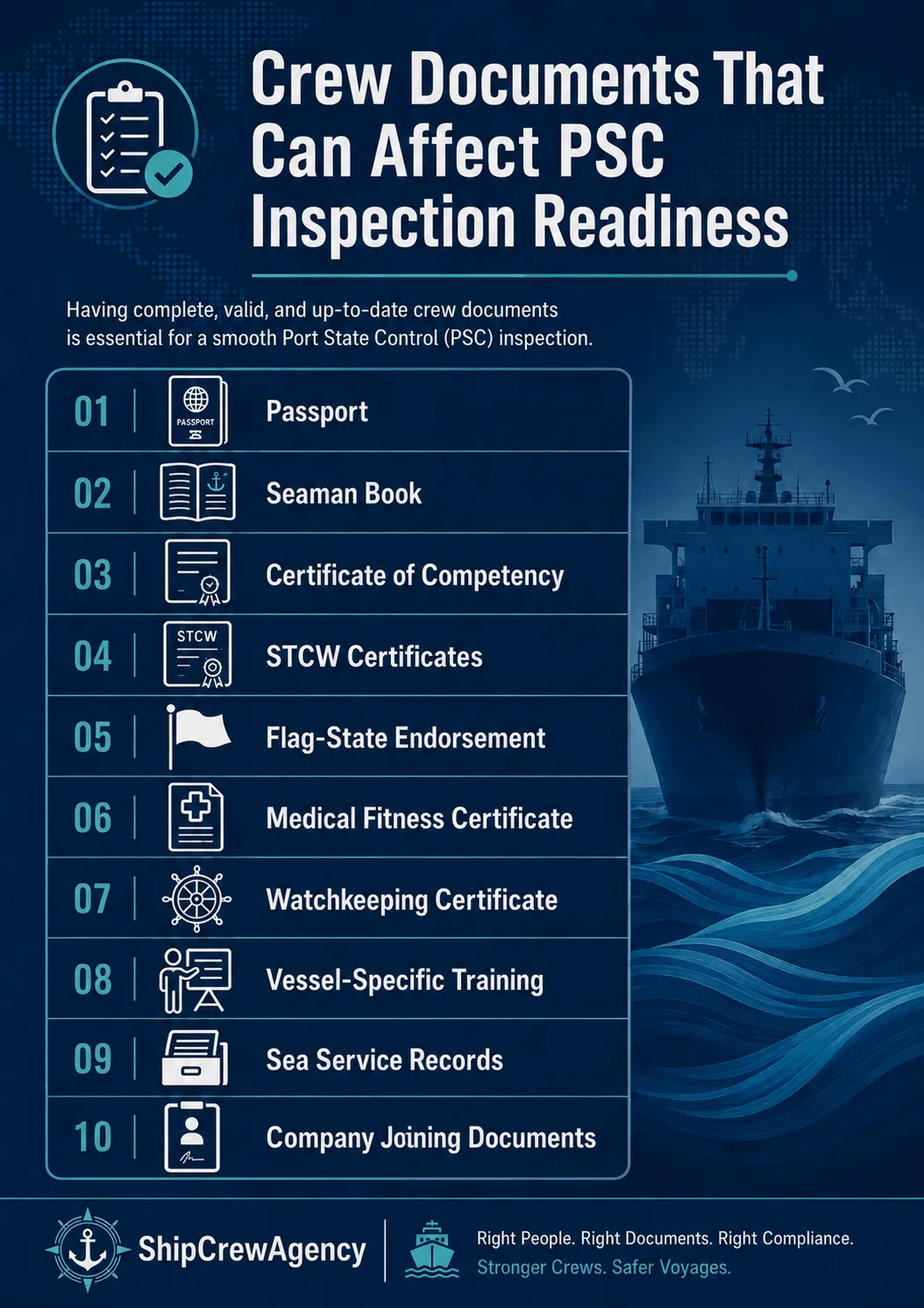
Image: Infographic showing crew documents that should be checked to reduce PSC detention risk.
For shipowners and managers, detention can create:
Schedule delays
Charterparty pressure
Port cost increases
Reputational damage
Future inspection targeting
Crew change disruption
Commercial and operational stress
PSC detention is not always caused by crew documents. It can involve technical, safety, environmental, operational, or labour-related deficiencies. But crew documentation is one of the areas that can raise red flags quickly, especially when documents are missing, expired, mismatched, unclear, or not aligned with the assigned onboard role.
Why Crew Documents Matter in PSC Inspections
Crew documents are often among the first things checked during a Port State Control inspection.
The Paris MoU explains that a PSC visit normally starts, at minimum, with an examination of ship certificates and documents. It also states that the absence of valid certificates or documents may be considered clear grounds for a more detailed inspection. (Paris MoU)
That matters because a document issue may not stay isolated. A missing or invalid certificate can lead the inspector to look deeper into the crew’s qualifications, onboard competence, hours of rest, manning level, safety familiarization, and operational readiness.
This is why the keyword PSC detention crew documents is so important for shipowners and crew managers. Crew paperwork is not just paperwork. It is evidence that the right people are onboard, properly qualified, medically fit, and legally ready to perform their duties.
What Crew Document Problems Can Create PSC Risk?
Certificate-related problems usually come from weak checking before joining, rushed recruitment, poor communication between parties, or incomplete documentation control.
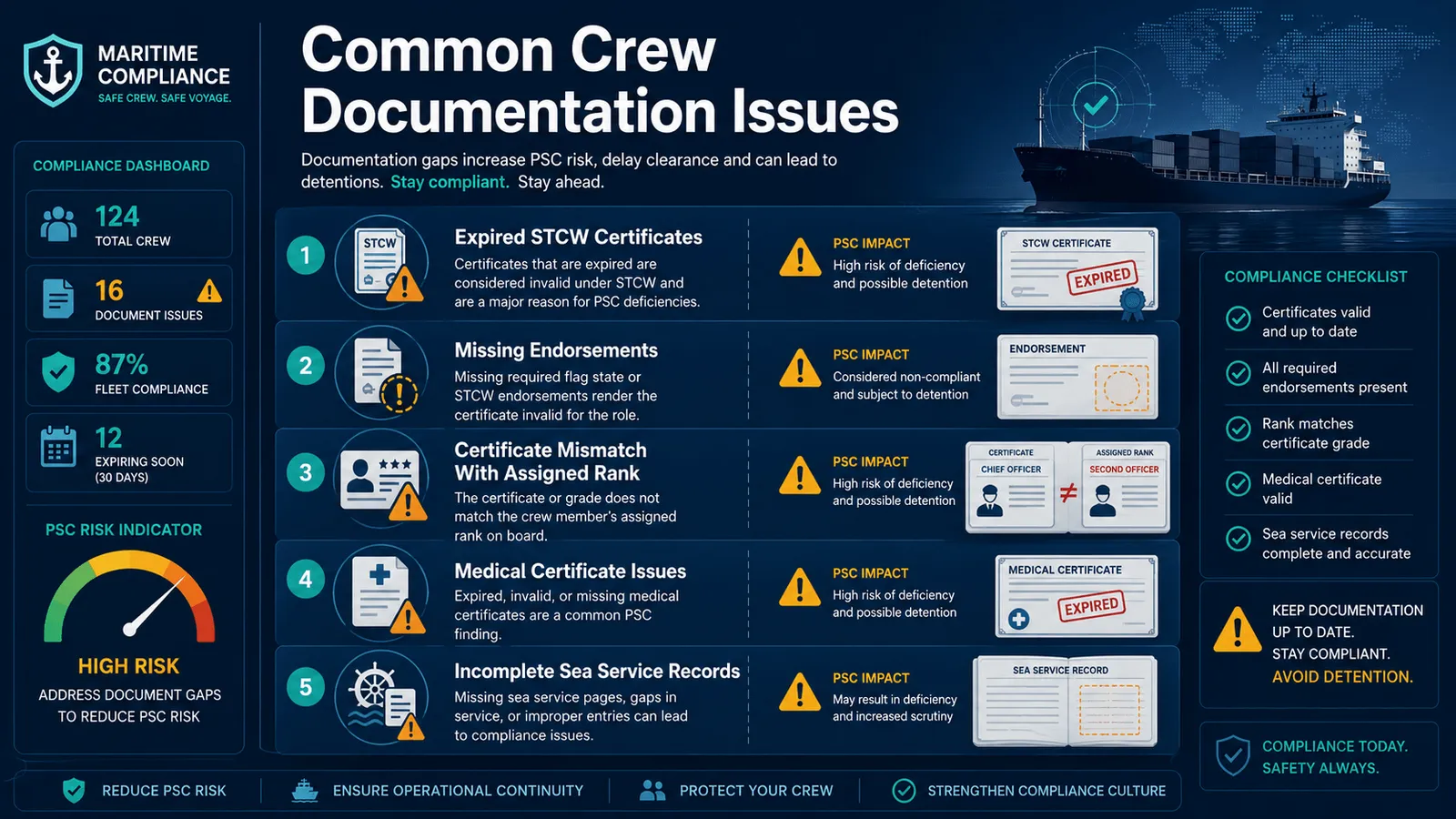
Image: Warning-style maritime compliance graphic showing common crew document issues that may increase PSC risk.
Common crew documentation issues include:
Expired STCW certificates
Missing flag-state endorsements
Certificate of Competency not matching the assigned rank
Incomplete or outdated medical fitness certificates
Missing watchkeeping certificates
Incorrect seaman book or CDC details
Unclear scanned copies
Inconsistent name, passport, or certificate information
Missing tanker, offshore, or vessel-specific training certificates
Incomplete sea service records
Missing company joining forms
Visa or travel document delays
Late document discovery after ticketing or mobilization
The problem is not only the missing document itself. The real problem is timing.
If a certificate issue is discovered before shortlisting, it can be fixed or the candidate can be replaced early. If it is discovered after travel is arranged, after joining is planned, or during inspection, the operational impact becomes much bigger.
The Manning Agency’s Role in Certificate Compliance
A manning agency is not the flag State, classification society, shipowner, or port authority. It does not replace the shipowner’s compliance responsibility.
But a professional manning agency plays a major support role in reducing certificate-related risk before crew deployment.
The agency’s job is to help make sure that crew selection is not based only on availability. It should be based on role fit, document readiness, certificate validity, medical fitness, experience, and joining feasibility.
Here is what that looks like in practice.
1. Pre-Screening Crew Documents Before Shortlisting
The first mistake many crewing teams make is reviewing documents too late.
A candidate may look suitable at first glance. They may have the right rank, experience, and availability. But if their certificates are expired, incomplete, unclear, or not aligned with the vessel requirement, that candidate can create delays later.
A good manning agency checks core documents before presenting a shortlist.
This includes:
Passport validity
Seaman book or CDC
Certificate of Competency
STCW certificates
Relevant endorsements
Medical fitness certificate
Sea service records
Training certificates
Rank-specific documents
Vessel-specific certificates
This saves time for the crew manager because the shortlist becomes cleaner. Instead of receiving a list of available people, the shipowner receives candidates who are closer to deployment readiness.
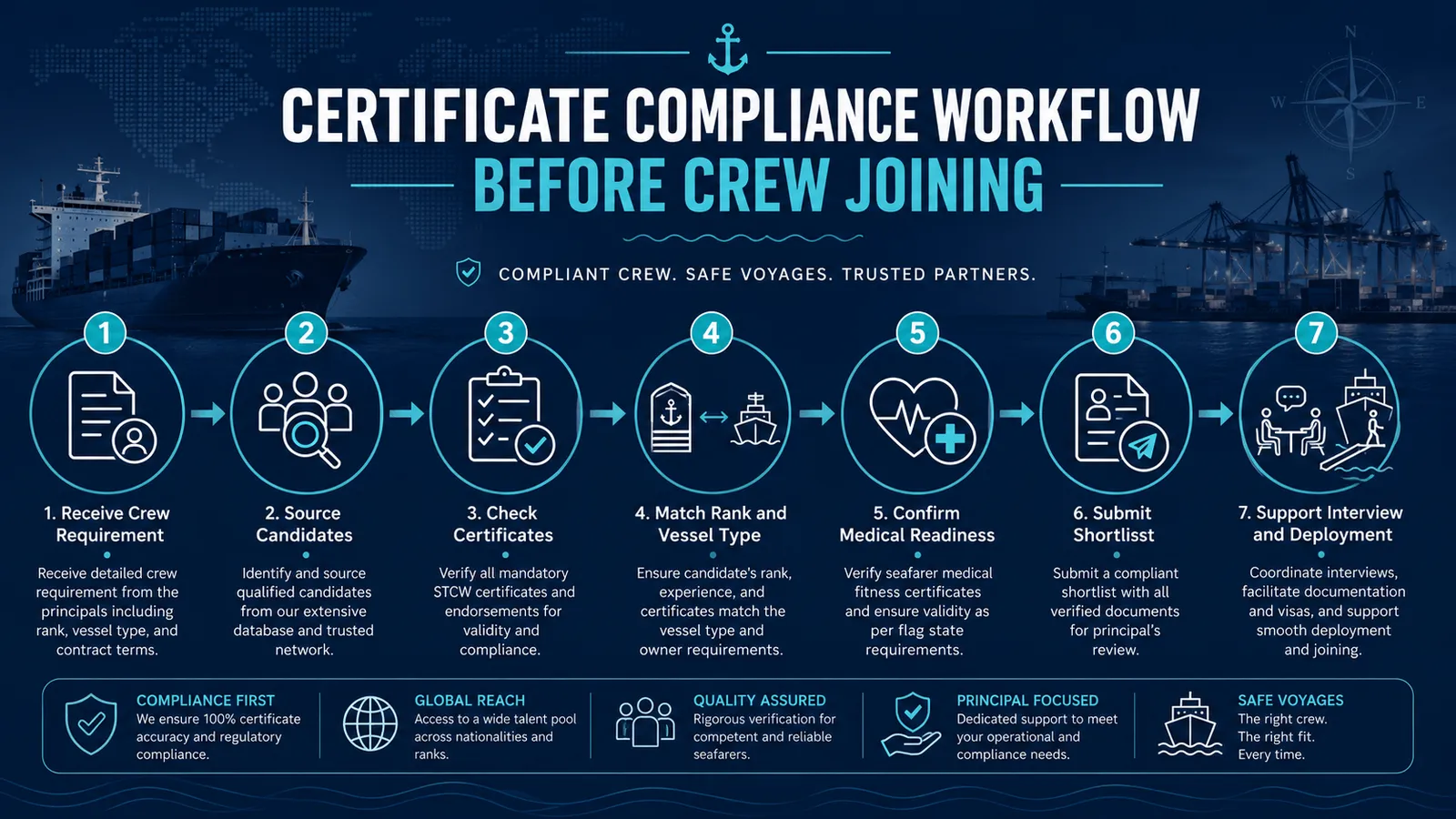
Image: Certificate compliance workflow showing how crew documents are checked before joining a vessel.
2. Matching Certificates With Rank and Vessel Requirement
Certificate compliance is not only about whether a seafarer has documents. The documents must match the role.
For example, a deck officer, engine officer, AB, OS, cook, wiper, utility crew member, or offshore support crew member may require different combinations of certificates, training, endorsements, and experience depending on the vessel type and operational area.
The IMO describes the STCW Convention as the international framework establishing basic requirements for seafarer training, certification, and watchkeeping. It also notes that STCW sets minimum standards that countries must meet or exceed. (International Maritime Organization)
This means a manning agency should not only ask, “Does the candidate have STCW certificates?”
The better question is:
Do the candidate’s certificates match the assigned rank, vessel type, flag requirement, and expected duties onboard?
That is where proper screening becomes valuable.
3. Checking STCW Certificate Validity
STCW certificate checks should be part of the early recruitment process.
For many vessels, crew managers need to verify whether the candidate’s training and certification status supports the assigned onboard function. This can include basic safety training, proficiency certificates, watchkeeping qualifications, tanker-related training, security awareness, designated security duties, and other role-specific requirements depending on the vessel.
A manning agency should help check:
Whether certificates are valid
Whether refresher training is needed
Whether certificate copies are readable
Whether the certificate belongs to the same person
Whether rank and certificate level are aligned
Whether the vessel type requires additional training
Whether the flag or company requires extra documentation
This does not remove the need for final verification by the shipowner, manager, or relevant authority. But it reduces the chance of obvious problems reaching the final joining stage.
4. Supporting Medical Fitness Certificate Readiness
Medical fitness is another important part of seafarer documentation.
Under MLC-related guidance, a seafarer medical certificate generally has a maximum validity period of two years, unless a shorter period is required by duties or STCW; for seafarers under 18, the maximum is one year, and colour vision certification has a maximum validity of six years. The same ILO FAQ also explains that flag States may decide whether a medical certificate issued in another country is accepted for a ship flying their flag. (International Labour Organization)
For crewing teams, this means medical documents should not be treated casually.
A manning agency can support by checking:
Medical certificate validity
Recognized medical practitioner requirements
Flag-specific acceptance issues
Fitness for assigned duty
Colour vision validity where relevant
Any special medical or vaccination requirements based on trade route
A seafarer may be skilled and experienced, but if medical documentation is not valid or accepted, joining can be delayed.
5. Coordinating Flag-State and Company-Specific Documents
Crew documentation does not stop with STCW and medical certificates.
Flag-state requirements, vessel manager policies, owner requirements, charterer expectations, and trading area conditions may all create additional document needs.
For example, depending on the vessel and operation, the crew manager may need:
Flag-state endorsement
Visa or travel clearance
Company application forms
Drug and alcohol test records
Joining declaration
Crew employment agreement
SEA documentation
Vaccination documents where applicable
Offshore or tanker-specific training records
Client-specific approval documents
A professional manning agency helps coordinate these items early so the joining process does not become a last-minute chase.
This is especially useful when the owner needs replacement crew quickly. In urgent cases, every missing document costs time.
6. Reducing Last-Minute Joining Delays
Last-minute crew replacement is already stressful. Certificate problems make it worse.
When a vessel needs crew urgently, the temptation is to focus on immediate availability. But fast hiring without document control can create bigger problems later.
A better manning process works like this:
Understand the vessel requirement
Confirm rank and joining timeline
Source suitable candidates
Check certificate readiness
Verify medical and travel document status
Prepare a compliant shortlist
Coordinate interview and approval
Support deployment and replacement planning
This process does not slow hiring down. It usually makes hiring faster because it removes unsuitable candidates earlier.
Certificate Compliance Checklist for Shipowners and Crew Managers
| Certificate / Document | Why It Matters | Manning Agency Support |
|---|---|---|
| Passport | Needed for travel, visa, and joining process | Check validity, name consistency, and travel readiness |
| Seaman book / CDC | Supports seafarer identity and sea service history | Review validity and document clarity |
| Certificate of Competency | Confirms rank-level qualification | Match certificate with assigned rank and vessel need |
| STCW certificates | Supports training, safety, and watchkeeping readiness | Check validity, refresher status, and role alignment |
| Flag-state endorsement | May be required depending on vessel flag | Coordinate with owner, manager, or flag process |
| Medical fitness certificate | Confirms fitness for sea service | Check validity, acceptance, and expiry risk |
| Colour vision certificate | Important for certain duties and roles | Review validity where applicable |
| Watchkeeping certificate | Supports assigned watchkeeping duties | Match certificate with deck or engine watchkeeping role |
| Tanker or vessel-specific training | Required for certain vessel types | Check whether the candidate has relevant training |
| Sea service records | Helps confirm experience and suitability | Review sea-time relevance and vessel exposure |
| Security training certificates | Supports shipboard security compliance | Check required security awareness or designated duties |
| Company joining documents | Needed for internal onboarding | Help collect, organize, and submit documents |
| Visa and travel documents | Needed for timely joining | Coordinate document readiness before deployment |
| Employment agreement documents | Supports employment and MLC-related readiness | Assist with documentation flow as requested |
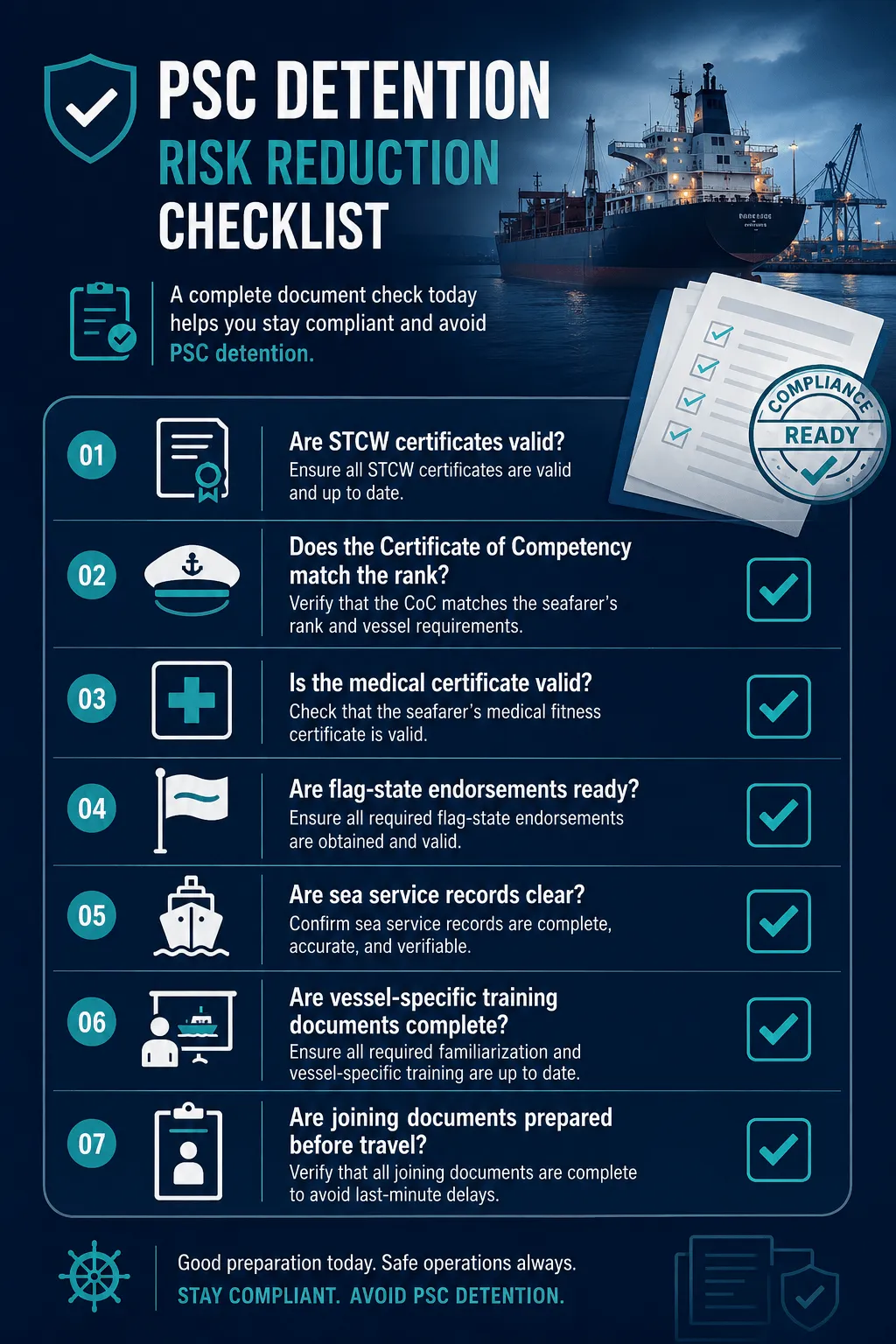
How ShipCrewAgency Supports Certificate Compliance
ShipCrewAgency helps shipowners, vessel operators, and crew managers source reliable Bangladeshi seafarers through structured screening and practical documentation support.
Our role is to make crew sourcing clearer, faster, and more controlled before the candidate reaches the final joining stage.
ShipCrewAgency supports the process by helping with:
Crew requirement collection
Rank and vessel-specific candidate sourcing
Candidate pre-screening
STCW document checks
Medical certificate readiness checks
Sea service and experience review
Shortlist preparation
Documentation coordination
Interview support
Replacement crew pipeline planning
For global fleets, Bangladesh can be a strong crew sourcing market when recruitment is structured, verified, and compliance-focused.
The value is not only cost efficiency. The stronger value is finding crew who are properly screened, document-ready, and matched to the operational requirement.
Why Certificate Compliance Should Start Before the Crew Joins
Many certificate problems become expensive because they are discovered too late.
If a missing endorsement is found before shortlisting, it is a recruitment issue.
If it is found after travel booking, it becomes a deployment issue.
If it is found during inspection, it may become a compliance issue.
That is why certificate compliance should begin at the first stage of crew sourcing, not at the final stage of joining.
A manning agency helps by creating an early filter. The agency checks whether the candidate is not only available but also practically ready for the vessel’s requirement.
This matters most when:
The vessel has urgent replacement needs
The vessel operates across multiple jurisdictions
The flag has specific documentation requirements
The crew member needs special training
The vessel type requires role-specific certification
The owner wants fewer joining surprises
The crew manager needs a stable replacement pipeline
A Practical Process to Reduce PSC Detention Risk From Crew Documents
Shipowners and crew managers can reduce certificate-related PSC risk by treating crew documents as part of operational planning.
A practical process includes:
Step 1: Define the exact crew requirement
Do not only say “need AB” or “need 2/E.”
Clarify:
Vessel type
Trading area
Flag
Joining port
Joining date
Contract duration
Special training requirement
Minimum sea-time expectation
Company-specific approval process
Step 2: Screen certificates before interview
Before the interview, check whether the candidate’s documents are suitable enough to proceed.
This avoids wasting time on candidates who cannot realistically join.
Step 3: Match documents to role
A certificate may be valid but still not suitable for the assigned position or vessel.
The check must connect the person, rank, duty, vessel, and flag.
Step 4: Confirm medical and travel readiness
Do not leave medical fitness, visa status, or passport validity until the end.
These items can create delays even when the candidate is technically qualified.
Step 5: Keep a replacement pipeline ready
A good crew pipeline reduces panic hiring.
When backup candidates are already screened, urgent replacement becomes easier and safer.
What Shipowners Should Ask Their Manning Agency
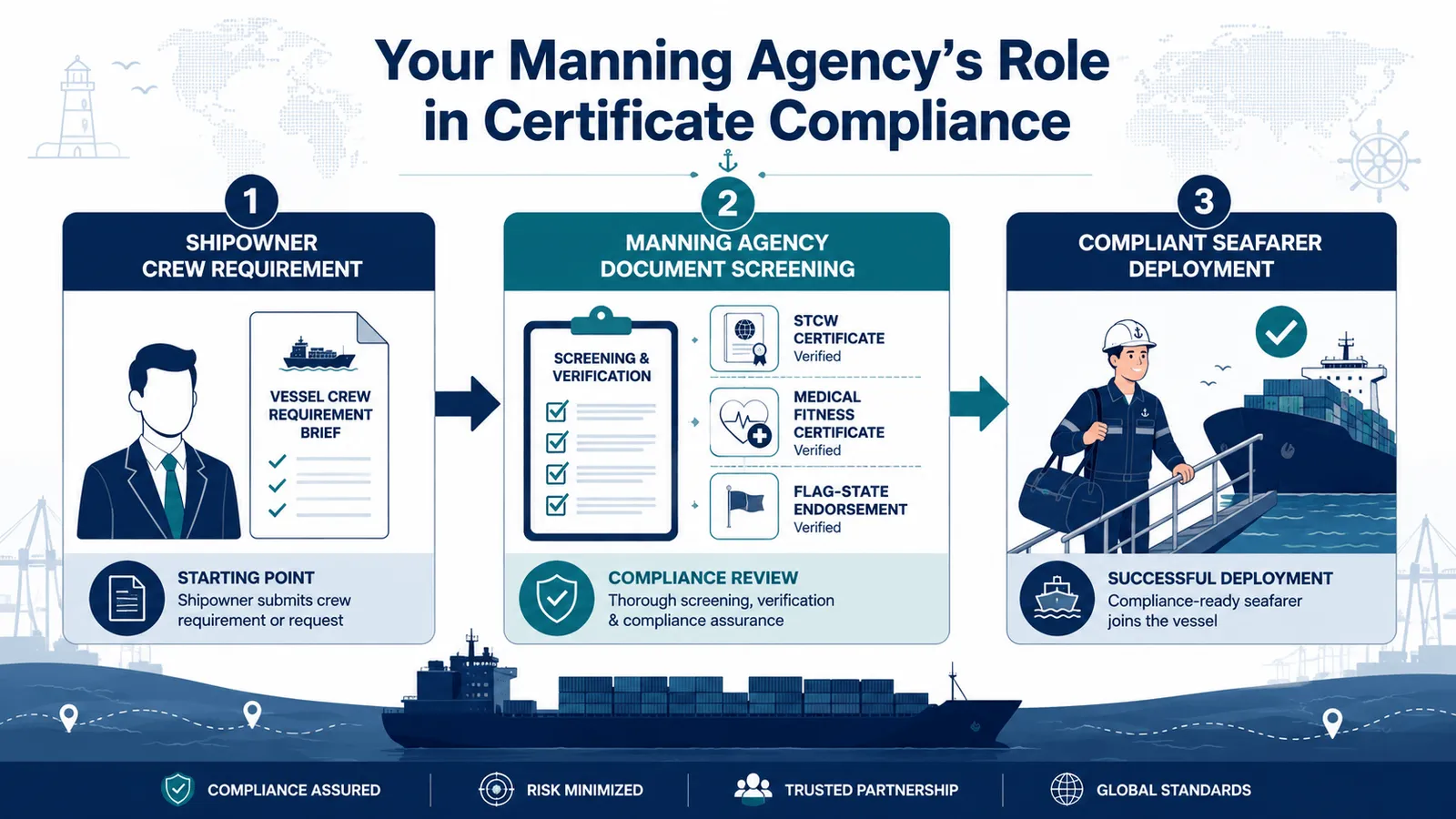 image: Diagram showing how a manning agency supports crew certificate compliance before seafarer deployment.
Before working with a manning agency, shipowners and crew managers should ask practical questions:
Do you check certificates before sending candidates?
Do you verify document validity and expiry dates?
Do you match certificates with vessel type and rank?
Do you check medical certificate readiness?
Do you support flag-state documentation coordination?
Do you provide replacement candidate support?
Do you maintain a pipeline of screened crew?
Do you understand STCW and MLC-related documentation needs?
The answers will show whether the agency is only sending CVs or actually supporting crewing risk control.
Final Thoughts
PSC detention risk cannot be removed completely, and crew certificate compliance is only one part of a much larger vessel compliance system.
But certificate-related problems are often preventable.
When crew documents are checked early, matched correctly, and coordinated properly, shipowners and crew managers gain more control over the joining process. They reduce last-minute surprises, improve onboarding speed, and support smoother fleet operations.
The right manning agency helps by making crew sourcing structured, verified, and role-specific.
Need compliant crew for your vessel?
ShipCrewAgency helps shipowners and crew managers source reliable Bangladeshi seafarers with structured screening, certificate readiness checks, and practical deployment support.
📋 Send your crew requirement today Request Crew on WhatsApp and receive a customised candidate list within 24–48 hours.
FAQ
What is PSC detention?
PSC detention happens when a port authority finds serious deficiencies and does not allow the vessel to sail until the required corrective actions are completed and accepted. PSC inspections are used by port States to check whether visiting foreign ships meet applicable international standards. (International Maritime Organization)
Can crew document issues cause PSC detention?
Crew document issues can contribute to PSC risk, especially if certificates are missing, invalid, expired, mismatched, or unclear. The Paris MoU notes that PSC inspections normally begin with document examination, and the absence of valid certificates or documents may be clear grounds for more detailed inspection. (Paris MoU)
What crew documents should be checked before a seafarer joins a vessel?
Important documents may include passport, seaman book or CDC, Certificate of Competency, STCW certificates, flag-state endorsement, medical fitness certificate, sea service records, security training certificates, company joining documents, and any vessel-specific training certificates.
How can a manning agency help with certificate compliance?
A manning agency can help by pre-screening documents, checking expiry dates, matching certificates with rank and vessel requirements, coordinating missing paperwork, preparing cleaner shortlists, and supporting faster crew deployment. This helps reduce risk, but it does not guarantee PSC detention prevention.
Does ShipCrewAgency help with Bangladeshi seafarer documentation checks?
Yes. ShipCrewAgency supports shipowners and crew managers by helping source Bangladeshi seafarers through structured screening, document readiness checks, and practical deployment coordination based on the vessel’s crew requirement.
Note: This article is general maritime compliance content, not legal advice. Shipowners, managers, and operators should always follow flag-state, port-state, company, charterer, and applicable international requirements.