 Ship Crew Agency
Maritime Editorial Team
In This Article
- Why Global Shipowners Hire Bangladeshi Seafarers
- 1. Strong Work Ethic
- 2. Competitive Wage Structure
- 3. English Communication Skills
- 4. STCW Compliance
- 5. International Vessel Experience
- 6. High Retention Potential
- Benefits of Hiring Bangladeshi Seafarers
- What are the benefits of hiring Bangladeshi seafarers?
- Typical Wage Expectations for Bangladeshi Seafarers in 2026
- How much does it cost to hire bangladeshi seafarers?
- Factors That Affect Crew Wages
- Required Certifications and Training
- STCW Certifications
- Medical Certificates
- Seaman Book
- Passport Requirements
- Tanker Endorsements
- Security Awareness Training
- Flag-State Compliance
- Crew Documentation Checklist
- MLC Compliance Checklist for Shipowners
- Downloadable-Style MLC Compliance Checklist
- How to Recruit Bangladeshi Seafarers
- How do shipowners recruit crew from Bangladesh?
- Step 1: Define Crew Requirements
- Step 2: Select a Crewing Agency
- Step 3: Candidate Sourcing
- Step 4: Screening
- Step 5: Verification
- Step 6: Interview
- Step 7: Documentation
- Step 8: Deployment
- Step 9: Crew Management
- How to Vet a Crew Manning Agency in Bangladesh
- Licensing Verification
- Industry Reputation
- Crew Database Quality
- Training Partnerships
- Compliance Systems
- Response Time
- Client References
- Retention Metrics
- Agency Comparison Checklist
- Who Should Hire Bangladeshi Seafarers?
- Why Choose Bangladeshi Crew?
- What Qualifications Do Bangladeshi Seafarers Possess?
- When Should Shipowners Outsource Crewing?
- Where Can Shipowners Recruit Certified Crew?
- How Does the Recruitment Process Work?
- Common Mistakes Shipowners Make When Hiring Crew
- Choosing the Cheapest Agency
- Ignoring Compliance
- Poor Screening
- Lack of Retention Strategy
- Weak Documentation Controls
- Why ShipCrewAgency.com Can Help
- How ShipCrewAgency.com Supports Shipowners
- Frequently Asked Questions
- 1. How much does it cost to hire Bangladeshi seafarers?
- 2. Are Bangladeshi officers internationally certified?
- 3. Can Bangladeshi seafarers work on tanker vessels?
- 4. What is the recruitment timeline?
- 5. How do shipowners verify certifications?
- 6. Are Bangladeshi seafarers fluent in English?
- 7. What documents are required before deployment?
- 8. What is MLC compliance?
- 9. What is an MLC-compliant crewing agency?
- 10. Why are Bangladeshi seafarers in demand globally?
- 11. What certifications are required?
- 12. How do shipowners recruit crew from Bangladesh?
- 13. Can ShipCrewAgency.com support long-term crew management?
- 14. What vessel types can Bangladeshi crew serve on?
- 15. Why should shipowners avoid informal crew brokers?
- Conclusion: Hiring Bangladeshi Seafarers the right way!
- 🚢 Ready to Source Qualified Bangladeshi Crew?
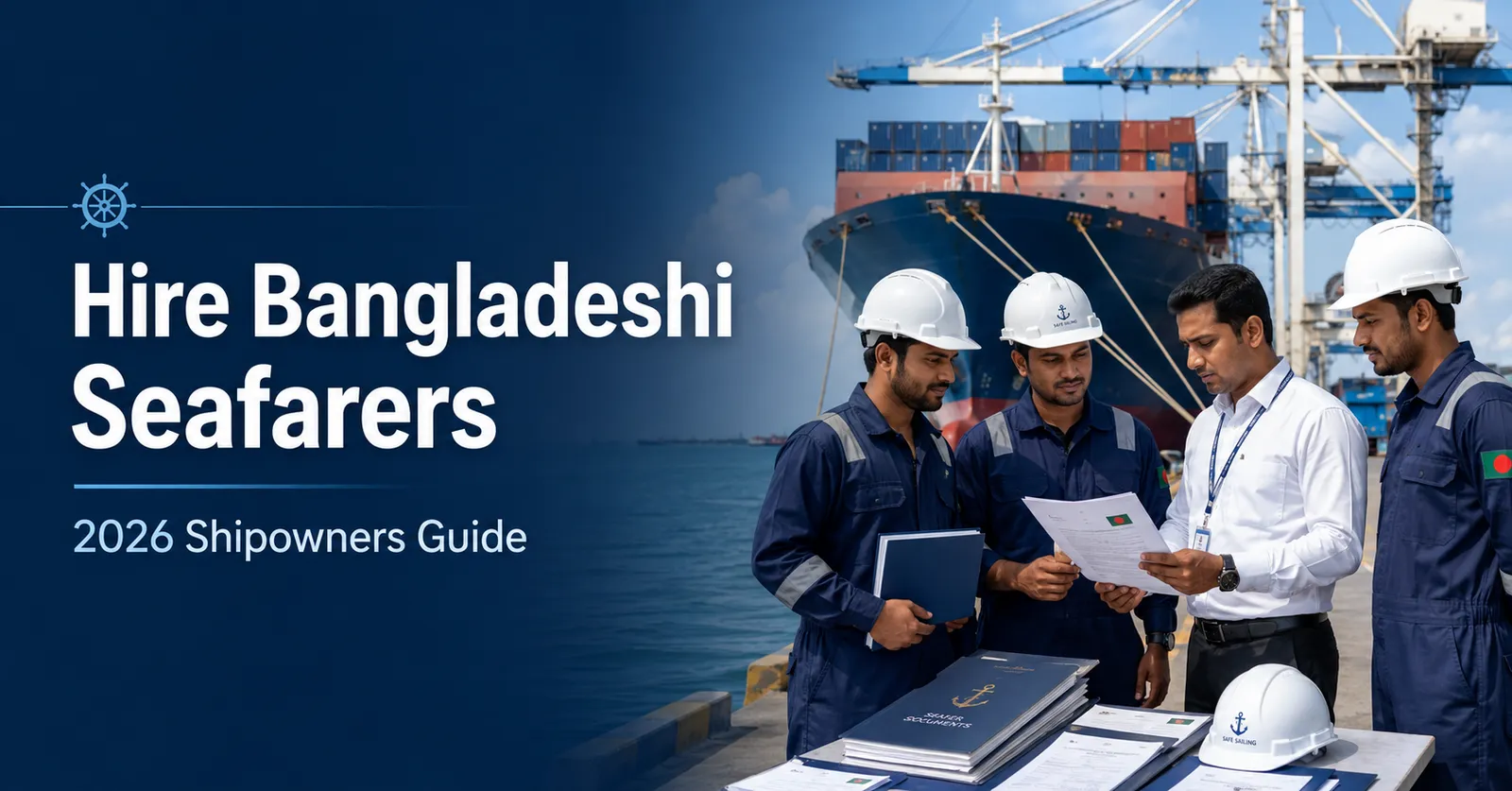
Global shipowners are increasingly turning to Bangladesh for highly skilled, cost-effective, English-speaking maritime professionals. From deck officers and marine engineers to AB seamen, oilers, fitters, cooks, and tanker crew, Bangladesh has become an important maritime manpower supply market for international ship management companies.
For shipowners, vessel operators, crew managers, maritime HR teams, and crewing departments, the decision to hire Bangladeshi seafarers is usually driven by four practical needs: reliable crew availability, STCW-certified competence, competitive wage expectations, and long-term crew retention.
Bangladeshi seafarers are now working across bulk carriers, container vessels, tankers, offshore vessels, general cargo ships, and other international trading fleets. Many receive training through Bangladesh Marine Academy, private maritime training institutes, and other approved maritime education providers under the oversight of the Department of Shipping Bangladesh.
But hiring crew from Bangladesh is not just about finding available candidates. It requires proper crew sourcing, certificate verification, MLC-compliant recruitment, flag-state documentation, medical fitness checks, and deployment coordination. A weak process can create delays, port-state control risks, crew welfare issues, and avoidable operational disruption.
This guide explains how shipowners can recruit Bangladeshi crew safely, legally, and efficiently in 2026.
📋 Looking to source crew now? Request Crew on WhatsApp and receive a customised candidate list within 24–48 hours.
Why Global Shipowners Hire Bangladeshi Seafarers
Shipowners hire Bangladeshi seafarers because they offer a strong balance of competence, cost efficiency, English communication ability, adaptability, and international vessel experience.
Bangladesh has a growing maritime workforce supported by merchant navy recruitment, officer training, rating development, and STCW-aligned maritime training. For shipowners hiring crew, this creates a practical recruitment market for both officers and ratings.
1. Strong Work Ethic
Bangladeshi crew members are often valued for discipline, commitment, and willingness to work long contracts under structured onboard systems. This matters because vessel operations depend on routine, watchkeeping, safety compliance, and teamwork.
For ship management companies, a technically capable crew is not enough. The crew must also be reliable during port operations, cargo handling, engine maintenance, emergency drills, inspections, and long ocean passages.
2. Competitive Wage Structure
One of the biggest reasons shipowners recruit Bangladeshi crew is cost efficiency. Bangladeshi seafarers generally offer competitive wage expectations compared with some higher-cost maritime labor markets.
This does not mean shipowners should choose the lowest possible wage. Under MLC 2006, wages, employment agreements, rest hours, medical coverage, repatriation rights, and welfare standards must be protected. The smarter approach is to balance cost with verified competence.
3. English Communication Skills
English is the working language of international shipping. Many Bangladeshi officers and ratings have operational English exposure through maritime training, onboard experience, international crews, safety drills, bridge communication, engine-room coordination, and port documentation.
Clear English communication is especially important for:
Bridge team management
Engine-room reporting
Cargo operations
Safety meetings
Emergency response
PSC inspections
ISM documentation
Multinational crew coordination
4. STCW Compliance
Bangladeshi seafarers working internationally must hold valid certificates aligned with the STCW Convention. The International Maritime Organization introduced STCW to create minimum international standards for seafarer training, certification, and watchkeeping.
For shipowners, STCW compliance helps reduce hiring risk. It allows crewing teams to verify whether a candidate has the required competency for their rank, vessel type, and watchkeeping duties.
5. International Vessel Experience
Many Bangladeshi seafarers have served on foreign-flagged vessels and understand the requirements of international ship management systems. Experienced Bangladeshi officers and ratings may be suitable for:
Bulk carrier crew
Container vessel crew
Tanker crew
General cargo crew
Offshore crew
Engine-room ratings
Deck ratings
Catering department roles
6. High Retention Potential
Retention is a major issue in global ship crew recruitment. Replacing crew too frequently increases travel costs, documentation workload, operational disruption, and onboarding risk.
A well-managed Bangladeshi crew pool can support long-term vessel crewing services when the agency maintains fair wages, transparent communication, proper welfare support, and a stable rotation plan.
📋 Need Reliable officers, engineers, or ratings from Bangladesh? Request a Crew Proposal from ShipCrewAgency.com and receive a customised candidate list within 24–48 hours.
Benefits of Hiring Bangladeshi Seafarers
What are the benefits of hiring Bangladeshi seafarers?
Hiring Bangladeshi seafarers gives shipowners access to cost-effective, STCW-certified, English-speaking maritime professionals with strong adaptability, international vessel experience, and good retention potential when managed through an MLC-compliant crewing agency.Factor | Bangladeshi Crew | Global Average |
Cost Efficiency | Often more competitive wage expectations while maintaining compliance | Higher variation depending on nationality, vessel type, and CBA |
Experience | Available across deck, engine, ratings, catering, tanker, and bulk sectors | Strong but sometimes costly in mature labor markets |
Retention | Good retention when wages, welfare, and rotation are handled properly | Retention varies widely by agency and fleet culture |
Certification | STCW-certified candidates available through approved training routes | STCW required globally, but verification quality varies |
Adaptability | Comfortable in multinational crew environments | Depends on nationality mix and prior experience |
English Communication | Operational English available among trained officers and experienced ratings | English level varies by source market |
Good availability through crew manning agency Bangladesh networks | Depends on local agency capacity | |
Crew Management | Suitable for long-term crew pool planning | Depends heavily on agency systems |
The main benefit is not simply “lower cost.” The real value is finding qualified seafarers from Bangladesh who match the vessel’s trading pattern, safety requirements, flag-state documentation, and company procedures.
Typical Wage Expectations for Bangladeshi Seafarers in 2026
How much does it cost to hire bangladeshi seafarers?
The cost depends on rank, vessel type, experience, contract length, flag requirements, CBA coverage, tanker endorsements, travel costs, insurance, medicals, and agency service fees. In 2026, Bangladeshi crew wages are generally competitive, but shipowners should use rank-based planning ranges instead of assuming one fixed salary.The table below gives practical 2026 planning ranges for internationally deployed Bangladeshi seafarers. These are not legal wage guarantees. They are market-oriented budgeting estimates for shipowners and crew managers.
Rank | Monthly Wage Range (USD) |
Master | $7,000 – $11,500 |
Chief Officer | $4,800 – $8,000 |
Chief Engineer | $7,000 – $11,000 |
Second Engineer | $4,500 – $7,500 |
Third Officer | $2,500 – $4,300 |
Fourth Engineer | $1,800 – $3,300 |
AB | $1,300 – $2,400 |
Oiler | $1,300 – $2,300 |
Fitter | $1,600 – $2,800 |
Cook | $1,200 – $2,100 |
Factors That Affect Crew Wages
Wage expectations can increase or decrease based on:
Vessel type: tanker, LNG, LPG, offshore, bulk, container, general cargo
Rank and sea time
Certificate of Competency level
Tanker endorsements
DP or offshore experience
Flag-state requirements
Contract duration
Trading area
Union or CBA coverage
Owner-specific safety standards
Urgency of deployment
Availability of replacement crew
Tanker crew and offshore crew usually command higher wages because the work requires specialized training, higher-risk operations, additional endorsements, and stronger safety awareness.
📋 Want a realistic crew budget for your vessel type? Speak with a maritime recruitment Specialist at Request Crew on WhatsAppand receive a customised candidate list within 24–48 hours.
Required Certifications and Training
Are Bangladeshi seafarers STCW certified?
Yes, internationally deployable Bangladeshi seafarers must hold STCW-aligned certificates appropriate to their rank, department, and vessel type. Shipowners should verify certificates through the Department of Shipping Bangladesh, issuing authority records, and the crewing agency’s documentation process before deployment.
STCW Certifications
The STCW Convention sets minimum standards for training, certification, and watchkeeping. For shipowners, STCW is the foundation of crew competency verification.
Common STCW-related documents include:
Certificate of Competency for officers
Certificate of Proficiency for ratings
Basic safety training
Personal survival techniques
Fire prevention and firefighting
Elementary first aid
Personal safety and social responsibility
Security awareness
Designated security duties, where required
Proficiency in survival craft and rescue boats, where required
Medical Certificates
Every seafarer must have a valid medical fitness certificate from an approved medical practitioner or authorized medical center. The certificate should confirm the seafarer is fit for sea service and meets eyesight, hearing, physical health, and general medical standards.
Seaman Book
A valid seaman book records a seafarer’s identity, sea service, and employment history. Shipowners should confirm the seaman book is valid, matches the passport, and supports the claimed onboard experience.
Passport Requirements
The passport must be valid for the expected contract period and meet the visa or immigration requirements of joining ports, flag states, and trading routes. Short passport validity can delay deployment, especially for last-minute crew changes.
Tanker Endorsements
For tanker vessels, shipowners must verify tanker-specific training and endorsements. These may include oil tanker, chemical tanker, or gas tanker requirements depending on vessel type and rank.
Security Awareness Training
Security awareness is essential for compliance with ship security duties, ISPS-related procedures, piracy-risk areas, access control, and onboard security plans.
Flag-State Compliance
Some flag states require additional verification, endorsements, applications, or recognition of certificates. A good marine recruitment agency should check flag-state requirements before proposing candidates.
Crew Documentation Checklist
Before deployment, verify:
Valid passport
Valid seaman book
STCW certificates
Certificate of Competency or Proficiency
Medical fitness certificate
Vaccination records, where required
Sea service records
Previous employer references
Tanker endorsement, where applicable
Flag-state documents
Visa requirements
Seafarer Employment Agreement
Emergency contact information
Insurance and repatriation coverage
📬 Need qualified Bangladeshi officers, engineers, or ratings for your fleet? Contact ShipCrewAgency today for a customised crew sourcing proposal.
MLC Compliance Checklist for Shipowners
What is an MLC-compliant crewing agency?
An MLC-compliant crewing agency follows the Maritime Labour Convention standards for fair recruitment, valid employment agreements, wage protection, medical care, repatriation, rest hours, complaint handling, and seafarer welfare. In Bangladesh, shipowners should work with authorized recruitment agents and verify compliance before crew deployment.
Use this checklist before hiring any crew through a maritime staffing agency.
Downloadable-Style MLC Compliance Checklist
□ Valid Seafarer Employment Agreement
Every seafarer should sign a clear employment agreement before joining the vessel. The agreement should define rank, wage, contract duration, leave, repatriation, benefits, and termination terms.
□ Wage Protection
Wages must be paid regularly, correctly, and in line with the employment agreement. Shipowners should avoid unclear deductions, delayed payments, or informal payment practices.
□ Medical Coverage
Crew must have access to medical care while onboard and during employment. Medical responsibility should be clearly defined before deployment.
□ Repatriation Rights
The seafarer must have the right to return home at the end of contract or under valid repatriation conditions. Repatriation cost responsibility should be documented.
□ Insurance Coverage
Shipowners should confirm insurance for injury, illness, death, disability, and contractual liabilities where applicable.
□ Rest Hours Compliance
Rest hours must be monitored and recorded. Poor rest-hour compliance increases fatigue risk and inspection exposure.
□ Accommodation Standards
Crew accommodation must meet applicable standards for safety, space, hygiene, ventilation, lighting, and comfort.
□ Food Standards
Food must be sufficient, safe, nutritious, and culturally appropriate where practical. Catering standards affect morale and retention.
□ Complaint Procedures
Seafarers must have a clear onboard complaint process without fear of retaliation.
□ Record Keeping
Crewing records, contracts, certificates, medicals, wage records, rest-hour logs, and deployment documents should be organized and auditable.
📋 ShipCrewAgency.com supports compliance-focused crew sourcing for shipowners that want smoother deployments and fewer documentation headaches.
How to Recruit Bangladeshi Seafarers
How do shipowners recruit crew from Bangladesh?
Shipowners recruit Bangladeshi crew by defining vessel requirements, selecting an authorized crew manning agency Bangladesh partner, sourcing suitable candidates, screening certificates and sea service, conducting interviews, completing documentation, arranging travel, and managing crew after deployment.Step 1: Define Crew Requirements
Start with a detailed crew request. Include:
Vessel type
Flag
Trading area
Rank required
Joining port
Joining date
Contract length
Required certificates
Tanker or offshore requirements
Minimum experience
English communication level
Salary budget
Rotation expectations
A precise crew request helps the agency shortlist the right candidates faster.
Step 2: Select a Crewing Agency
Choose a crew manning agency Bangladesh partner that understands MLC compliant crew recruitment, ship crew recruitment, certificate verification, and international deployment.
Avoid choosing only by price. The cheapest agency can become the most expensive if it creates delays, poor screening, or compliance problems.
Step 3: Candidate Sourcing
The agency searches its crew database and external networks for suitable officers, engineers, ratings, or catering crew. Strong agencies maintain pre-screened pools of deck officers, marine engineers, AB seamen, oilers, fitters, cooks, and specialist tanker crew.
Step 4: Screening
Screening should include:
Rank competency
Sea service history
Vessel-type experience
English communication
Medical fitness
Disciplinary record
Past performance
Availability
Salary expectations
Step 5: Verification
Verification is where many weak agencies fail. Shipowners should confirm:
STCW certificates
CoC or CoP
Seaman book
Passport
Medical certificate
Tanker endorsement
Sea service
Previous employer references
Flag-state requirements
Step 6: Interview
The interview should test practical knowledge, not just confidence. Ask role-specific questions about watchkeeping, emergency response, cargo operations, maintenance routines, safety culture, ISM procedures, MARPOL awareness, SOLAS safety requirements, and crew coordination.
Step 7: Documentation
Once selected, the crewing team prepares documentation for employment, travel, visa, flag-state approval, medicals, insurance, and joining instructions.
Step 8: Deployment
Deployment includes ticketing, visa coordination, port agent communication, joining instructions, travel updates, and handover planning.
Step 9: Crew Management
After joining, crew management continues through performance monitoring, welfare support, payroll coordination, documentation updates, relief planning, and retention strategy.
How to Vet a Crew Manning Agency in Bangladesh
A good crewing partner protects the shipowner from operational, financial, and compliance risk. A poor agency simply sends CVs and hopes for the best. That is not crew management. That is maritime matchmaking with a clipboard.
Licensing Verification
Confirm the agency is authorized to provide seafarer recruitment and placement services. Ask for license details, authorization status, and compliance documentation.
Industry Reputation
Check reputation with shipowners, ship managers, former clients, and seafarers. A strong maritime recruitment Bangladesh partner should have a track record of reliable deployment and professional communication.
Crew Database Quality
Ask how many candidates are pre-screened, how often documents are updated, and whether the agency can supply officers, engineers, ratings, tanker crew, offshore crew, and catering staff.
Training Partnerships
Strong agencies maintain relationships with maritime training institutes, Bangladesh Marine Academy graduates, ratings training centers, and specialized STCW training providers.
Compliance Systems
The agency should have structured systems for document control, certificate verification, MLC requirements, medical checks, SEA preparation, travel records, and crew communication.
Response Time
In shipping, timing matters. A slow reply can mean a missed crew change window. Evaluate how quickly the agency responds with suitable candidates, updated documents, and deployment status.
Client References
Ask for references from ship management companies, vessel operators, or crewing departments. Real references are more useful than polished brochures.
Retention Metrics
Good agencies track retention, repeat deployment, contract completion, replacement cases, and crew performance.
Agency Comparison Checklist
Evaluation Area | Strong Agency | Risky Agency |
Licensing | Authorized and transparent | Unclear or avoids proof |
Screening | Verifies documents and experience | Sends CVs without checking |
Crew Database | Updated and segmented by rank | Small or outdated database |
Compliance | MLC, STCW, flag-state aware | Compliance treated casually |
Communication | Fast and structured | Slow or inconsistent |
References | Can provide client proof | No reliable references |
Retention | Tracks crew performance | No retention data |
Documentation | Organized and auditable | Missing or messy records |
📞 Want an accurate crew cost breakdown for your vessel? Speak With a Maritime Recruitment Specialist at Request Crew on WhatsApp for a transparent, rank-by-rank cost model.
Who Should Hire Bangladeshi Seafarers?
Shipowners, ship managers, vessel operators, offshore companies, crew managers, maritime HR departments, and crewing departments should consider Bangladeshi seafarers when they need qualified, cost-effective, English-speaking crew for international vessel operations.
Bangladeshi crew can be suitable for:
Bulk carriers
Container vessels
Tankers
General cargo ships
Offshore support vessels
Coastal and international trading vessels
Engine-room operations
Deck operations
Catering departments
Why Choose Bangladeshi Crew?
Choose Bangladeshi crew when you need a practical balance of cost, competence, availability, and long-term crew planning. Bangladesh offers a growing maritime workforce with officers, engineers, ratings, and support crew trained for international shipping.
The best results come when shipowners work with an MLC-compliant marine recruitment agency that screens candidates carefully and manages deployment professionally.
What Qualifications Do Bangladeshi Seafarers Possess?
Bangladeshi seafarers may hold STCW certificates, Certificates of Competency, Certificates of Proficiency, medical certificates, seaman books, tanker endorsements, security awareness training, and rank-specific sea service records.
The exact qualification depends on rank, department, vessel type, and trading area.
When Should Shipowners Outsource Crewing?
Shipowners should outsource crewing when internal teams lack time, local market access, compliance expertise, document verification capacity, or urgent deployment support.
Outsourcing is especially useful when:
Crew changes are frequent
Multiple vessels need crew
Deployment is urgent
Flag-state requirements are complex
Documentation control is weak
Retention needs improvement
Vessel operators need a scalable crew pool
Where Can Shipowners Recruit Certified Crew?
Shipowners can recruit certified Bangladeshi crew through an authorized crew manning agency Bangladesh partner, maritime staffing agency, marine recruitment agency, or crew management services provider with access to verified seafarer databases.
For safer recruitment, shipowners should avoid informal brokers and use agencies that understand STCW, MLC 2006, ISM Code, SOLAS Convention, MARPOL Convention, and flag-state documentation requirements.
How Does the Recruitment Process Work?
The recruitment process works by matching vessel requirements with verified seafarer profiles, checking certificates, interviewing candidates, completing employment documents, arranging travel, and managing crew after joining.
A professional crew management system should track candidate data, certificate expiry, medical status, deployment history, client feedback, rotation planning, and retention performance.
Common Mistakes Shipowners Make When Hiring Crew
Choosing the Cheapest Agency
The cheapest crew option can create expensive problems. Poorly screened crew may cause safety issues, documentation delays, early repatriation, or performance problems.
Ignoring Compliance
MLC, STCW, SOLAS, MARPOL, ISM, and flag-state requirements are not optional paperwork. They are core risk controls for vessel operations.
Poor Screening
A CV is not enough. Shipowners should verify certificates, sea service, references, medical fitness, English communication, and vessel-type experience.
Lack of Retention Strategy
If crew feel unsupported, turnover increases. Better retention comes from fair wages, clear contracts, welfare support, respectful communication, and stable rotation planning.
Weak Documentation Controls
Expired certificates, missing medicals, incomplete SEA records, and visa issues can delay joining. Strong documentation control is essential for smooth deployment.
Why ShipCrewAgency.com Can Help
ShipCrewAgency.com helps shipowners, vessel operators, ship managers, and crewing departments source qualified Bangladeshi seafarers through a practical, compliance-focused recruitment process.
The goal is not just to send candidates. The goal is to help shipowners find the right crew for the right vessel at the right time.
How ShipCrewAgency.com Supports Shipowners
Access to qualified Bangladeshi seafarers
Crew sourcing for officers, engineers, ratings, and support roles
Support for fast crew deployment
Compliance-focused recruitment process
Transparent communication
Candidate shortlisting
Documentation support
Crew management coordination
Long-term crewing partnership support
ShipCrewAgency.com can support shipowners looking for deck officers, chief officers, marine engineers, chief engineers, second engineers, third officers, AB seamen, oilers, fitters, cooks, tanker crew, bulk carrier crew, container vessel crew, and offshore crew.
🚢 Ready to start? Request a Crew Proposal from ShipCrewAgency.com — qualified officers and ratings available for bulk carrier, general cargo, tanker, and offshore operations.
Frequently Asked Questions
1. How much does it cost to hire Bangladeshi seafarers?
The cost depends on rank, vessel type, experience, contract length, flag-state requirements, travel, insurance, medicals, and agency service fees. Ratings such as AB, oiler, fitter, and cook usually cost less than senior officers. Tanker and offshore crew often command higher wages because they need specialized training and endorsements.
2. Are Bangladeshi officers internationally certified?
Yes, internationally deployable Bangladeshi officers should hold STCW-aligned Certificates of Competency and rank-specific training documents. Shipowners should verify each officer’s certificates, sea service, medical fitness, passport, seaman book, and flag-state eligibility before confirming employment. Verification should be handled before travel or joining arrangements are finalized.
3. Can Bangladeshi seafarers work on tanker vessels?
Yes, Bangladeshi seafarers can work on tanker vessels if they hold the required tanker familiarization, advanced tanker training, STCW certificates, medical fitness documents, and vessel-specific experience. Shipowners should verify whether the candidate has oil, chemical, or gas tanker experience depending on the vessel type and cargo operation.
4. What is the recruitment timeline?
The recruitment timeline can range from a few days to several weeks depending on rank, availability, documentation, visa requirements, joining port, medical checks, and flag-state approval. Urgent crew changes may be faster if the agency has pre-screened candidates. Senior officer roles and tanker roles usually need more verification time.
5. How do shipowners verify certifications?
Shipowners verify certifications by checking certificate numbers, issuing authority records, expiry dates, STCW references, seaman book details, medical certificates, sea service documents, and previous employer references. A professional crewing agency should complete pre-verification and share organized documentation before the final interview or deployment approval.
6. Are Bangladeshi seafarers fluent in English?
Yes, Bangladeshi officers and experienced ratings can communicate in operational English fluently, especially those trained for international vessels. English ability still varies by individual, rank, and experience. Shipowners should test communication during interviews, especially for bridge watchkeeping, engine-room reporting, safety drills, and multinational crew coordination.
7. What documents are required before deployment?
Before deployment, shipowners usually require a valid passport, seaman book, STCW certificates, Certificate of Competency or Proficiency, medical certificate, sea service records, visa documents, employment agreement, emergency contact details, and any vessel-specific endorsements. Tanker crew may also need oil, chemical, or gas tanker endorsements.
8. What is MLC compliance?
MLC compliance means following the Maritime Labour Convention standards for fair seafarer recruitment, employment agreements, wage payment, rest hours, medical care, repatriation, accommodation, food, welfare, and complaint procedures. For shipowners, MLC compliance reduces legal risk, protects seafarers, and supports smoother vessel operations.
9. What is an MLC-compliant crewing agency?
An MLC-compliant crewing agency follows fair recruitment practices, does not charge illegal recruitment fees to seafarers, maintains proper records, verifies documents, supports valid employment agreements, and protects seafarer welfare. In Bangladesh, shipowners should work with authorized recruitment agents and confirm compliance before hiring crew.
10. Why are Bangladeshi seafarers in demand globally?
Bangladeshi seafarers are in demand because they offer competitive wage expectations, STCW-aligned training, English communication ability, adaptability, and experience across international vessel types. Shipowners also value Bangladesh as a growing maritime workforce market for officers, engineers, ratings, and support crew.
11. What certifications are required?
Required certifications depend on rank and vessel type. Common requirements include STCW basic safety training, Certificate of Competency, Certificate of Proficiency, medical certificate, seaman book, security awareness, designated security duties, survival craft training, and tanker endorsements where applicable. Flag-state documents may also be needed.
12. How do shipowners recruit crew from Bangladesh?
Shipowners recruit crew from Bangladesh by working with a crew manning agency, defining rank and vessel requirements, reviewing shortlisted candidates, verifying certificates, conducting interviews, approving documentation, arranging travel, and managing crew after deployment. A structured process reduces delays and improves crew quality.
13. Can ShipCrewAgency.com support long-term crew management?
Yes, ShipCrewAgency.com can support long-term crew sourcing and crew management coordination for shipowners seeking Bangladeshi officers, engineers, ratings, and support crew. Long-term support may include candidate pooling, rotation planning, document tracking, deployment coordination, and retention-focused communication.
14. What vessel types can Bangladeshi crew serve on?
Bangladeshi crew may serve on bulk carriers, container vessels, tankers, general cargo ships, offshore support vessels, and other international vessels depending on experience and certification. Shipowners should always match candidates to vessel type, cargo profile, machinery, trading area, and flag-state requirements.
15. Why should shipowners avoid informal crew brokers?
Informal brokers can create serious risks, including unverified certificates, weak documentation, illegal fee practices, poor candidate screening, deployment delays, and MLC compliance problems. Shipowners should use an authorized maritime recruitment Bangladesh partner with transparent systems, clear communication, and proper crew documentation controls.
Conclusion: Hiring Bangladeshi Seafarers the right way!
Hiring Bangladeshi seafarers can be a smart, cost-effective, and operationally reliable strategy for shipowners in 2026. Bangladesh offers a growing maritime workforce with STCW certified seafarers, trained deck officers, marine engineers, ratings, tanker crew, and support personnel ready for international vessel operations.
The key is to recruit properly. Shipowners should not treat crew hiring as a simple CV collection process. The right approach includes vessel requirement planning, agency vetting, certificate verification, MLC-compliant employment, medical checks, documentation control, deployment coordination, and long-term crew retention.
ShipCrewAgency.com helps shipowners, ship managers, vessel operators, and maritime HR teams recruit Bangladeshi crew with a practical, compliance-focused process.
🚢 Ready to Source Qualified Bangladeshi Crew?
Need verified officers, engineers, or ratings for your fleet? Contact ShipCrewAgency.com today for a customised crew sourcing proposal tailored to your vessel type, flag, and trade route.
📋 [Request a Crew Proposal](https://shipcrew agency.com/contact) | 📞 Speak With a Specialist | 🌐 Learn About Our Crew Manning Services