 Ship Crew Agency
Maritime Editorial Team
In This Article
- Why Greek Shipowners Are Increasingly Hiring Bangladeshi Seafarers
- Potential advantages for Greek fleets
- Why Bangladesh is relevant to the Greek maritime market
- What Types of Bangladeshi Seafarers Are Available for Greek Fleets
- Deck department
- Engine department
- Electrical and specialist positions
- Catering department
- Full crew, partial crew or individual relief
- What Qualifications and Certifications Should Greek Employers Verify
- Core document-verification checklist
- Step-by-Step Process for Hiring Bangladeshi Seafarers
- Step 1: Define the vessel and rank requirements
- Step 2: Submit the formal crew request
- Step 3: Candidate sourcing and shortlisting
- Step 4: Interview and competence assessment
- Step 5: Verify certificates and employment history
- Step 6: Arrange medical examinations
- Step 7: Complete endorsement, visa and travel arrangements
- Step 8: Deploy and confirm sign-on
- How Long Does Crew Deployment Usually Take
- Factors that affect deployment speed
- Which Vessel Types Can Bangladesh Support
- Bulk carriers
- Oil and chemical tankers
- LNG and LPG carriers
- Container vessels
- Offshore vessels
- How Ship Crew Agency Handles Compliance and Documentation
- Pre-employment compliance file
- MLC recruitment controls
- PSC readiness
- Common Challenges Greek Shipowners Face When Hiring Crew Internationally
- Certificate fraud or inconsistency
- CV experience that cannot be demonstrated
- Flag-state recognition delays
- Weak communication
- Unclear wage expectations
- Poor retention
- Last-minute relief planning
- Inadequate familiarization
- How Bangladesh Compares With Other Crew Supply Countries
- The right comparison model
- Why Long-Term Partnerships Improve Fleet Performance
- Benefits of an established crew pool
- Recommended partnership structure
- Performance indicators to monitor
- Frequently Asked Questions
- 1. Can Bangladesh supply senior officers?
- 2. Are Bangladeshi seafarers STCW certified?
- 3. Can Bangladeshi seafarers work on Greek-owned vessels under foreign flags?
- 4. How quickly can crew be deployed?
- 5. Can urgent replacements be arranged?
- 6. Are Bangladeshi crews suitable for tanker operations?
- 7. What documents should shipowners verify?
- 8. Who pays recruitment and visa costs?
- 9. Can a Greek company recruit directly without an agency?
- 10. How should a shipowner select a Bangladesh manning agency?
- 11. Can Bangladesh supply a full vessel crew?
- 12. Does the agency handle crew changes outside Greece?
- 13. How can Greek employers improve retention?
- 14. Can Ship Crew Agency support bulk carriers and offshore vessels?
- Final Hiring Checklist for Greek Shipowners
- Partner With Ship Crew Agency
Greek shipowners can hire Bangladeshi seafarers by partnering with a licensed Bangladesh ship manning agency that can source candidates, verify STCW qualifications, arrange interviews, coordinate flag-state recognition, complete medical and travel formalities, and deploy selected crew under Maritime Labour Convention and company Safety Management System requirements.
Greek shipping operates at a scale that demands a dependable international crew strategy. According to the Union of Greek Shipowners’ 2025–2026 Annual Report, the Greek-owned fleet comprises nearly 5,800 vessels and represents more than 19% of global tonnage and 61% of the EU-controlled merchant fleet.
At the same time, competition for qualified seafarers is becoming more intense. The BIMCO and International Chamber of Shipping Seafarer Workforce Report 2026 states that global demand for STCW-certified seafarers has increased by 35% since 2021, including a 23.1% rise in officer demand and a 46.3% rise in ratings demand.
For Greek shipowners, fleet operators and ship management companies, this creates a clear commercial requirement:
Greek shipowners need qualified crew → partner with a licensed ship crew agency → access verified Bangladeshi seafarers → maintain STCW, IMO, flag-state and MLC compliance → support safe and reliable vessel operations.
Bangladesh offers access to deck officers, engineering officers, electrical officers, ratings and catering personnel for bulk carriers, tankers, container ships, gas carriers and offshore vessels. However, successful recruitment depends on structured screening, certificate verification, vessel-specific competence assessment and disciplined deployment management.
This guide explains how the process should work.
Why Greek Shipowners Are Increasingly Hiring Bangladeshi Seafarers
Greek shipowners are widening their international recruitment networks because global demand for competent officers and ratings is rising. Bangladesh can support this strategy through its maritime academies, STCW certification system, government certificate-verification facilities and growing pool of officers and ratings seeking international employment across dry cargo, tanker, container and offshore fleets.
Bangladesh should not be selected only because of headline wage expectations. The stronger commercial case is the opportunity to build a reliable crew pool around specific vessel types, ranks, rotation plans and company operating standards.
Potential advantages for Greek fleets
A properly managed Bangladeshi crew programme can offer:
- Access to both officers and ratings
- English-language maritime education and communication
- Familiarity with multinational working environments
- Candidates with bulk carrier, tanker, container and general cargo experience
- Structured STCW training and certification
- Opportunities to develop long-term company-loyal crew pools
- Flexible sourcing for full crews, partial crews and individual replacements
- Potentially competitive total employment costs when recruitment, travel, retention and relief planning are managed together
Actual crew cost must be calculated on a total-cost basis. Greek employers should include wages, overtime, leave pay, insurance, agency charges, travel, visas, flag endorsements, medical examinations, training, hotel expenses, relief costs and the operational consequences of turnover.
A low monthly wage does not create value when the seafarer leaves after one contract, requires repeated replacement or lacks vessel-specific competence.
Why Bangladesh is relevant to the Greek maritime market
The Bangladesh Department of Shipping maintains maritime certification systems, approved medical-practitioner information, certificate-verification services and information on approved seafarer recruitment agents. Bangladesh also ratified the Maritime Labour Convention in 2014, with the Convention entering into force for the country in 2015.
The strategic opportunity is therefore not simply to hire individual seafarers. It is to establish an organized Bangladesh crew supply channel for Greek ships.
Fleet consultation Discuss your vessel types, rank requirements, trading areas and rotation schedule with Ship Crew Agency to develop a Bangladesh crew-supply plan for your fleet.
What Types of Bangladeshi Seafarers Are Available for Greek Fleets
Bangladesh can supply senior officers, junior officers, cadets, deck ratings, engine ratings, electrical personnel and catering crew. Availability varies by vessel type, rank, certification, recent sea service and joining date, so every candidate should be matched against the vessel’s safe manning document, flag requirements and company competence matrix.
Deck department
Commonly sourced deck personnel include:
| Rank | Typical responsibility |
|---|---|
| Master | Overall command, navigation safety, statutory compliance and commercial voyage execution |
| Chief Officer | Cargo operations, stability, deck maintenance and safety management |
| Second Officer | Passage planning, navigation and chart or ECDIS management |
| Third Officer | Safety equipment, watchkeeping and emergency-preparedness duties |
| Deck Cadet | Supervised training and watchkeeping development |
| Bosun | Deck work supervision and planned maintenance |
| Able Seaman | Navigational watch, mooring, maintenance and cargo support |
| Ordinary Seaman | Entry-level deck operations under supervision |
Engine department
Available engineering personnel may include:
| Rank | Typical responsibility |
| Chief Engineer | Machinery operation, technical management and engine-room compliance |
| Second Engineer | Daily engine-room management, maintenance planning and watch organization |
| Third Engineer | Machinery systems, watchkeeping and assigned maintenance |
| Fourth Engineer | Auxiliary machinery and supervised engineering duties |
| Engine Cadet | Structured onboard engineering training |
| Fitter | Welding, fabrication and mechanical repair |
| Oiler or Motorman | Engine-room watch support, lubrication and machinery maintenance |
| Wiper | Entry-level engine-room support |
Electrical and specialist positions
Depending on availability and vessel specification, Bangladesh may also supply:- Electro-Technical Officers
- Electricians
- Pumpmen
- Refrigeration personnel
- Crane operators
- Offshore technicians
- Dynamic-positioning personnel
- Safety officers
- Vessel-specific maintenance specialists
Catering department
Catering personnel can include:
- Chief Cook
- Second Cook
- General Steward
- Messman
Ship cooks must hold the qualifications required by the vessel’s flag administration and applicable MLC provisions. The Bangladesh Department of Shipping provides an online process and verification route for ship cook certification.
Full crew, partial crew or individual relief
Greek employers can engage Bangladeshi personnel through several models:
- Full crew supply: Most or all shipboard positions are supplied through one crewing partner.
- Partial crew supply: Selected departments or ranks are sourced from Bangladesh.
- Individual recruitment: One officer, rating or specialist is hired for a specific vacancy.
- Relief pool arrangement: Pre-approved personnel are maintained for scheduled rotations.
- Emergency replacement: A ready candidate is deployed after accelerated verification.
For a first engagement, partial crew supply is often the most controlled approach. It allows the ship manager to evaluate competence, communication, retention and cultural integration before expanding the programme.
Explore related services through Seafarer Recruitment Services and Crew Manning Agency Bangladesh.
What Qualifications and Certifications Should Greek Employers Verify
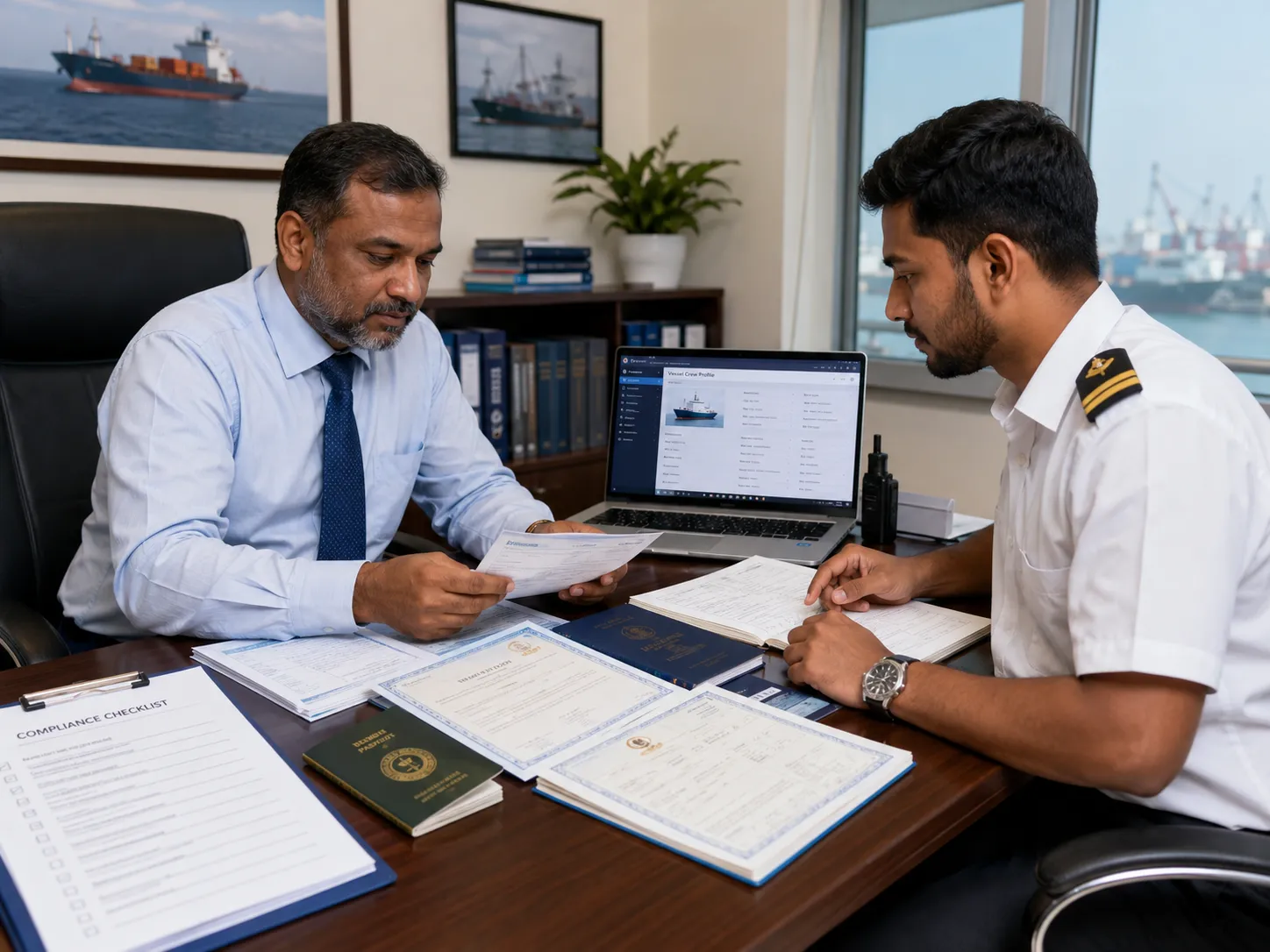
Greek employers should verify each seafarer’s identity, Certificate of Competency or Proficiency, STCW training, medical fitness, sea-service history, passport, seaman’s book, flag-state endorsement and vessel-specific qualifications. Verification must be completed with the issuing authority rather than relying only on scanned documents supplied by the candidate or recruiter.
The STCW Convention establishes international minimum standards for seafarer training, certification and watchkeeping. National administrations may exceed those minimums, while the ship’s flag state determines whether and how foreign certificates are recognized for service aboard its vessels.
Core document-verification checklist
1. Certificate of Competency
For officers, verify:
- Certificate number
- Issuing administration
- Rank and capacity
- Operational or management level
- Tonnage or propulsion limitations
- Vessel-type limitations
- Issue and expiry dates
- Suspension, cancellation or revalidation status
- Flag-state recognition eligibility
The IMO explains that STCW parties must maintain certificate registers and make certificate-status information available to administrations and companies requesting authenticity verification.
Bangladesh’s Department of Shipping provides online verification systems for Certificates of Competency and Certificates of Proficiency.
2. Certificates of Proficiency
Depending on rank and assignment, these may include:
- Personal Survival Techniques
- Fire Prevention and Fire Fighting
- Elementary First Aid
- Personal Safety and Social Responsibilities
- Security Awareness
- Designated Security Duties
- Survival Craft and Rescue Boats
- Advanced Fire Fighting
- Medical First Aid
- Medical Care
- GMDSS certification
- Radar and ARPA
- ECDIS
- Bridge Resource Management
- Engine-Room Resource Management
Bangladesh implemented updated Personal Safety and Social Responsibilities training following amendments to the STCW Code, illustrating why employers must check whether training reflects the latest applicable course standard.
3. Tanker qualifications
For oil, chemical, LNG or LPG vessels, verify the appropriate tanker training and sea-service evidence.
This may include:
- Basic oil and chemical tanker training
- Advanced oil tanker cargo operations
- Advanced chemical tanker cargo operations
- Basic liquefied-gas tanker training
- Advanced liquefied-gas tanker cargo operations
- Ship-specific cargo-system experience
- Relevant terminal and cargo-operation exposure
A certificate alone does not confirm operational competence. Interviewers should test the candidate’s knowledge of cargo hazards, permits, enclosed-space procedures, emergency shutdowns, pollution prevention and the vessel’s expected cargo systems.
See Tanker Crew Recruitment for vessel-specific sourcing.
4. Medical certificate
The seafarer must be medically fit for the intended position and carry a valid medical certificate issued under an accepted system. The MLC requires medical certification appropriate to the seafarer’s duties, while Bangladesh publishes information on doctors approved for seafarer examinations.
Check:
- Expiry date
- Eyesight and colour-vision status
- Hearing
- Work limitations
- Medication declarations
- Vessel or duty restrictions
- Authenticity of issuing physician
- Acceptance by the vessel’s flag state or company standard
5. Sea-service record
Verify sea service against:
- Discharge book or CDC entries
- Previous contracts
- Sea-service testimonials
- Company records
- Vessel databases
- References from previous employers
- Vessel name, IMO number, type, tonnage and engine power
- Sign-on and sign-off dates
- Rank served
Recent experience is especially important. A chief officer who has not conducted cargo operations on a tanker for several years may require additional assessment or familiarization even when certificates remain valid.
6. Passport and seafarer identity documents
Confirm:
- Passport validity
- Remaining blank pages
- Name consistency across all records
- Date-of-birth consistency
- Valid seaman’s book or Continuous Discharge Certificate
- Previous visa or immigration issues
- Transit eligibility for the intended joining route
7. Flag-state endorsement
A Bangladesh-issued officer certificate cannot automatically be used on every foreign-flagged vessel. The ship’s flag administration must recognize the issuing country’s certificates under STCW Regulation I/10 and may require an endorsement attesting recognition.
The IMO maintains information concerning certificate recognition between STCW parties.
The 2025 IMO Port State Control Procedures also identify Certificates of Competency, Certificates of Proficiency, flag-state recognition endorsements and medical certificates as key items examined during seafarer-certification inspections.
Compliance Request a document pre-audit before interviewing candidates. Ship Crew Agency can prepare a rank-by-rank verification file for review by your crewing, marine and compliance departments.
Step-by-Step Process for Hiring Bangladeshi Seafarers
The hiring process should move through eight controlled stages: defining vessel requirements, submitting a crew request, shortlisting candidates, conducting interviews, verifying documents, completing medical examinations, arranging flag, visa and travel formalities, and deploying the crew. Each stage should have a responsible person, deadline and documented approval.
Step 1: Define the vessel and rank requirements
Provide the manning agency with a detailed crew requisition containing:
- Vessel name and IMO number
- Flag
- Vessel type
- Year built
- Gross tonnage and deadweight
- Main engine type and power
- Cargo or operational profile
- Trading area
- Joining port
- Proposed joining date
- Contract duration
- Rank required
- Wage and leave structure
- Required nationality mix
- Minimum experience
- Required certificates
- Flag endorsements
- English standard
- Company-specific training
- Vaccination or medical requirements
A generic request such as “need one chief engineer urgently” creates avoidable risk. The agency needs enough technical information to match the engineer’s actual experience with the vessel.
Step 2: Submit the formal crew request
The crew request should identify whether the position is:
- Planned relief
- New appointment
- Promotion
- Replacement following rejection
- Medical repatriation replacement
- Performance-related replacement
- Emergency crew change
- New vessel delivery requirement
The agency should confirm receipt, candidate availability and an estimated deployment schedule.
Step 3: Candidate sourcing and shortlisting
A professional Bangladesh maritime recruitment service should search its active database, previous crew pool, referrals and verified applicant network.
Shortlisting criteria should include:
- Valid certificates
- Rank experience
- Vessel-type experience
- Similar engine or cargo-system experience
- Recent sea service
- English communication
- Employment stability
- Performance references
- Availability
- Wage alignment
- Medical history relevant to duty
- Previous incidents or disciplinary concerns
The employer should receive a standardized candidate profile rather than unstructured CVs.
Step 4: Interview and competence assessment
Interviews should be tailored by rank.
For a master or chief officer, assess:
- Passage planning
- Bridge-team management
- Cargo operations
- Stability
- emergency leadership
- PSC preparation
- ISM implementation
- Incident reporting
- Work-and-rest management
For a chief or second engineer, assess:
- Planned maintenance
- Main-engine troubleshooting
- Fuel changeover
- Bunkering
- Pollution-prevention systems
- Critical-equipment management
- Engine-room resource management
- Spare-parts control
For ratings, assess practical knowledge, safety awareness, communication and familiarity with assigned duties.
Use a documented scorecard with technical, safety, behavioural and communication categories.
Step 5: Verify certificates and employment history
Verification should include:
- Direct online certificate checks
- Issuing-authority confirmation where necessary
- Previous employer references
- Sea-service comparison
- Passport and CDC review
- Name and date consistency
- Flag-recognition status
- Training-course validity
- Medical-provider approval
Do not treat a visually convincing PDF as proof of authenticity.
Step 6: Arrange medical examinations
The candidate should attend an approved medical practitioner and complete any company-specific tests.
These may include:
- Standard seafarer medical examination
- Drug and alcohol testing
- Additional cardiac or respiratory tests
- Psychological assessment for selected roles
- Offshore medical examination
- Client-specific health declarations
Medical information must be handled confidentially and only for legitimate fitness and employment purposes.
Step 7: Complete endorsement, visa and travel arrangements
The agency and employer should coordinate:
- Flag-state application
- Confirmation of receipt of application when permitted
- Entry or transit visa
- Port agent invitation
- Letter of guarantee
- OK-to-board documentation
- Flight booking
- Airport assistance
- Hotel accommodation
- Domestic transport
- Joining instructions
- Local agent communication
- Sign-on documents
Travel requirements depend on the vessel’s flag, joining country, transit airports, seafarer nationality and port-agent procedures. They must be checked for each deployment.
Under MLC Regulation 1.4, recruitment or placement charges should not be passed to the seafarer, apart from limited personal-document costs. Visa costs are to be borne by the shipowner.
Step 8: Deploy and confirm sign-on
Before departure, provide the seafarer with:
- Signed Seafarers’ Employment Agreement
- Wage terms
- Contract duration
- Insurance information
- Travel itinerary
- Joining-agent details
- Emergency contact
- PPE instructions
- Company policies
- Drug and alcohol policy
- Complaint procedure
- Familiarization expectations
After joining, the agency should obtain sign-on confirmation and update the crew-management record.
The MLC covers employment agreements, wages, hours of work and rest, repatriation, medical care, recruitment services, accommodation, occupational safety and onboard complaint procedures.
Related support is available through Crew Change Services.
How Long Does Crew Deployment Usually Take
A standard international deployment from Bangladesh generally requires two to four weeks when documents are valid and the joining route is straightforward. Ready-pool replacements may sometimes deploy within five to ten working days, while officers needing flag endorsements, specialist training, complex visas or additional medical clearance may require three to six weeks.
These are planning benchmarks, not guaranteed legal timelines.
| Deployment situation | Practical planning range |
| Ready rating with valid documents | 5–10 working days |
| Standard officer deployment | 2–4 weeks |
| Officer requiring flag endorsement | 3–6 weeks |
| Tanker officer requiring additional review | 3–6 weeks |
| Full or substantial crew complement | 4–8 weeks |
| Emergency replacement | Case-specific |
Factors that affect deployment speed
- Candidate availability
- Notice period with previous employer
- Passport validity
- Medical status
- Certificate verification
- Flag-state endorsement processing
- Visa appointment availability
- Joining-port restrictions
- Flight availability
- Transit visa requirements
- Company approval speed
- Client interview scheduling
- Required specialist courses
- Public holidays in Bangladesh or the joining country
Greek shipowners can reduce delays by maintaining an approved relief pool at least 60 to 90 days ahead of planned crew changes.
Crew availability Send your rank list, vessel details and target joining dates to receive a current crew-availability report and realistic deployment plan.
Which Vessel Types Can Bangladesh Support
Bangladesh can support Greek fleets operating bulk carriers, general cargo vessels, container ships, oil and chemical tankers, LNG and LPG carriers, offshore support vessels and selected specialized ships. Candidate suitability must still be established through verified sea service, relevant STCW endorsements, equipment familiarity and company-specific competence assessment.
Bulk carriers
Bangladeshi officers and ratings may be sourced for:
- Handysize
- Handymax
- Supramax
- Ultramax
- Panamax
- Kamsarmax
- Capesize bulk carriers
Important screening areas include:
- Hold preparation
- Cargo contamination prevention
- Grain stability
- Coal and mineral cargo hazards
- Hatch-cover maintenance
- Ballast operations
- Cargo crane operation
- IMSBC Code awareness
Oil and chemical tankers
Tanker candidates require stronger documentation and competence controls.
Assess:
- Cargo grades previously handled
- Pump-room or deepwell-pump experience
- Inert-gas systems
- Tank cleaning
- Cargo heating
- Vapour return
- Closed loading
- Ship-shore safety checklists
- Pollution emergency procedures
- Chemical compatibility
- Personal protective equipment
LNG and LPG carriers
Gas-carrier recruitment should focus on:
- Relevant gas-tanker certification
- Cargo-containment system experience
- Reliquefaction or boil-off-gas systems
- Gas detection
- ESD systems
- Cryogenic hazards
- Compressor experience
- Dual-fuel engine exposure
- Previous vessel and cargo records
Availability for experienced senior gas officers may be more limited than for conventional cargo fleets. Early workforce planning is therefore essential.
Container vessels
Important experience includes:
- Reefer monitoring
- Container securing
- Stability and stack-weight control
- Dangerous-goods documentation
- Fast port turnaround
- Lashing safety
- Main-engine and auxiliary reliability
Offshore vessels
Bangladesh may support selected offshore roles, subject to project requirements.
Potential vessel types include:
- Platform supply vessels
- Anchor-handling tug supply vessels
- Crew boats
- Offshore construction vessels
- Accommodation vessels
- Dredgers
- Tugs
Additional requirements may include offshore medicals, BOSIET or equivalent training, dynamic-positioning certification, client approval and regional offshore experience.
How Ship Crew Agency Handles Compliance and Documentation
Ship Crew Agency should function as a controlled compliance partner rather than a CV-forwarding service. Its responsibilities should include licence verification, candidate due diligence, STCW checks, flag-state coordination, medical control, employment documentation, MLC-compliant recruitment, travel management, data protection, deployment records and post-joining performance follow-up.
The ISM Code establishes an international standard for safe ship management, safe operation and pollution prevention. SOLAS Chapter IX requires the responsible company to establish a Safety Management System. Crew competence, familiarization, communication and documented responsibility therefore form part of the ship manager’s wider safety-management obligations.
Pre-employment compliance file
For each candidate, the agency should maintain:
- Approved CV
- Interview score
- Certificate-verification evidence
- Passport copy
- CDC or seaman’s book
- Medical certificate
- Sea-service record
- Reference checks
- Flag endorsement or application
- Training records
- Employment agreement
- Visa records
- Flight itinerary
- Joining acknowledgement
- Emergency contact
- Data-consent documentation
MLC recruitment controls
A compliant recruitment service should:
- Avoid charging prohibited recruitment fees to seafarers
- Give candidates access to employment terms before signing
- Prevent misleading job offers
- Confirm that employment agreements comply with applicable law
- Maintain a complaint procedure
- Protect personal data
- Verify that recruited seafarers are qualified
- Maintain financial protection where required
- Avoid blacklisting or improper employment restrictions
- Support repatriation and abandonment procedures when applicable
The ILO’s MLC Regulation 1.4 requires an efficient, adequate and accountable recruitment and placement system and places specific controls on private recruitment services.
The MLC’s 2022 amendments entered into force on 23 December 2024, strengthening several protections concerning seafarers’ working and living conditions.
PSC readiness
Port State Control officers may inspect:
- Certificates and endorsements
- Medical certificates
- Minimum safe manning
- Watch schedules
- Hours-of-rest records
- Familiarization
- Competence related to assigned safety duties
- Employment and MLC documentation
PSC is the inspection of foreign ships in port to verify compliance with international safety, security, environmental and manning requirements.
A crew agency cannot transfer the ship manager’s statutory responsibility. It can, however, reduce exposure by producing complete, traceable and auditable recruitment records.
Common Challenges Greek Shipowners Face When Hiring Crew Internationally
The main international crewing risks are invalid documentation, poor vessel matching, delayed visas, weak English, inadequate technical assessment, unexpected turnover, inconsistent employment terms and lack of relief planning. These risks can be controlled through authority-level verification, structured interviews, transparent contracts, ready relief pools and documented responsibility between owner, manager and agency.
Certificate fraud or inconsistency
Names, dates, certificate numbers and sea-service records may not match. Direct verification is essential.
CV experience that cannot be demonstrated
A candidate may list a vessel type without having performed the responsibilities expected at the proposed rank. Technical interviews should test actual decision-making.
Flag-state recognition delays
The employer should check certificate-recognition eligibility before final selection, not after flights have been planned.
Weak communication
Maritime English affects bridge communication, engine-room coordination, permits, drills, emergency response and multinational teamwork.
Use practical scenario-based interviews rather than asking only whether the candidate speaks English.
Unclear wage expectations
Avoid verbal or informal wage promises. The employment agreement should identify:
- Basic wage
- Guaranteed overtime
- Leave pay
- Bonuses
- Contract period
- Allotments
- Deductions
- Repatriation terms
- Insurance coverage
- Applicable collective agreement
Poor retention
Retention problems often result from inconsistent relief, delayed wages, unclear promotion pathways, disrespectful management or repeated contract extensions.
A slightly higher but stable crew cost may be commercially better than constant recruitment and familiarization.
Last-minute relief planning
Late requests increase travel costs and reduce candidate choice. Maintain forecasted crew changes by vessel, rank and month.
Inadequate familiarization
Even an experienced seafarer needs familiarization with:
- Vessel layout
- Emergency duties
- Safety Management System
- Critical equipment
- Cargo systems
- Cybersecurity procedures
- Permit-to-work system
- Environmental procedures
- Company reporting standards
How Bangladesh Compares With Other Crew Supply Countries
Bangladesh should be compared with the Philippines, India, Indonesia and Myanmar using measurable criteria rather than nationality assumptions. Greek employers should examine officer depth, vessel experience, certification verification, English, availability, wage structure, retention, travel routes, agency governance and flag recognition before deciding which nationalities best fit each vessel and rank.
| Crew market | Typical procurement consideration | Recommended Greek employer approach |
| Bangladesh | Developing international supply pool with officers and ratings across several vessel categories | Build a screened company pool and invest in retention |
| Philippines | Large and mature international crewing infrastructure | Examine agency capacity, wage structure and retention competition |
| India | Broad officer and technical talent base | Match candidates carefully by vessel, engine and cargo experience |
| Indonesia | Significant ratings and officer market | Confirm English, recent sea service and client-specific competence |
| Myanmar | Potentially competitive supply for selected ranks | Review deployment routes, regulatory conditions and agency controls |
This table is not a ranking. Capability varies substantially between individual seafarers, training institutions and agencies in every country.
The right comparison model
Score each source market against the same criteria:
- Availability by rank
- Senior-officer depth
- Tanker and gas experience
- English communication
- Certificate-verification access
- Flag-state recognition
- Medical infrastructure
- Deployment time
- Total crew cost
- Contract completion
- Retention
- Performance history
- Agency transparency
- Emergency replacement capacity
A mixed-nationality strategy may be appropriate for some fleets. Other companies may gain better operational consistency from developing a stable pool from one or two principal source countries.
Bangladesh becomes especially valuable when the Greek employer treats it as a long-term workforce-development market rather than a source of last-minute low-cost replacements.
Why Long-Term Partnerships Improve Fleet Performance
Long-term partnerships improve fleet performance because the agency learns the company’s vessels, technical standards, interview criteria, wage structure, safety culture and rotation needs. The employer gains repeat crew, better succession planning, faster replacements, stronger retention and more consistent documentation instead of restarting recruitment for every vacancy.
Benefits of an established crew pool
- Returning seafarers already understand company procedures
- Familiarization time can be reduced
- Performance history becomes measurable
- Promotion candidates can be developed internally
- Relief planning becomes more predictable
- Travel can be booked earlier
- Emergency replacements are easier to arrange
- Retention problems can be identified by vessel or rank
- Training investments remain within the fleet pool
- Cultural integration improves over time
Recommended partnership structure
A Greek shipowner and Bangladesh ship manning agency should agree on:
- Target vessels
- Required ranks
- Annual deployment volume
- Wage scales
- Interview authority
- Document-verification procedure
- Response times
- Replacement responsibilities
- Performance reporting
- Complaint escalation
- Data protection
- Audit rights
- Recruitment-fee prohibition
- Retention targets
- Cadet-development plans
- Promotion pathways
- Quarterly review meetings
Performance indicators to monitor
| KPI | What it reveals |
| Contract completion rate | Reliability and retention |
| Early repatriation rate | Selection or performance issues |
| Promotion rate | Crew-development effectiveness |
| Repeat employment rate | Pool stability |
| Deployment lead time | Operational responsiveness |
| Document rejection rate | Compliance quality |
| PSC crew-related deficiencies | Shipboard compliance exposure |
| Medical rejection rate | Pre-screening effectiveness |
| Candidate interview pass rate | Shortlisting quality |
| Relief punctuality | Rotation-management discipline |
Fleet partnership Request a fleet crewing consultation to design a Bangladesh crew pool for planned rotations, new deliveries, tanker operations or emergency relief requirements.
Frequently Asked Questions
Greek shipowners commonly ask whether Bangladesh can supply senior officers, how certificates are verified, whether tanker crews are available, how quickly personnel can join and who manages visas and flag endorsements. The answers depend on rank availability, vessel type, flag recognition, joining port and the quality of the selected Bangladesh ship manning agency.
1. Can Bangladesh supply senior officers?
Yes. Bangladesh can supply masters, chief officers, chief engineers, second engineers and other senior personnel, subject to current availability and the required vessel experience. Senior candidates should undergo detailed technical interviews, reference checks and direct certificate verification.
2. Are Bangladeshi seafarers STCW certified?
Bangladeshi officers and ratings serving internationally must hold the STCW certificates required for their rank and duties. Employers should verify every Certificate of Competency and Certificate of Proficiency through the Bangladesh Department of Shipping and confirm flag-state recognition.
3. Can Bangladeshi seafarers work on Greek-owned vessels under foreign flags?
Yes, provided their certificates and qualifications are accepted by the vessel’s flag administration. Officers may require an endorsement attesting recognition under STCW Regulation I/10.
4. How quickly can crew be deployed?
It bais on joining port. if the port/country required visa then it's may take time to get VISA (Urgent 72hrs or less to get), if joining port/country no need visa then we can flight crew within 24hrs via OK TO BOARD, GURANTEE LETTER etc. It's basically depends on joining port/required documents.
Note: Regarding Visa it's also depend on country (some of country issue visa early and some of country take time for their formalitices)
5. Can urgent replacements be arranged?
Yes, when the agency maintains a pre-screened relief pool. Emergency deployment still requires valid certificates, medical fitness, immigration clearance and travel feasibility. Compliance checks should not be removed merely to accelerate joining. we done many more cases urgent deployment in Chittagong (Chattogram) port, mongla port and differnet countries as well.
6. Are Bangladeshi crews suitable for tanker operations?
Bangladeshi officers and ratings with verified tanker certificates and relevant sea service can work on oil, chemical, LNG and LPG vessels. Employers should assess cargo-specific experience, vessel systems, emergency procedures and recent tanker service. Still we are working with many more tankers fleet shipowners ( VLCC, AFRAMAX, SUPERMAX etc)
7. What documents should shipowners verify?
Verify the passport, seaman’s book or CDC, Certificate of Competency, Certificates of Proficiency, medical certificate, sea-service record, flag endorsement, tanker qualifications, employment references, employment agreement and travel documents.
8. Who pays recruitment and visa costs?
Under MLC 2006 Regulation 1.4 and Standard A1.4.5(b), seafarers must not be charged recruitment or placement fees either directly or indirectly. The only costs that may normally be borne by seafarers are personal documents such as statutory medical certificates, passports, and seafarer's books. Visa expenses required for shipboard employment must be paid by the shipowner.
9. Can a Greek company recruit directly without an agency?
Yes. In many cases, Greek shipowners and ship management companies may recruit seafarers directly, subject to applicable flag-state requirements, national legislation, and company procedures. However, partnering with a licensed and MLC-compliant recruitment and placement service in Bangladesh often simplifies local sourcing, candidate screening, document verification, medical coordination, visa processing, travel arrangements, crew changes, and regulatory compliance management.
10. How should a shipowner select a Bangladesh manning agency?
Confirm its Department of Shipping approval, MLC procedures, certificate-verification process, office infrastructure, candidate database, client references, financial protection, complaint system, data controls and ability to support seafarers after deployment.
11. Can Bangladesh supply a full vessel crew?
Yes, subject to rank availability, vessel type and implementation time. A full-crew transition should be planned carefully to preserve operational continuity and an appropriate balance of experienced personnel.
12. Does the agency handle crew changes outside Greece?
A capable agency can coordinate crew changes through international joining ports using the ship manager, port agent, airlines and immigration representatives. Requirements must be confirmed for the specific port and transit route.
13. How can Greek employers improve retention?
Provide punctual relief, transparent wages, respectful onboard management, clear promotion criteria, reliable communication and opportunities for repeat employment. Retention should be tracked by vessel, rank, contract completion and reason for leaving.
14. Can Ship Crew Agency support bulk carriers and offshore vessels?
Yes, subject to candidate availability and project requirements. Dedicated services should be structured through Bulk Carrier Crew Supply and Offshore Crew Manning.
Final Hiring Checklist for Greek Shipowners
Before approving a Bangladeshi seafarer, confirm that:
The agency is properly approved in Bangladesh
The vessel and rank requirements are documented
The candidate has relevant vessel-type experience
The technical interview has been completed
English communication has been assessed
CoC and CoP records have been verified
Sea service has been checked
Previous-employer references have been obtained
The medical certificate is valid and accepted
Flag-state recognition has been confirmed
Passport and seaman’s book are valid
Tanker or specialist certificates are complete
The employment agreement is signed
Recruitment-fee controls comply with the MLC
Visa and travel responsibilities are assigned
Joining instructions have been issued
Onboard familiarization is planned
Relief and repatriation arrangements are documented
Emergency contacts are available
Post-joining performance will be monitored
Partner With Ship Crew Agency
Ship Crew Agency supports Greek shipowners, ship management companies, fleet operators and marine HR departments seeking qualified Bangladeshi seafarers.
Services can include:
- Officer and rating recruitment
- Full and partial crew supply
- Candidate screening
- Technical interview coordination
- STCW certificate verification
- Medical examination coordination
- Flag-state documentation
- Visa and travel support
- Crew change management
- Tanker and offshore recruitment
- Planned relief pools
- Emergency replacements
- Crew-retention programmes
- Fleet-specific workforce planning
Request crew availability: Submit your vessel type, flag, required ranks, joining port and target deployment date.
Book a fleet consultation: Request Crew on WhatsApp Develop a long-term Bangladesh crew-supply strategy for your Greek-owned or Greek-managed fleet.