 Ship Crew Agency
Maritime Editorial Team
In This Article
- What Is Tanker Crew Recruitment?
- Tanker recruitment is more than candidate sourcing
- Recruitment must be vessel-specific
- Recruitment, deployment, and retention are connected
- Why Recruiting Qualified Tanker Crews Is Critical for Safe Operations
- Tanker cargoes create specialised operational risks
- Crew competence supports the Safety Management System
- Cargo performance affects commercial performance
- Qualified crew reduce inspection and documentation exposure
- Emergency replacements require the same standard
- Qualifications and Certifications Required for Tanker Seafarers
- STCW Basic Training
- Basic tanker training
- Advanced tanker training
- Dangerous cargo familiarity
- Rank-specific certificates
- Medical fitness
- Flag State endorsements and company requirements
- Key Officer and Rating Positions on Tankers
- Master
- Chief Officer
- Deck Officers
- Chief Engineer
- Second Engineer
- Electro-Technical Officer
- Pumpman
- Able Seaman
- Oiler
- Fitter
- Position-specific recruitment matrix
- Types of Tankers and Their Crew Requirements
- Crude Oil Tankers
- Product Tankers
- Chemical Tankers
- LNG Carriers
- LPG Carriers
- Tanker-type recruitment comparison
- Challenges in Tanker Crew Recruitment
- Limited pools of specialised experience
- Certification and compliance complexity
- Verifying genuine operational experience
- Retaining experienced tanker personnel
- Emergency replacements
- Matching candidates to the company, not only the vessel
- Documentation and deployment delays
- Maintaining recruitment quality under commercial pressure
- Why Many Shipowners Recruit Bangladeshi Tanker Seafarers
- STCW-Based Certification and Verifiable Records
- Access to Officers and Ratings
- Commercial Cost Efficiency
- Retention Potential
- Operational Reliability
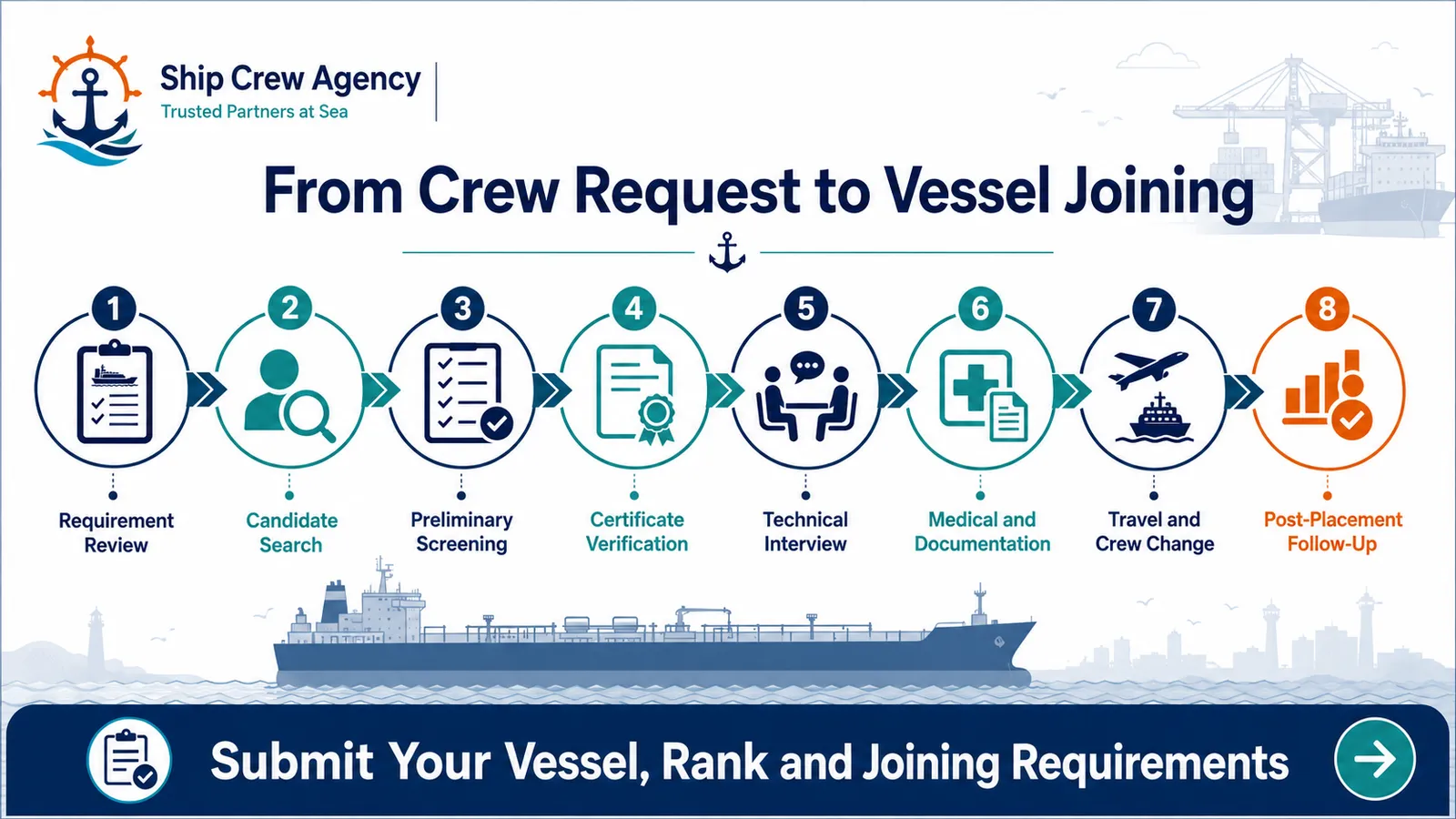
- How Ship Crew Agency Supports Tanker Recruitment
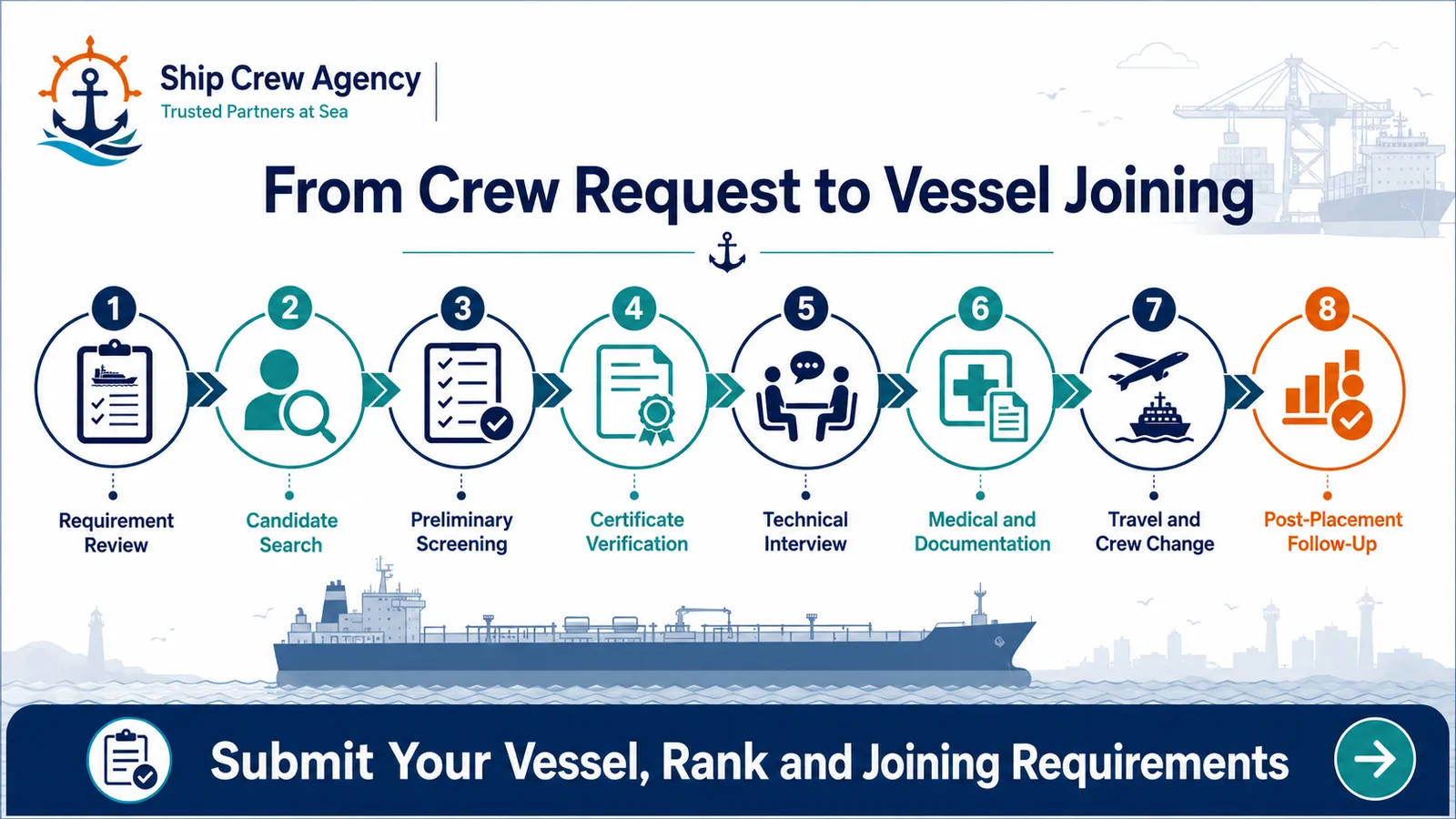
- 1. Defining the Tanker Crew Requirement
- 2. Candidate Sourcing
- 3. Preliminary Screening
- 4. Certificate and Document Verification
- 5. Sea-Service and Experience Verification
- 6. Technical and Behavioural Assessment
- 7. Documentation, Medical and Deployment Support
- 8. Crew Change and Post-Placement Follow-Up
- Frequently Asked Questions About Tanker Crew Recruitment
- 1. What is tanker crew recruitment?
- 2. How is tanker recruitment different from general ship recruitment?
- 3. What STCW certificates do tanker seafarers need?
- 4. Can an oil tanker officer work on a chemical tanker?
- 5. Are LNG and LPG tanker qualifications the same?
- 6. Which tanker crew positions are commonly recruited?
- 7. How should tanker experience be verified?
- 8. How long does tanker crew deployment take?
- 9. Can tanker crew be supplied for emergency replacements?
- 10. What information should a shipowner provide when requesting tanker crew?
- 11. Do tanker seafarers need a valid medical certificate?
- 12. Can a valid tanker certificate replace practical experience?
- 13. Why recruit tanker seafarers from Bangladesh?
- 14. Does Ship Crew Agency handle crew-change logistics?
- 15. How can shipowners improve tanker crew retention?
- Conclusion: Build Tanker Competence Before Filling Tanker Vacancies
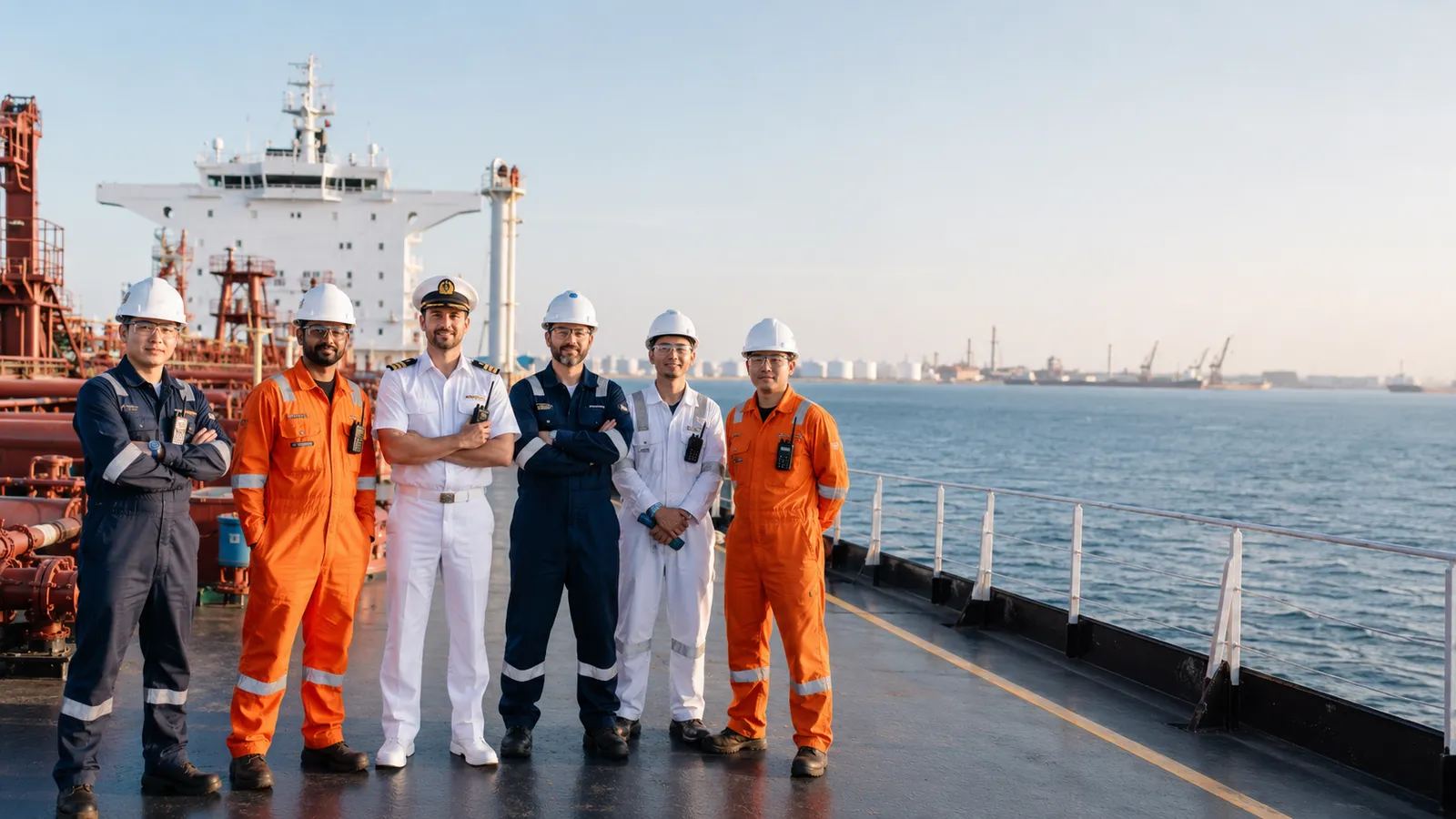
Tanker crew recruitment cannot be treated as a routine exercise in collecting CVs and filling vacant ranks. A candidate may hold a valid Certificate of Competency and still be unsuitable for a particular tanker, cargo system, trading pattern, or onboard operating environment. Effective recruitment requires the shipowner or crewing manager to assess the seafarer’s rank competence, vessel-type experience, tanker endorsements, cargo familiarity, safety behaviour, medical fitness, communication skills, sea-service history, and ability to work within the company’s safety management system.
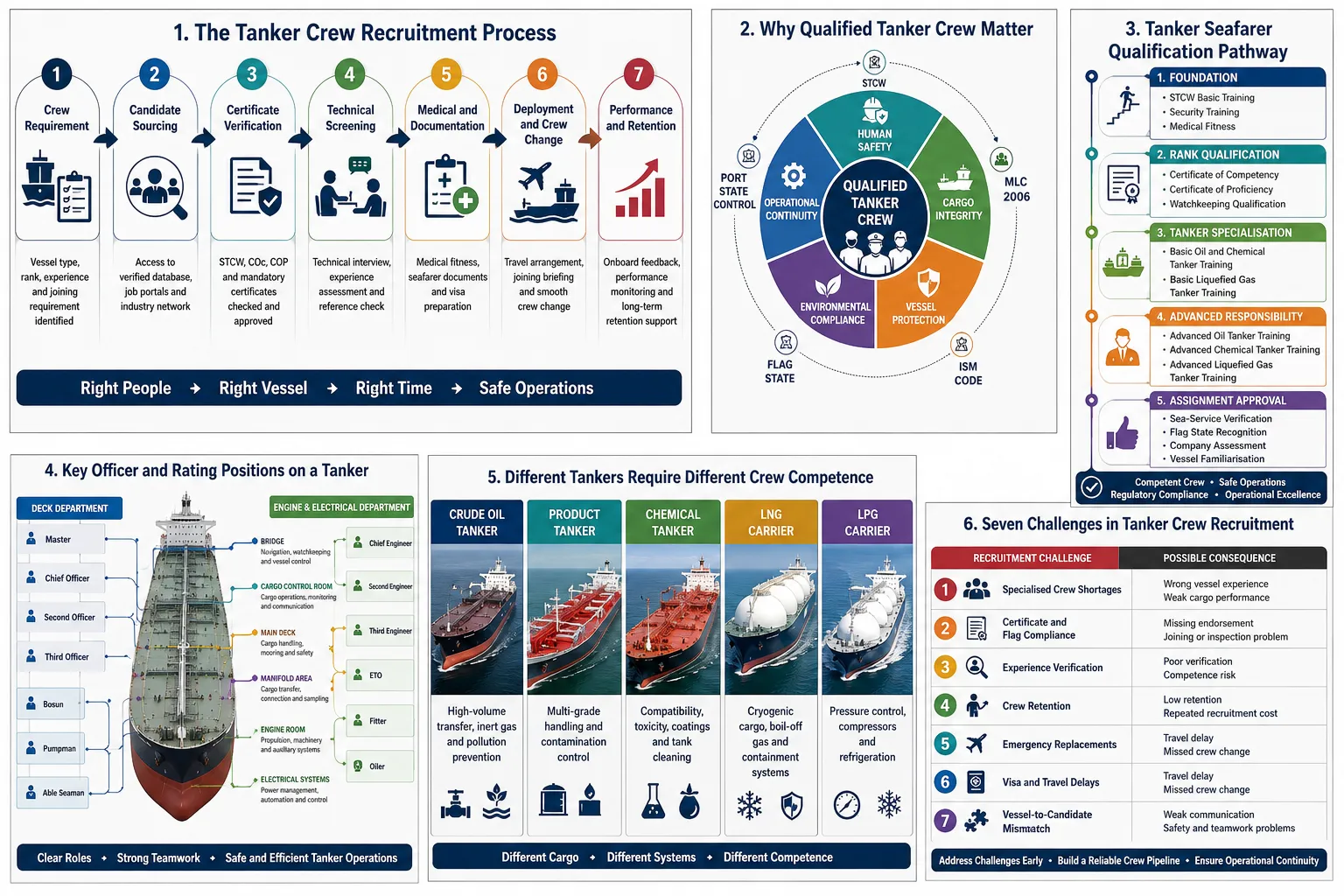
The International Convention on Standards of Training, Certification and Watchkeeping for Seafarers, commonly known as the STCW Convention, establishes the international framework for seafarer training, certification, competence, and watchkeeping. The Maritime Labour Convention, 2006, or MLC 2006, addresses employment conditions, recruitment and placement services, working and living standards, repatriation, health protection, and seafarer welfare. Together, these instruments create essential foundations for responsible international maritime recruitment.
For shipowners and fleet managers, the objective is not merely to recruit a certified individual. It is to place the right person, with the right tanker experience, in the right position, on the right vessel, at the required time.
This guide explains how tanker recruitment works, why specialised competence matters, which qualifications should be verified, and how a structured recruitment process can reduce safety, compliance, and deployment risks. Shipowners seeking wider recruitment support can also review Ship Crew Agency’s Seafarer Recruitment Services.
What Is Tanker Crew Recruitment?
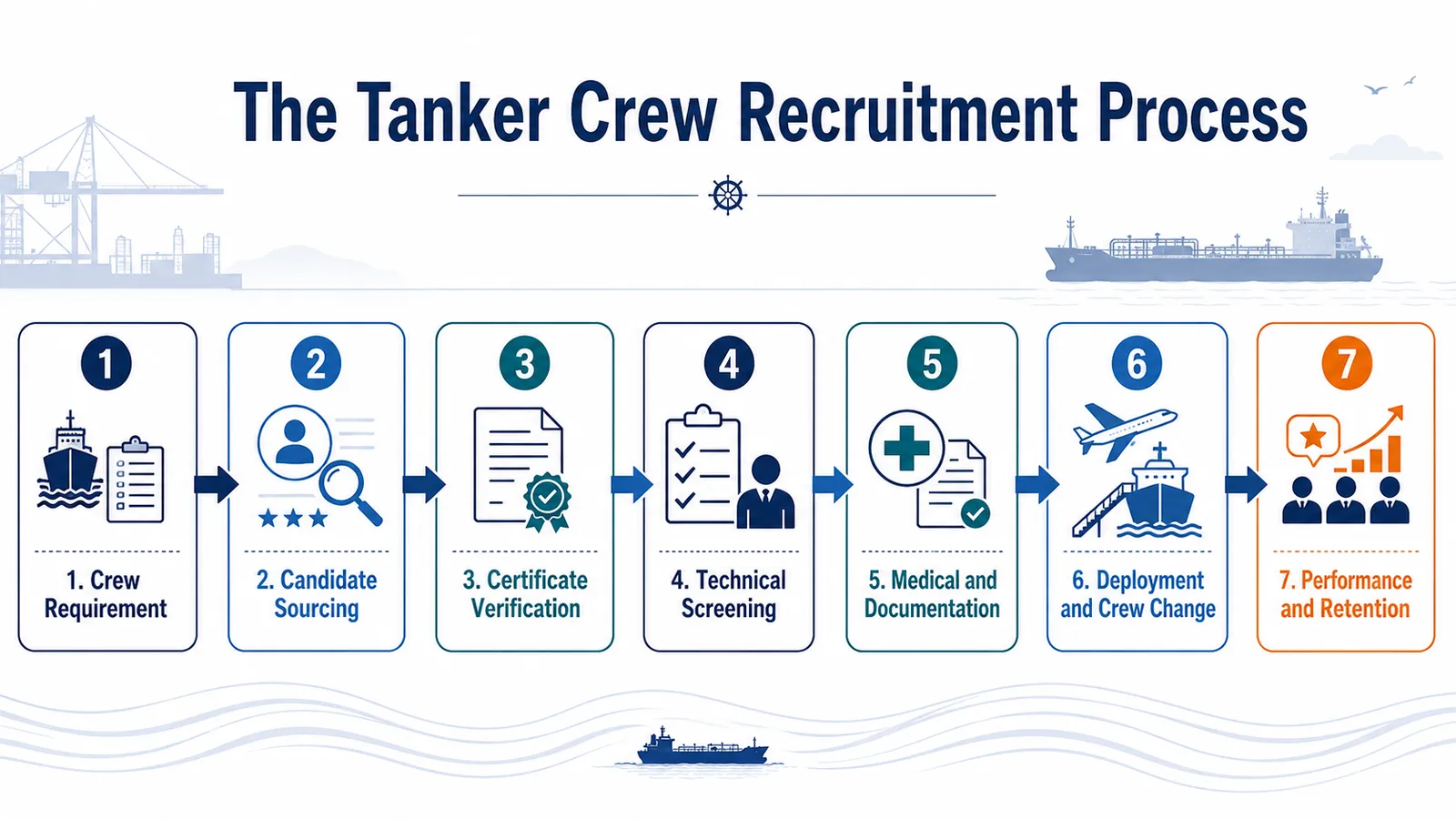
Tanker crew recruitment is the structured process of sourcing, screening, verifying, selecting, and deploying seafarers whose qualifications and experience match a specific tanker type, cargo profile, flag, trade route, and company safety management system. It covers officers, engineers, ratings, documentation, medical fitness, tanker endorsements, travel, crew change, and retention planning.
Unlike general merchant-vessel recruitment, tanker recruitment requires a clear understanding of cargo-specific responsibilities. A competent officer on a bulk carrier or container vessel cannot automatically be treated as qualified for an oil, chemical, LNG, or LPG tanker assignment. The seafarer’s previous tanker service, approved training, cargo exposure, rank responsibilities, and certificate limitations must be examined before placement.
Tanker recruitment is more than candidate sourcing
Crew sourcing is only the first stage. A professional tanker recruitment process normally includes:
Defining the vessel and rank requirements
Identifying suitable candidates
Checking rank-specific certificates
Verifying tanker training and endorsements
Reviewing sea service and vessel history
Assessing cargo and equipment familiarity
Conducting technical and behavioural interviews
Confirming medical fitness
Checking references and previous performance
Preparing employment and flag State documentation
Coordinating visas, travel, joining instructions, and crew change
Monitoring performance and planning future rotations
Each stage controls a different category of risk. Certificate verification addresses legal eligibility. Sea-service verification helps confirm practical experience. Technical interviews test whether claimed experience reflects real operational understanding. Medical assessments establish whether the seafarer can perform routine and emergency duties safely.
Recruitment must be vessel-specific
The term “tanker experience” is too broad to support a sound hiring decision.
A Chief Officer with extensive product tanker experience may understand petroleum cargo operations but have limited exposure to the cargo segregation, compatibility concerns, tank preparation standards, and documentation associated with chemical tankers. An engineer experienced on conventional oil tankers may still require vessel-specific familiarisation before working with the cargo plant, reliquefaction equipment, compressors, containment systems, and safety arrangements of an LNG or LPG carrier.
Recruitment specifications should therefore identify:
| Recruitment factor | Information required |
|---|---|
| Vessel type | Crude oil, product, chemical, LNG or LPG tanker |
| Vessel size | Coastal tanker, MR, LR, Aframax, Suezmax, VLCC or relevant gas-carrier class |
| Rank | Master, Chief Officer, engineer, ETO, Pumpman, AB, Oiler or other position |
| Cargo profile | Petroleum, chemical, liquefied gas or mixed approved cargo programme |
| Cargo system | Pumps, compressors, reliquefaction systems, tank coatings and control systems |
| Flag | Certificate recognition and endorsement requirements, e.g panama, hong kong etc |
| Trading area | Ports, terminals, travel route and environmental conditions |
| Joining details | Port, date, visa requirements and relief window |
| Required experience | Rank experience, tanker type and minimum sea time |
| Company requirements | English level, assessment standard, rotation and safety expectations |
A clearly written crew request reduces irrelevant applications and allows the recruitment agency to screen against operational requirements rather than relying on rank titles alone.
Recruitment, deployment, and retention are connected
Tanker recruitment does not end when the seafarer joins the vessel. Poor role matching often appears later through weak performance, failed probation, communication problems, early repatriation, or reluctance to return for another contract.
Effective crew management therefore connects recruitment with:
Structured onboard appraisal
Crew welfare and communication
Contract completion monitoring
Relief and rotation planning
Certificate-expiry tracking
Training-gap identification
Promotion planning
Re-employment and retention decisions
For shipowners managing multiple tankers, maintaining a stable pool of returning officers and ratings can support operational consistency. Familiarity with company procedures, fleet standards, reporting systems, and safety expectations reduces the repeated learning burden associated with constant crew turnover.
A specialist Crew Manning Agency should therefore be evaluated not only by how quickly it supplies CVs, but by how well it verifies candidates, supports deployment, tracks performance, and develops a reliable long-term crew pool.
Why Recruiting Qualified Tanker Crews Is Critical for Safe Operations
Recruiting qualified tanker personnel is critical because tanker operations combine hazardous cargoes, complex transfer systems, strict pollution controls, and limited tolerance for human error. Competent crew protect life, cargo, vessel integrity, the marine environment, and commercial schedules while helping operators meet STCW, ISM, ISPS, flag State, and Port State Control expectations.
Tanker cargoes create specialised operational risks
Tanker personnel may work around flammable vapours, toxic substances, corrosive chemicals, pressurised cargoes, extremely low-temperature liquids, enclosed spaces, complex pipelines, and high-capacity cargo-transfer systems.
The exact risks vary by tanker type. Oil and product tankers require strong control of ignition sources, vapour exposure, static electricity, tank atmospheres, cargo transfer, pollution prevention, and enclosed-space hazards. Chemical tankers introduce additional considerations such as cargo compatibility, toxicity, reactivity, contamination control, tank coatings, and cargo-specific protective measures.
LNG and LPG carriers require personnel who understand the behaviour of liquefied gases, pressure and temperature control, containment arrangements, cargo compressors, emergency shutdown systems, gas detection, and specialised cargo-transfer procedures.
A certificate confirms that defined training requirements have been completed. It does not, by itself, prove that the holder has recent, relevant, and rank-appropriate experience on the vessel being crewed.
Crew competence supports the Safety Management System
The International Safety Management Code requires shipping companies to establish safety-management objectives and a structured system for the safe operation of ships and pollution prevention. The effectiveness of that system depends heavily on the competence, communication, discipline, and decision-making of the personnel implementing it onboard.
Qualified tanker personnel should be able to:
Follow company cargo and safety procedures
Participate effectively in risk assessments and toolbox meetings
Understand permits to work and operational limitations
Recognise unsafe conditions before they develop into incidents
Communicate clearly during cargo operations
Respond to alarms and emergencies according to assigned duties
Maintain accurate cargo, maintenance, safety, and rest-hour records
Use stop-work authority when conditions are unsafe
Cooperate with terminals, surveyors, inspectors, pilots, and shore management
The recruitment process should therefore assess safety behaviour as well as technical knowledge. A technically experienced candidate who ignores procedures, communicates poorly, or conceals mistakes can create significant operational exposure.
Cargo performance affects commercial performance
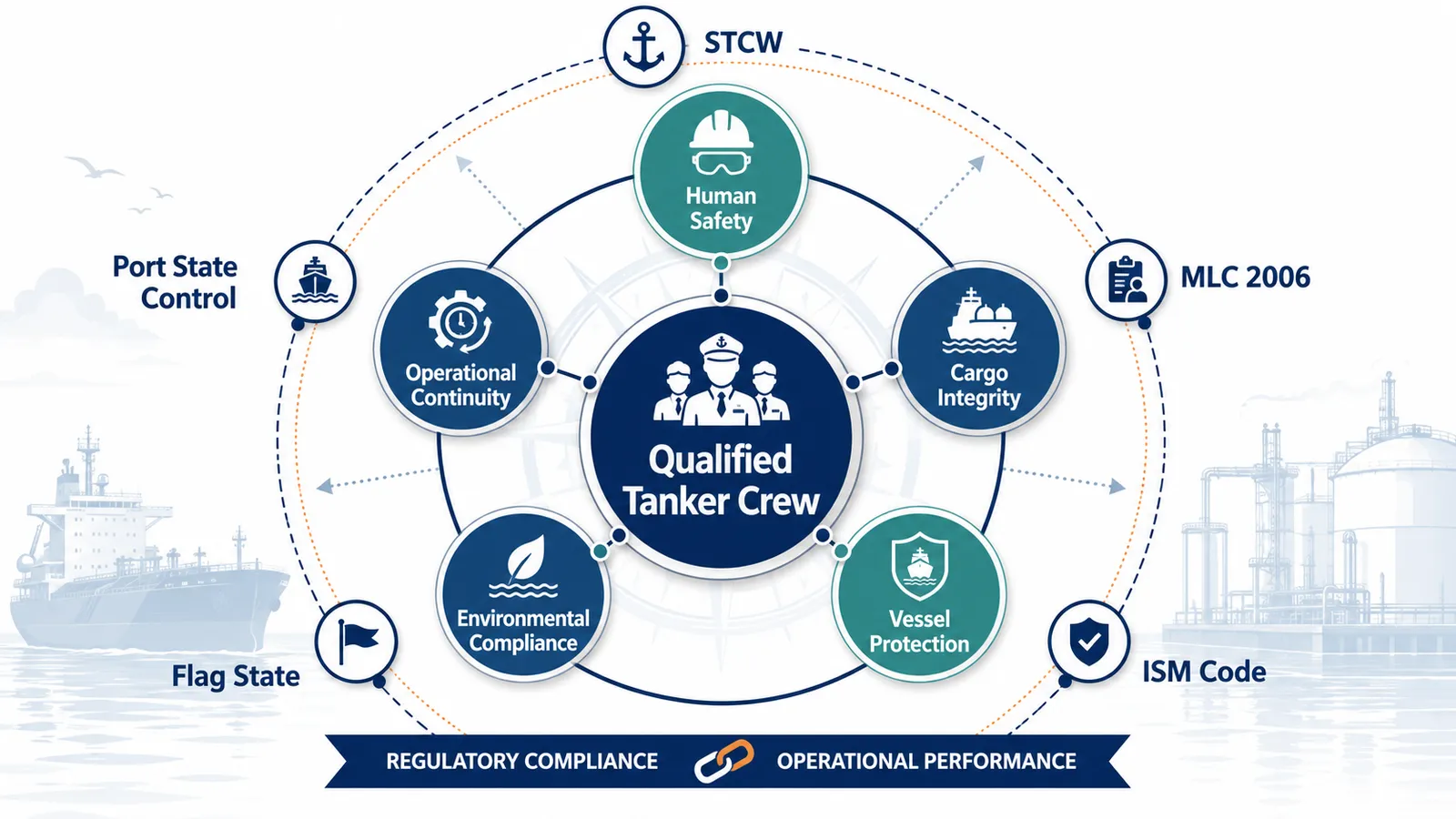
Crew quality influences more than statutory compliance. It can affect loading and discharge efficiency, tank preparation, cargo claims, contamination risk, terminal performance, maintenance standards, voyage schedules, inspection outcomes, and customer confidence.
The Chief Officer’s cargo planning, the Pumpman’s familiarity with cargo lines and pumps, the deck team’s execution, and the engine department’s support must function as one coordinated system. A weakness in one position can delay the entire cargo operation.
Recruiting decisions should consequently consider the operational relationship between ranks. Supplying individually qualified seafarers without evaluating team balance, leadership strength, communication, and combined experience may still leave the vessel vulnerable.
Qualified crew reduce inspection and documentation exposure
Port State Control officers may review crew certificates, endorsements, safe-manning compliance, medical documents, rest-hour records, drills, familiarisation, and the crew’s ability to operate essential shipboard systems. Current IMO Port State Control procedures support consistent inspection of deficiencies relating to a ship, its equipment, and its crew.
Recruitment teams should verify documentation before mobilisation rather than discovering deficiencies at the joining port or during inspection. Important checks include:
Certificate authenticity
Certificate validity and expiry
Correct rank and capacity
Tanker training required for assigned duties
Flag State recognition or endorsement
Medical certificate validity
Seaman’s record book and sea service
Security training
Passport and visa validity
Seafarer Employment Agreement
Safe-manning requirements
Company-specific training and familiarisation
A document may be genuine but still unsuitable for the intended assignment. The recruitment team must check whether the certificate covers the candidate’s actual rank, tanker type, cargo responsibilities, and flag requirements.
Emergency replacements require the same standard
Illness, family emergencies, failed medical examinations, visa problems, missed flights, certificate issues, or unexpected resignation can create urgent replacement requirements. Speed is important, but emergency recruitment must not lower the verification standard.
A replacement who reaches the port quickly but lacks the correct tanker certification or vessel experience may create a larger operational delay. Strong tanker recruitment systems maintain pre-screened pools organised by rank, tanker type, documentation status, location, and availability.
Qualifications and Certifications Required for Tanker Seafarers
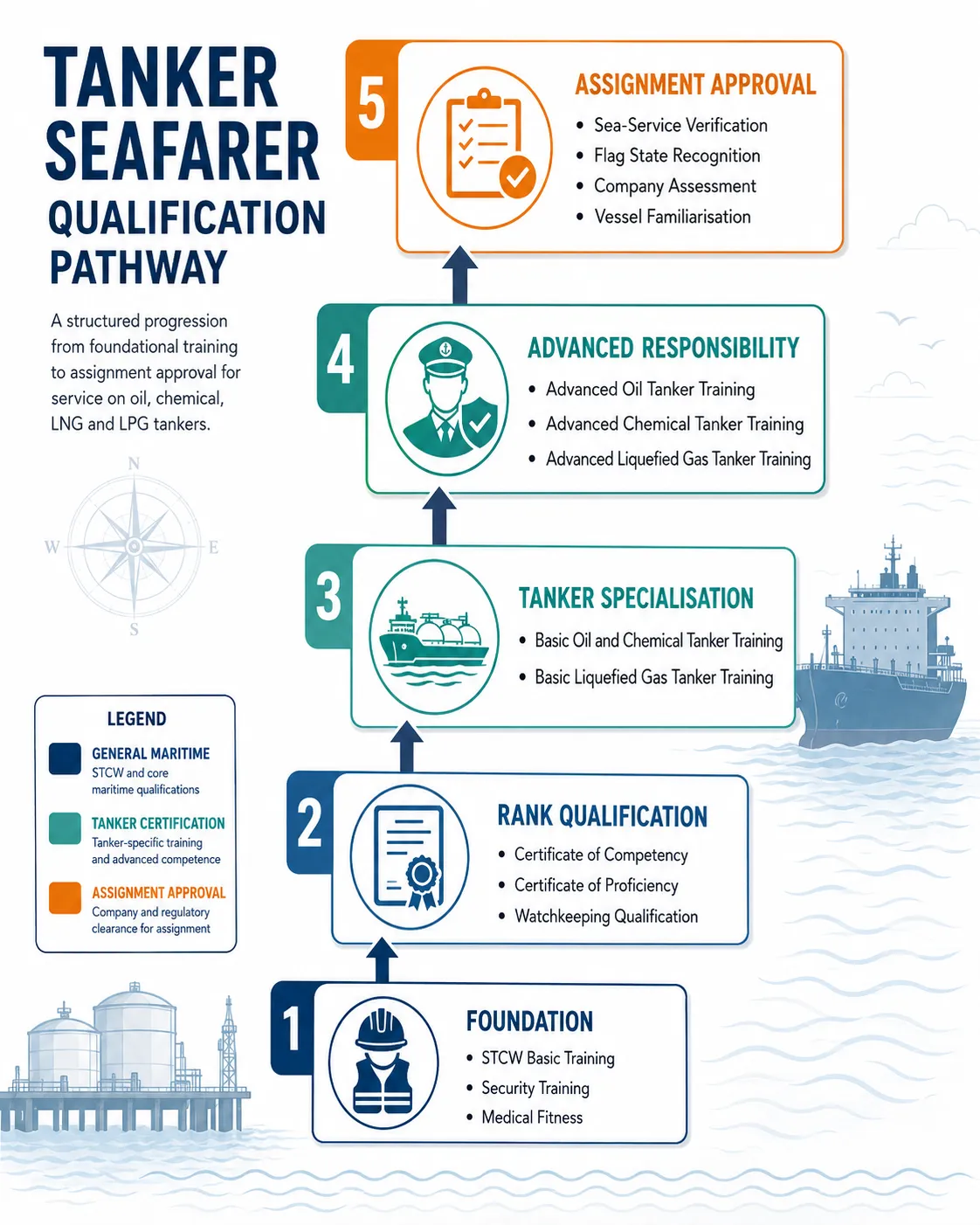
Tanker seafarers need valid rank and safety credentials plus vessel-specific cargo training appropriate to their assigned duties. The minimum package normally includes STCW basic training, a valid competency or proficiency certificate, approved tanker training where cargo responsibilities apply, security training, medical fitness, documented sea service, and any endorsements required by the flag State or shipowner.
The exact requirements depend on the seafarer’s rank, duties, tanker type, level of cargo responsibility, flag administration, and company policy. Recruiters should avoid using one universal checklist for every tanker candidate.
STCW Basic Training
STCW Basic Training establishes essential competencies for seafarers serving on seagoing ships. The core areas include:
Personal Survival Techniques
Fire Prevention and Fire Fighting
Elementary First Aid
Personal Safety and Social Responsibilities
These competencies are set out under STCW regulation VI/1 and section A-VI/1 of the STCW Code. Certain practical competencies, including personal survival and firefighting, are also subject to evidence of continued competence at prescribed intervals.
Basic Training is essential, but it is not tanker-specialist training. It establishes the general safety foundation on which oil, chemical, LNG, and LPG tanker competence is built.
Basic tanker training
Personnel assigned specific duties related to cargo or cargo equipment require approved tanker training appropriate to the vessel category.
STCW separates tanker cargo training into:
| Tanker training category | Typical application |
|---|---|
| Basic training for oil and chemical tanker cargo operations | Personnel assigned cargo-related duties on oil or chemical tankers |
| Advanced training for oil tanker cargo operations | Senior officers and personnel with immediate responsibility for oil cargo operations |
| Advanced training for chemical tanker cargo operations | Senior officers and personnel with immediate responsibility for chemical cargo operations |
| Basic training for liquefied gas tanker cargo operations | Personnel assigned cargo-related duties on LNG or LPG carriers |
| Advanced training for liquefied gas tanker cargo operations | Senior officers and personnel with immediate responsibility for liquefied-gas cargo operations |
Under STCW regulation V/1-1, Masters, Chief Engineer Officers, Chief Mates, Second Engineer Officers, and other personnel with immediate responsibility for loading, discharging, cargo care, cargo handling, tank cleaning, or related operations must hold the applicable advanced oil or chemical tanker training certification. Regulation V/1-2 provides corresponding requirements for liquefied-gas tankers.
Recruiters must examine the candidate’s actual assignment. Rank alone should not determine the decision. A person with immediate cargo responsibility may require advanced certification even where the job title does not clearly describe that responsibility.
Advanced tanker training
Advanced tanker training is intended for personnel who plan, manage, supervise, or hold immediate responsibility for cargo operations.
Depending on the tanker type, advanced competence may include:
Cargo properties and associated hazards
Cargo planning and operational control
Loading and discharge supervision
Cargo measurement and monitoring
Tank cleaning and preparation
Ballast and stability considerations
Pollution-prevention procedures
Cargo-system limitations
Emergency-response actions
Occupational health and safety controls
Compliance with applicable codes and operating procedures
For recruitment purposes, an advanced certificate should be supported by relevant sea service and credible operational experience. The interview should test what the candidate has actually done, not simply what appears on the certificate.
Dangerous cargo familiarity
Tanker personnel must understand the hazards connected with the cargoes they will handle. Familiarity should be assessed against the vessel’s normal cargo programme rather than discussed only in general terms.
Relevant areas may include:
Flammability and ignition risks
Toxicity and exposure control
Corrosive or reactive properties
Cargo compatibility
Vapour and gas hazards
Pressure and temperature behaviour
Static-electricity precautions
Personal protective equipment
Gas-detection practices
Enclosed-space controls
Emergency shutdown arrangements
Pollution-prevention measures
Cargo information and safety-data documentation
Recruiters do not need to reproduce a full cargo examination during every interview. They should, however, ask scenario-based questions appropriate to the rank and confirm that the candidate understands the operating discipline required on the relevant tanker type.
Rank-specific certificates
Officers must hold a valid Certificate of Competency appropriate to their rank, department, vessel limitations, and area of operation. Ratings may require Certificates of Proficiency for their assigned capacity and watchkeeping responsibilities.
Depending on the role, documentation may include:
Master or deck-officer Certificate of Competency
Engineer-officer Certificate of Competency
Electro-Technical Officer certification
Rating forming part of a navigational watch
Rating forming part of an engineering watch
Able Seafarer Deck certification
Able Seafarer Engine certification
GMDSS certification for designated personnel
Survival craft and rescue boat proficiency
Advanced firefighting
Medical first aid or medical care
Security awareness or designated security duties
Ship Security Officer certification where applicable
The issuing authority, certificate number, capacity, limitations, endorsements, and expiry date should be checked before the candidate is approved.
Medical fitness
Seafarers must be medically fit to perform their routine and emergency duties at sea. Medical assessment is particularly important on tankers because personnel may need to use respiratory protection, climb vertical ladders, work in demanding environmental conditions, participate in emergency response, and distinguish alarms, indicators, and safety signals.
The joint ILO and IMO medical examination guidelines are intended to help authorities and approved medical practitioners determine whether seafarers can safely and effectively perform their duties. Assessments may consider vision, colour vision, hearing, physical capability, medication use, and medical conditions relevant to work at sea.
Recruiters should verify that:
The medical certificate is genuine and valid
It was issued by an appropriately recognised practitioner
The seafarer is fit for the proposed capacity
Any restrictions are understood before placement
The certificate meets flag State and company requirements
The examination remains valid through the expected joining period
A valid medical certificate should not be treated as an administrative formality. It is an operational safeguard for the seafarer, the vessel, and the rest of the crew.
Flag State endorsements and company requirements
STCW establishes international minimum standards, but administrations implement certification and recognition through national systems. A seafarer may therefore need a flag State endorsement, recognition document, verification letter, or additional approval before serving on a particular vessel.
Shipowners may also impose standards above the regulatory minimum, including:
Minimum time in rank
Minimum experience on the same tanker type
Experience with specific cargo systems
English or Maritime English assessments
Psychometric or behavioural testing
Drug and alcohol screening, where lawful and applicable
Company safety-management training
Cybersecurity or information-security awareness
Additional terminal, charterer, or vetting requirements
The correct recruitment question is not simply, “Does this person hold STCW certificates?” It is:
Does this seafarer possess the valid certification, proven experience, medical fitness, operational knowledge, and professional behaviour required for this exact tanker assignment?
That distinction separates basic candidate placement from responsible tanker crew recruitment.
Key Officer and Rating Positions on Tankers
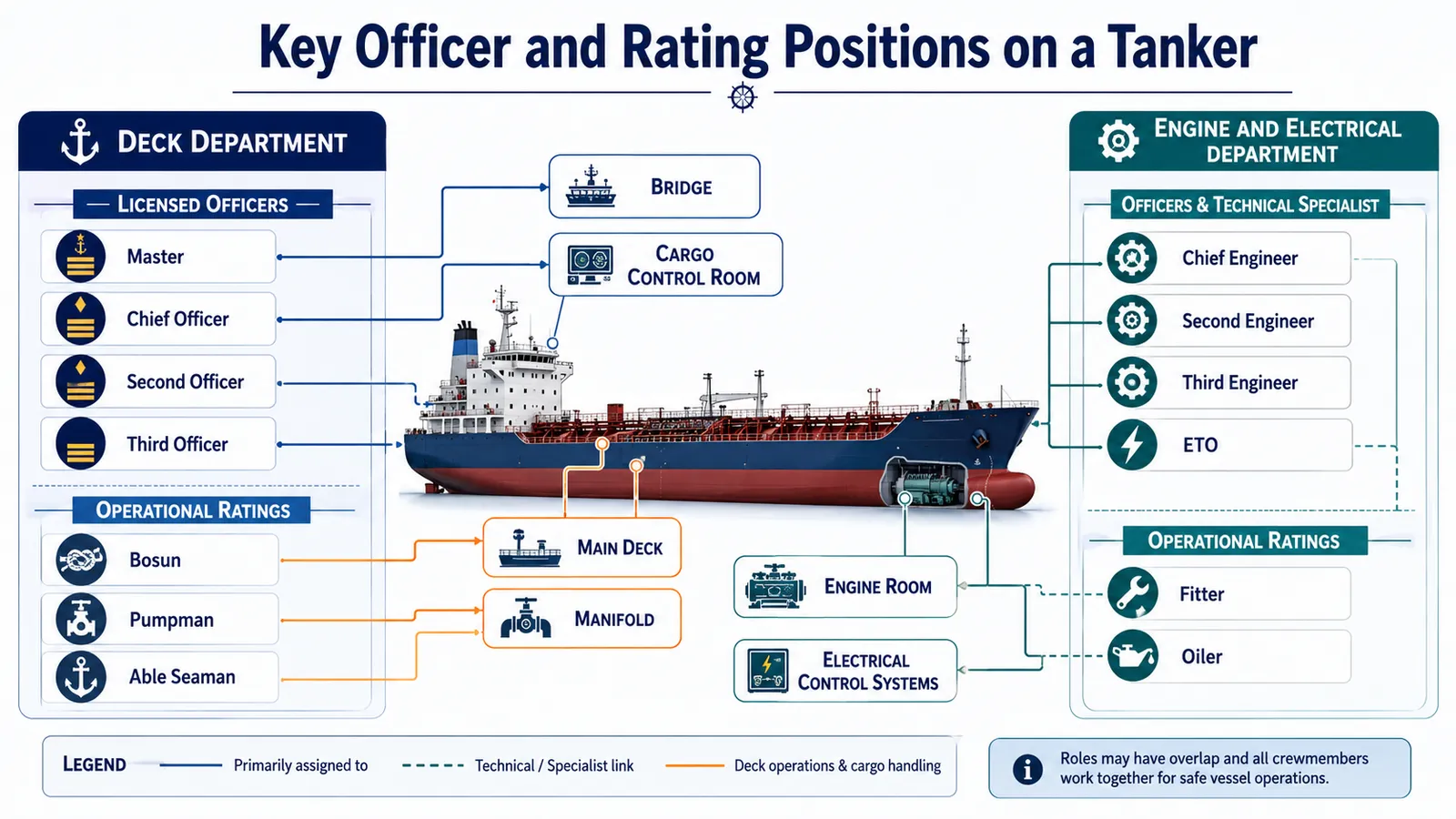
A tanker’s safe operation depends on a coordinated team of deck officers, engineers, electro-technical personnel, and ratings. Each position carries defined navigational, cargo, machinery, maintenance, or emergency responsibilities. Recruitment must therefore assess rank competence, tanker experience, certification, communication ability, and familiarity with the vessel’s specific cargo-handling and safety systems.
The number and composition of personnel onboard are determined through the vessel’s Minimum Safe Manning requirements, applicable flag State rules, ship design, automation level, trading pattern, cargo operations, and company procedures. IMO guidance makes clear that safe manning concerns not only the number of seafarers but also whether they are qualified and experienced enough to protect the ship, crew, cargo, property, and marine environment.
A Minimum Safe Manning Document should not be treated as an ideal operational staffing plan. It establishes the approved minimum, while the shipowner must still consider workload, maintenance demands, fatigue exposure, port frequency, cargo complexity, security duties, and emergency preparedness.
Master
The Master holds overall command of the tanker and ultimate responsibility for the safety of the vessel, crew, cargo, and marine environment. The Master must ensure that navigation, cargo operations, security, pollution-prevention measures, emergency procedures, and company policies are implemented effectively.
A tanker Master should normally demonstrate:
Valid certification and flag State recognition for command
Appropriate tanker training and endorsements
Sufficient command experience on the relevant tanker category
Familiarity with the company’s Safety Management System
Strong bridge resource management and decision-making skills
Understanding of terminal, charterer, vetting, and cargo requirements
Ability to lead emergency response and communicate with shore management
Knowledge of pollution-prevention and incident-reporting procedures
The ISM Code requires the company to ensure that the Master is properly qualified, fully familiar with the company’s Safety Management System, and given the support needed to perform command duties safely.
Recruiters should assess more than sea time. Leadership behaviour, safety judgement, communication style, previous inspection performance, incident history, and familiarity with comparable vessels can be equally important.
Chief Officer
The Chief Officer is usually the senior deck officer responsible for planning, supervising, and documenting cargo operations. On many tankers, this includes loading, discharging, ballasting, tank cleaning, cargo segregation, stability control, deck maintenance, and coordination with terminals and surveyors.
Depending on the vessel type, the Chief Officer may need detailed knowledge of:
Cargo plans and loading sequences
Stability, trim, stress, and draft limitations
Cargo pumps, pipelines, valves, manifolds, and monitoring systems
Inert gas or vapour-control arrangements
Tank cleaning and preparation
Cargo compatibility and segregation
Enclosed-space controls
Gas measurement and atmosphere monitoring
Pollution-prevention procedures
Ship-to-shore safety communication
Emergency shutdown and cargo-emergency procedures
Because the Chief Officer commonly holds immediate responsibility for cargo operations, the applicable advanced tanker training must match the vessel and cargo category. STCW distinguishes advanced training for oil tanker, chemical tanker, and liquefied gas tanker cargo operations.
Technical interviews for Chief Officers should include realistic operational scenarios rather than general questions. For example, the interviewer may test how the candidate would manage an unexpected pressure rise, cargo contamination risk, pump failure, leakage, loss of inert gas quality, cargo incompatibility concern, or emergency shutdown.
Deck Officers
The Second Officer and Third Officer support navigation, watchkeeping, safety equipment management, cargo watches, security duties, drills, and shipboard administration.
Their exact responsibilities depend on the company and vessel, but may include:
Passage planning and chart management
Navigational watchkeeping
Cargo watch duties
Safety-equipment inspections
Emergency-station responsibilities
GMDSS operations
Permit-to-work support
Security rounds and access control
Medical inventory or first-aid responsibilities
Recordkeeping and regulatory documentation
A deck officer recruited from another vessel sector may possess strong navigational competence but still need tanker-specific training, supervised familiarisation, and practical cargo-watch experience.
Chief Engineer
The Chief Engineer leads the engine department and is responsible for the reliable operation, maintenance, and safety of the vessel’s machinery and technical systems.
On a tanker, the Chief Engineer’s responsibilities may extend beyond propulsion and power generation to machinery supporting cargo operations, including:
Cargo pump drives
Hydraulic systems
Boilers and steam systems
Inert gas system machinery
Compressors and reliquefaction equipment
Cooling and heating systems
Gas-detection equipment
Emergency generators and fire pumps
Pollution-prevention equipment
Planned maintenance and spare-parts control
Recruitment should consider the candidate’s experience with the vessel’s propulsion plant, automation level, cargo-support machinery, fuel type, and maintenance-management system.
A Chief Engineer with strong experience on conventional oil tankers may not automatically be ready to lead the engineering department of an LNG or LPG carrier with specialised compressors, cryogenic equipment, gas-management systems, or dual-fuel machinery.
Second Engineer
The Second Engineer normally manages day-to-day engine-room operations under the Chief Engineer. This role often includes work allocation, planned maintenance, machinery inspections, defect monitoring, spare-parts coordination, and supervision of engineering ratings.
A suitable candidate should demonstrate:
Competence with the vessel’s main and auxiliary machinery
Experience supervising engine-room personnel
Familiarity with planned maintenance systems
Strong permit-to-work and isolation practices
Understanding of tanker-specific machinery
Emergency-response capability
Accurate defect reporting and maintenance records
Because the Second Engineer frequently controls daily technical execution, practical management ability is as important as the Certificate of Competency.
Electro-Technical Officer
The Electro-Technical Officer, commonly called the ETO, maintains and troubleshoots electrical, electronic, automation, communication, alarm, and control systems.
On modern tankers, the ETO may support:
Integrated automation systems
Cargo-control and monitoring equipment
Gas-detection systems
Emergency shutdown circuits
Electrical generation and distribution
Fire-detection and alarm systems
Navigation and communication equipment
Variable-frequency drives
Pump and compressor controls
High-voltage systems where fitted
ETO recruitment should be based on the actual equipment installed onboard. Experience with one automation or cargo-control platform may not transfer immediately to another without structured familiarisation.
Pumpman
The Pumpman is a specialist deck rating commonly associated with liquid-cargo operations. Although the exact position and duties vary across fleets, the Pumpman often supports the Chief Officer by maintaining and operating cargo pumps, valves, pipelines, manifolds, tank-cleaning equipment, and related deck machinery.
Typical responsibilities may include:
Preparing cargo lines and manifolds
Checking valves and pipeline alignments
Monitoring pump-room or cargo-equipment conditions
Supporting loading and discharge operations
Inspecting cargo-system components
Reporting leakage, vibration, pressure, or temperature abnormalities
Assisting with tank cleaning and line clearing
Maintaining cargo hoses, connections, and deck machinery
Participating in emergency and spill-response duties
Pumpman recruitment requires careful experience verification. A CV entry stating “tanker Pumpman” does not reveal whether the candidate worked on crude oil, product, chemical, or another tanker type, nor whether the cargo systems resemble those on the proposed vessel.
Able Seaman
An Able Seaman, or AB, performs navigational, mooring, cargo-watch, maintenance, security, and emergency duties under the direction of deck officers and senior ratings.
On tankers, ABs may be assigned to:
Gangway and security watches
Cargo-deck patrols
Manifold watches
Mooring and unmooring operations
Tank-cleaning support
Gas-testing assistance
Deck maintenance
Firefighting and spill response
Lifeboat and rescue-boat duties
Enclosed-space support teams
Recruiters should confirm whether the candidate’s tanker experience involved active cargo watches and safety-critical deck duties rather than only general maintenance.
Oiler
An Oiler supports engine-room watchkeeping, machinery inspections, lubrication, maintenance, cleaning, and emergency response.
Relevant tanker experience may include familiarity with:
Pumps and auxiliary machinery
Boiler and steam systems
Hydraulic equipment
Fuel and lubricating-oil systems
Pollution-prevention equipment
Machinery-space firefighting
Permit-to-work and lockout procedures
Engine-room rounds and defect reporting
An Oiler should understand the importance of immediately reporting leaks, unusual sounds, rising temperatures, pressure changes, or other signs of machinery failure.
Fitter
The Fitter performs fabrication, welding, cutting, mechanical repair, and structural maintenance. On tankers, this work requires strict compliance with hot-work controls, gas-free conditions, permits, isolations, fire watches, and company procedures.
Recruiters should verify:
Welding and fabrication competence
Previous vessel and tanker experience
Understanding of hot-work restrictions
Ability to interpret work instructions
Knowledge of personal protective equipment
Experience with pipe, valve, and structural repairs
Safety awareness in hazardous areas
The Fitter’s technical skill must never be separated from safe-work discipline. Improper hot work or uncontrolled repair activity can introduce serious ignition and exposure risks.
Position-specific recruitment matrix
| Position | Primary recruitment focus | Tanker-specific evidence |
|---|---|---|
| Master | Command, leadership, navigation and safety management | Comparable tanker command experience and applicable endorsement |
| Chief Officer | Cargo planning, stability and deck operations | Advanced tanker training and proven cargo-operation responsibility |
| Chief Engineer | Machinery leadership and technical reliability | Experience with comparable propulsion and cargo-support systems |
| Second Engineer | Daily engine-room management | Machinery, maintenance and supervisory experience |
| ETO | Electrical, automation and control systems | Familiarity with installed cargo and vessel-control technology |
| Pumpman | Cargo equipment and deck-system operation | Experience with comparable pumps, valves and pipelines |
| Able Seaman | Cargo watch, mooring and emergency duties | Relevant tanker deck experience and proficiency certification |
| Oiler | Engine-room support and machinery monitoring | Relevant watchkeeping and auxiliary-machinery experience |
| Fitter | Fabrication and technical repair | Proven competence plus strong permit-to-work awareness |
Shipowners seeking candidates for these positions should provide rank-specific requirements through the Tanker Crew Recruitment service page rather than issuing a general request for “experienced tanker crew.”
Types of Tankers and Their Crew Requirements
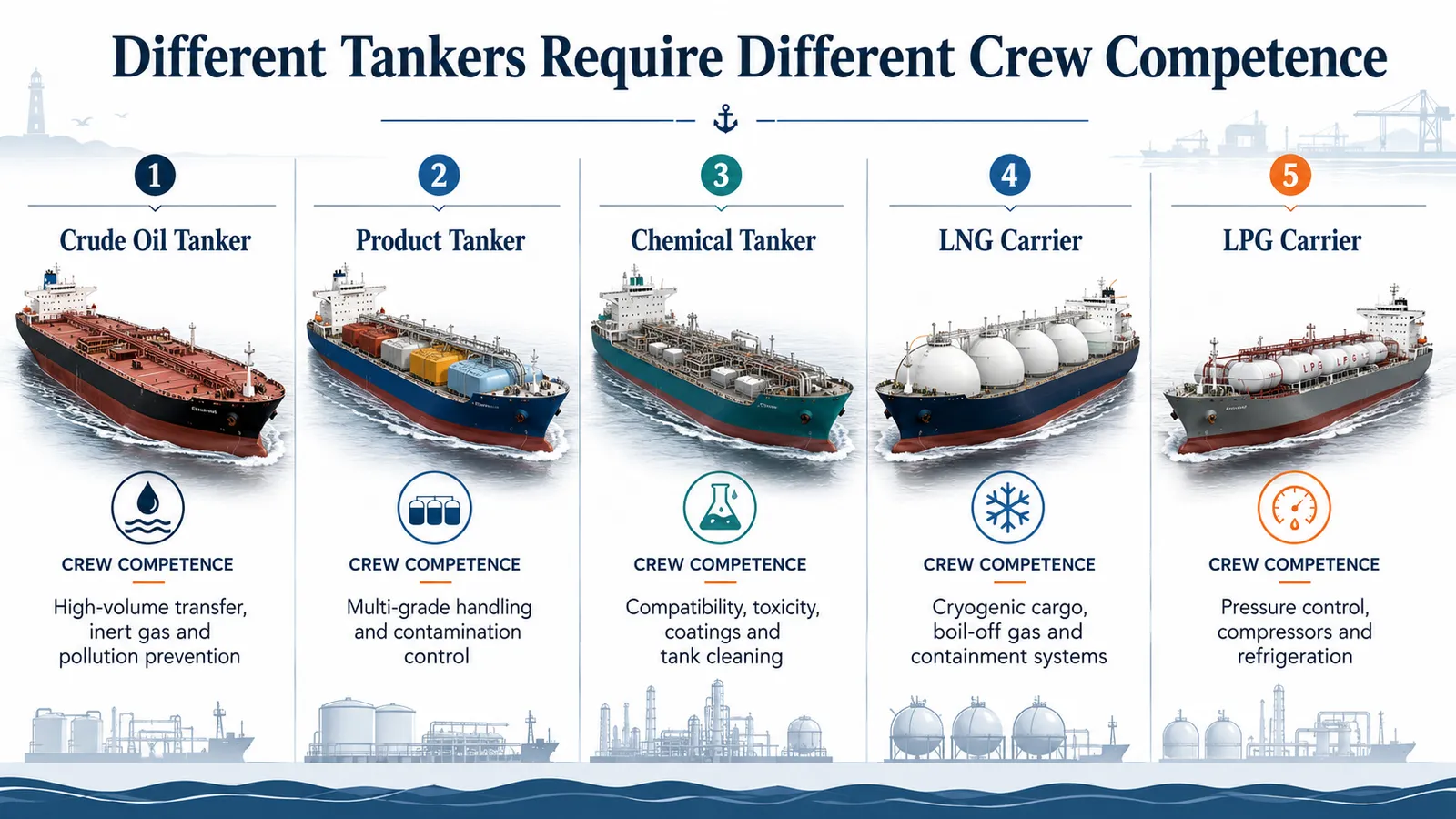
Different tanker categories require distinct combinations of cargo knowledge, certification, equipment familiarity, and operational experience. Crude oil, product, chemical, LNG, and LPG tankers cannot be crewed through one generic experience standard. Recruitment criteria must reflect cargo hazards, containment arrangements, transfer systems, tank preparation, operating pressures, temperatures, and each seafarer’s assigned responsibility.
Crude Oil Tankers
Crude oil tankers transport unrefined petroleum in bulk. Their operations may involve large cargo volumes, high-capacity pumping systems, inert gas arrangements, tank washing, vapour management, ballast operations, and strict pollution controls.
Recruitment priorities commonly include:
Previous service on crude oil tankers of comparable size
Experience with cargo pumps and pipeline arrangements
Understanding of inert gas operations
Familiarity with loading and discharge planning
Tank atmosphere and gas-monitoring competence
Knowledge of crude-oil washing where applicable
Pollution-prevention and spill-response discipline
Experience coordinating with large terminals
Experience should also be assessed by vessel scale. Operating an Aframax, Suezmax, or very large crude carrier may involve different cargo rates, terminal interfaces, manoeuvring conditions, workloads, and system complexity.
Product Tankers
Product tankers carry refined petroleum products and may trade more frequently between ports while transporting different cargo grades.
Their crewing requirements often emphasise:
Cargo segregation
Contamination prevention
Line and tank preparation
Frequent loading and discharge operations
Accurate sampling and documentation
Tank-cleanliness awareness
Cargo-switching discipline
Efficient port-turnaround management
A seafarer may have broad “oil tanker” experience but limited exposure to multi-grade product operations. Recruiters should examine the number of grades handled, tank configuration, coating type, cargo frequency, and the candidate’s actual responsibilities.
Chemical Tankers
Chemical tankers carry dangerous chemicals and noxious liquid substances subject to detailed construction, equipment, cargo, and environmental requirements. The IBC Code establishes international standards for their safe carriage and identifies cargo hazards and the ship types required for specific products.
Chemical tanker recruitment requires particularly detailed screening because the candidate may need knowledge of:
Cargo compatibility and segregation
Toxicity, corrosivity and reactivity
Tank-coating limitations
Stainless-steel cargo tanks where fitted
Tank-cleaning sequences
Wall-wash or cleanliness requirements
Heating and temperature control
Inhibited or sensitive cargoes
Personal protective equipment
Closed loading and vapour-return systems
Product-specific emergency procedures
Cargo documentation and safety information
“Chemical tanker experience” is not sufficiently precise. The interviewer should establish the products carried, vessel type, tank materials, cargo systems, cleaning responsibilities, and level of operational authority.
LNG Carriers
LNG carriers transport liquefied natural gas at extremely low temperatures using specialised containment, transfer, monitoring, and emergency systems. They fall within the regulatory framework for ships carrying liquefied gases in bulk under the IGC Code.
Recruitment may require experience with:
Cryogenic cargo behaviour
Cargo containment systems
Boil-off gas management
Cargo compressors
Vapour return
Emergency shutdown systems
Gas detection
Cargo heating or vaporisation arrangements where fitted
Reliquefaction or gas-management systems
Dual-fuel propulsion where applicable
Strict terminal communication procedures
The required competence varies significantly between vessel designs. Experience on one LNG containment or propulsion system should not automatically be treated as full familiarity with every LNG carrier.
LPG Carriers
LPG carriers transport liquefied petroleum gases and may be fully pressurised, semi-pressurised, refrigerated, or designed for specialised gas cargoes. Crew requirements should match the vessel’s containment system, cargo plant, pressure range, refrigeration equipment, and trading pattern.
Important recruitment factors include:
Gas-tanker training and endorsements
Cargo compressor experience
Refrigeration or reliquefaction knowledge
Pressure and temperature control
Purging, inerting and gas-freeing familiarity
Emergency shutdown-system competence
Gas detection and exposure control
Cargo-specific knowledge
Experience with the same or similar carrier design
LNG and LPG service should not be treated as identical. Both involve liquefied gases, but the cargo properties, operating conditions, plant configurations, and procedures can differ substantially.
Tanker-type recruitment comparison
| Tanker type | Core operational focus | Recruitment priority |
|---|---|---|
| Crude oil tanker | High-volume petroleum transfer, inert gas and pollution prevention | Comparable vessel size and crude-cargo experience |
| Product tanker | Multiple grades, segregation and contamination control | Frequent cargo-operation and tank-preparation experience |
| Chemical tanker | Compatibility, toxicity, coatings and cleaning standards | Product-specific knowledge and advanced chemical training |
| LNG carrier | Cryogenic containment and gas-management systems | LNG plant, containment and emergency-system familiarity |
| LPG carrier | Pressure, refrigeration and liquefied-gas handling | Experience with the relevant gas-carrier configuration |
Where tanker operations form part of a broader fleet requirement, internal links to Bulk Carrier Crew Supply, Offshore Crew Manning, and other vessel-specific services should remain separate. Cross-sector experience can be valuable, but it should not replace tanker-specific competence.
Challenges in Tanker Crew Recruitment
Tanker recruitment is difficult because certification, practical experience, availability, vessel compatibility, and deployment readiness must align at the same time. The main challenges include shortages within specialised candidate pools, complex compliance checks, weak experience verification, retention problems, urgent relief needs, documentation delays, and pressure to mobilise candidates without compromising safety or recruitment standards.
Limited pools of specialised experience
A shipowner may receive many applications for a rank but still find very few candidates who match the full requirement.
The available pool becomes narrower when the request includes:
A specific tanker type
Minimum experience in rank
Comparable vessel size
Particular cargo-system experience
Flag State acceptance
Advanced tanker certification
A fixed joining date
A difficult visa or travel route
A short contract
Previous experience with the company or vessel
This is why counting CVs is a poor measure of recruitment capability. The relevant metric is the number of verified, available, medically fit, properly certified, and operationally suitable candidates.
Certification and compliance complexity
The company must ensure that each ship is manned with qualified, certificated, medically fit, and appropriately experienced personnel. This responsibility remains with the operator even where an external recruitment agency performs sourcing and documentation support.
A compliant recruitment review may need to reconcile:
STCW certificates
Rank and capacity limitations
Oil, chemical or gas tanker endorsements
Flag State recognition
Medical fitness
Security training
Passport and seafarer-book validity
Safe-manning requirements
Employment agreements
Company familiarisation
Visa and port-entry requirements
Certificate-expiry dates during the contract
Ethical recruitment must also follow MLC 2006 requirements governing seafarer recruitment and placement. These include accountable employment services and restrictions on charging recruitment or placement fees to seafarers, subject to the specific document-cost exceptions stated in the Convention.
Verifying genuine operational experience
Certificates can be checked against issuing authorities, but operational competence is more difficult to establish.
Common weaknesses in candidate assessment include:
Vague vessel descriptions
Inflated responsibility claims
Unclear rank history
Missing discharge-book entries
Unverified references
Experience on a different tanker subtype
Long absence from tanker service
Limited recent cargo involvement
Memorised interview answers without practical understanding
A robust verification process should compare the CV, seaman’s record book, certificates, appraisal reports, reference responses, and interview answers. Dates, vessel names, ranks, tanker types, and employers should be consistent.
Scenario-based interviewing is particularly valuable. Candidates should explain how they would respond to realistic operational conditions rather than simply define technical terms.
Retaining experienced tanker personnel
Recruitment pressure increases when qualified officers and ratings do not return after completing a contract.
Retention may be affected by:
Unpredictable relief
Poor communication
Delayed wages
Unclear promotion paths
Repeated contract extensions
Weak onboard leadership
Unsuitable rotations
Welfare concerns
Travel problems
Assignment to unfamiliar vessels without adequate support
Retention should therefore begin during recruitment. The seafarer must receive accurate information about the vessel, rank, wages, contract length, joining arrangements, trading area, and expected duties.
Misrepresenting an assignment may fill one vacancy quickly, but it damages trust and makes future crew planning more difficult.
Emergency replacements
Emergency vacancies can arise from illness, medical failure, family emergencies, visa refusal, missed travel, disciplinary removal, certificate problems, or sudden resignation.
The central challenge is balancing speed with compliance. An urgent replacement still needs:
Correct certification
Relevant tanker experience
Medical fitness
Document verification
Flag acceptance
Travel readiness
Visa clearance
Technical approval
Clear joining instructions
A practical emergency-response system maintains pre-screened candidate pools by rank, tanker type, current location, document status, and availability. It also identifies alternative joining ports and realistic travel routes before the vacancy becomes critical.
Shipowners requiring urgent relief may use the internal Crew Change Services page to coordinate travel and port logistics alongside recruitment.
Matching candidates to the company, not only the vessel
Two tankers of similar type may operate under different procedures, equipment standards, reporting systems, charterer expectations, and organisational cultures.
Recruitment should therefore evaluate:
English and working-language ability
Safety attitude
Reporting discipline
Ability to use digital systems
Leadership or teamwork style
Familiarity with multinational crews
Willingness to follow company procedures
Ability to learn unfamiliar equipment
Previous appraisal and re-employment status
The technically strongest candidate is not always the best assignment match. A successful placement combines competence, professional conduct, adaptability, and compatibility with the vessel’s operating environment.
Documentation and deployment delays
A candidate may pass technical selection but still miss the vessel because of:
Expired documents
Slow flag endorsement
Medical restrictions
Visa delays
Unavailable flights
Port-entry limitations
Incomplete employment paperwork
Late ticket approval
Poor coordination between vessel, agency, owner, and local port representatives
Deployment planning should begin as soon as a candidate enters the final selection stage. Document checks, medical arrangements, endorsement applications, travel options, and relief-port requirements should proceed through a controlled checklist.
Maintaining recruitment quality under commercial pressure
The most serious recruitment risk appears when operational urgency causes decision-makers to weaken their own standards.
Warning signs include:
Accepting unexplained employment gaps
Skipping reference checks
Treating similar tanker types as equivalent
Approving expired or incomplete documents
Ignoring weak interview performance
Selecting solely on salary
Mobilising before flag approval
Reducing familiarisation to save time
A professional recruitment partner should communicate clearly when a candidate does not meet the requirement, even when the vessel’s joining date is approaching.
Shipowners can reduce these risks by issuing complete crew specifications, maintaining realistic relief windows, approving candidates promptly, and building long-term pools through a structured Seafarer Recruitment Services programme. For urgent or planned tanker vacancies, Ship Crew Agency can support candidate sourcing, technical screening, documentation verification, deployment, and crew-change coordination without separating speed from compliance.
Why Many Shipowners Recruit Bangladeshi Tanker Seafarers
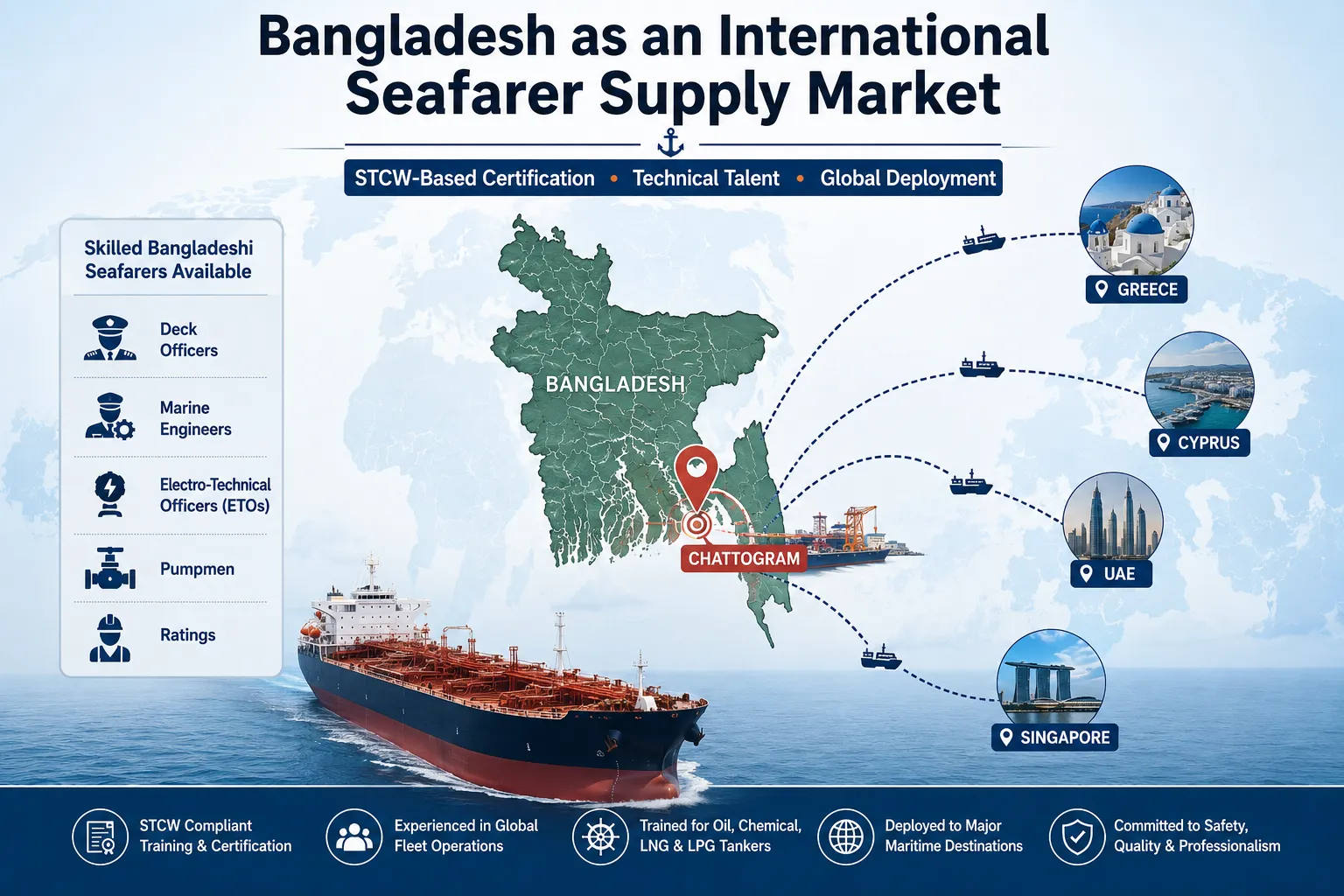
Many shipowners consider Bangladesh a practical source of tanker officers and ratings because it combines maritime training infrastructure, STCW-based certification, digital certificate-verification systems, and access to seafarers across deck, engine, electrical, and rating positions. However, nationality alone never proves competence; every candidate must still undergo vessel-specific screening, verification, and technical assessment.
Bangladesh has a long maritime tradition centred around Chattogram, the country’s principal seaport and an important base for maritime education, crewing, ship management, and seafarer deployment. Its seafarer population includes Masters, deck officers, marine engineers, Electro-Technical Officers, Pumpmen, Bosuns, Able Seamen, Oilers, Fitters, and catering personnel with experience across international vessel types.
For tanker operators in Greece, Singapore, the UAE, Cyprus, and other major shipping markets, Bangladesh can provide an additional recruitment channel when established labour markets cannot meet rank, experience, availability, or rotation requirements.
The commercial case should not be framed as finding the cheapest crew. It should be evaluated through five factors: competence, compliance, total employment cost, retention potential, and deployment reliability.
STCW-Based Certification and Verifiable Records
Bangladesh issues maritime Certificates of Competency and Certificates of Proficiency through its national maritime administration. The Department of Shipping provides online verification facilities for both categories, allowing recruiters and ship managers to check certificate records rather than relying only on scanned documents submitted by candidates.
Bangladesh also maintains a Government Shipping Office Seafarer Management System, while the Department of Shipping publishes information about countries that recognise Bangladesh-issued certificates under STCW arrangements.
These systems can improve administrative traceability, but they do not remove the need to check:
The certificate’s issuing authority and authenticity
Rank, capacity, limitations, and expiry date
Oil, chemical, or liquefied-gas tanker endorsements
Flag State recognition requirements
Sea service supporting the endorsement
Recent experience on the proposed tanker category
Medical fitness and security-training status
A verified certificate establishes that a credential exists. It does not establish that the seafarer is operationally suitable for a particular vessel.
Access to Officers and Ratings
Bangladesh can support recruitment across complete tanker departments rather than only entry-level positions.
Potential candidates may include:
| Department | Typical tanker positions |
|---|---|
| Deck | Master, Chief Officer, Second Officer and Third Officer |
| Engine | Chief Engineer, Second Engineer, Third Engineer and Fourth Engineer |
| Electrical | Electro-Technical Officer and electrical ratings |
| Deck ratings | Bosun, Pumpman, Able Seaman and Ordinary Seaman |
| Engine ratings | Oiler, Motorman, Fitter and Wiper |
| Catering | Chief Cook, Cook, Steward and Messman |
The practical advantage for a fleet operator is the ability to develop a structured national crew pool. Instead of recruiting unrelated individuals for each vacancy, the company can build planned rotations of officers and ratings who understand its procedures, reporting standards, safety culture, and performance expectations.
Commercial Cost Efficiency
Bangladeshi recruitment can be commercially attractive when shipowners compare the total cost of crewing rather than basic wages alone.
A meaningful cost assessment should include:
Contract wages and leave pay
Employer contributions and insurance
Flights and domestic travel
Visa and flag-document expenses
Medical examinations
Training and familiarisation
Recruitment administration
Crew-change costs
Early repatriation exposure
Replacement and retraining costs
Retention across future contracts
A candidate with the lowest wage expectation may become the most expensive placement if the person fails an assessment, misses the vessel, cannot obtain the required visa, requires early relief, or lacks sufficient tanker competence.
Cost efficiency therefore comes from correct matching, dependable contract completion, documentation readiness, and reduced repeat recruitment. It must never be achieved by transferring prohibited recruitment charges to seafarers. MLC 2006 generally prohibits seafarer recruitment or placement fees from being borne directly or indirectly by the seafarer, subject to limited document-related exceptions set out in the Convention.
Retention Potential
Bangladeshi officers and ratings can form part of a stable crew-retention programme when the shipowner offers transparent contracts, predictable relief, timely wages, fair treatment, welfare support, and realistic promotion opportunities.
Retention should not be presented as an automatic characteristic of any nationality. It is the result of employment quality and relationship management.
A retention-focused strategy should include:
Accurate vessel and contract information before acceptance
Clear wage, leave, overtime, and allotment arrangements
Reliable relief at the agreed contract end
Constructive onboard performance appraisals
Training support before promotion
Regular communication during leave periods
Early planning for the next assignment
Consistent treatment across nationalities
When reliable seafarers return to the same fleet, the operator gains continuity in procedures, equipment knowledge, maintenance history, cargo practices, and onboard leadership.
Operational Reliability
Operational reliability is created through the recruitment process, not assumed from a passport.
Bangladeshi tanker seafarers can become dependable fleet members when recruitment confirms:
Relevant tanker-type experience
Recent cargo-operation involvement
Correct STCW tanker certification
Suitable English communication
Strong safety and reporting behaviour
Compatibility with multinational teams
Readiness for the proposed rotation
Acceptance of company policies and working conditions
Shipowners should also review re-employment recommendations, previous appraisal reports, incident records, training gaps, and reasons for leaving former employers.
The strongest commercial argument for recruiting from Bangladesh is therefore not that every Bangladeshi seafarer is suitable. It is that Bangladesh provides a potentially valuable seafarer pool from which qualified tanker personnel can be identified through disciplined selection.
How Ship Crew Agency Supports Tanker Recruitment
Ship Crew Agency supports tanker recruitment by translating a shipowner’s vessel, cargo, rank, and joining requirements into a controlled sourcing and deployment process. Its service model includes candidate screening, certificate checks, sea-service verification, reference review, vessel-type matching, communication assessment, documentation assistance, medical coordination, travel planning, and post-placement feedback.
From its Chattogram office, Ship Crew Agency positions itself as a maritime recruitment and manning partner for shipowners, tanker operators, fleet managers, and ship management companies. Its website identifies Government Manning Licence No. MLA-0108 and lists oil tankers, chemical tankers, and LNG/LPG carriers among the vessel categories for which clients can submit crew requirements.
1. Defining the Tanker Crew Requirement
Recruitment begins with a detailed crew requisition rather than a general request for CVs.
The shipowner or crewing manager should provide:
Tanker type and vessel particulars
Flag and classification details
Required ranks
Minimum experience in rank
Required tanker endorsements
Cargoes normally carried
Cargo and machinery systems
Trading area
Contract length and rotation
Wage structure
Joining port and date
Visa or flag-document requirements
Company, charterer, or vetting criteria
This information allows the agency to distinguish between a candidate who is generally qualified and one who is suitable for the exact assignment.
2. Candidate Sourcing
Ship Crew Agency can search its available network for officers and ratings whose profiles correspond to the tanker category, rank, experience level, availability, and deployment route.
Candidate sourcing may cover:
Planned crew rotations
Individual officer or rating vacancies
Full or partial crew requirements
New vessel mobilisation
Fleet expansion
Sickness or compassionate relief
Last-minute replacement
Long-term crew-pool development
For emergency requirements, the agency should prioritise candidates whose essential documentation, medical status, availability, and tanker experience can be confirmed quickly.
3. Preliminary Screening
Preliminary screening removes candidates who do not meet the assignment’s essential conditions.
The review may assess:
Rank and department
Tanker category
Time in rank
Recent sea service
Vessel size and machinery
Cargo-operation exposure
Tanker endorsements
Flag eligibility
Joining availability
Wage and contract acceptance
Travel-document readiness
Only candidates meeting the mandatory criteria should proceed to detailed assessment.
4. Certificate and Document Verification
The documentation stage should verify authenticity, validity, applicability, and consistency.
Relevant records may include:
Certificate of Competency
Certificate of Proficiency
Tanker training endorsements
GMDSS certificate
Security training
Advanced firefighting
Survival craft training
Medical first aid or medical care
Passport
Continuous Discharge Certificate or seaman’s book
Medical fitness certificate
Vaccination or health documentation where required
Flag State endorsement
Previous contracts and sea-service testimonials
Names, dates of birth, certificate numbers, ranks, vessel records, and employment dates should agree across the candidate’s documentation.
5. Sea-Service and Experience Verification
Sea-service verification should establish what the candidate actually did onboard.
A tanker candidate’s records should be examined for:
Vessel name and IMO number
Tanker subtype
Deadweight or vessel size
Cargoes carried
Rank served
Sign-on and sign-off dates
Employer or manager
Cargo-system exposure
Machinery or propulsion experience
Reason for leaving
Eligibility for re-employment
Where possible, information should be checked through discharge-book entries, employer records, sea-service letters, appraisal reports, references, and technical interviews.
6. Technical and Behavioural Assessment
Technical screening should be rank-specific and tanker-specific.
A Chief Officer may be assessed on cargo planning, stability, segregation, tank cleaning, inert gas, cargo emergencies, and pollution prevention. A Chief Engineer may be assessed on propulsion, cargo-support machinery, boilers, compressors, inert gas equipment, automation, and emergency systems.
Ratings should also be tested at the level of their assigned duties. A Pumpman should be able to discuss pipelines, valves, pumps, manifolds, leakage detection, and cargo-watch responsibilities. An Able Seaman should understand mooring, cargo-deck watches, enclosed-space controls, and emergency duties.
Behavioural assessment should cover:
Safety attitude
Reporting integrity
Communication
Teamwork
Leadership
Response to authority
Stop-work judgement
Cultural adaptability
Ability to learn unfamiliar systems
7. Documentation, Medical and Deployment Support
After selection, Ship Crew Agency can coordinate employment and deployment documentation, medical arrangements, flag requirements, visas, flights, joining instructions, and communication with the shipowner or port agent.
Its Crew Change Services page states that its service covers crew rotation logistics, documentation, visas, travel, accommodation, port-agent coordination, and embarkation or repatriation support.
Deployment should follow a final readiness checklist confirming that:
Employment terms have been accepted
Medical clearance remains valid
Required certificates are onboard-ready
Flag documents are approved
Visas and transit permissions are complete
Flights match the vessel schedule
Joining instructions are understood
The port agent has confirmed arrangements
The vessel has received the candidate’s documents
Handover and familiarisation are planned
8. Crew Change and Post-Placement Follow-Up
A successful placement includes handover, familiarisation, performance monitoring, and future rotation planning.
Post-placement feedback can identify:
Training needs
Equipment-familiarisation gaps
Communication concerns
Leadership strengths
Promotion potential
Re-employment suitability
Preferred vessel types
Future availability
This creates a better-qualified candidate pool for subsequent assignments and supports long-term crew retention.
Shipowners needing tanker officers, engineers, Pumpmen, ETOs, and ratings can discuss their vessel particulars, required ranks, tanker type, joining port, and target date with Ship Crew Agency before requesting a shortlist.
Frequently Asked Questions About Tanker Crew Recruitment
Tanker recruitment questions usually concern certification, vessel experience, screening, deployment time, medical fitness, flag approval, and emergency replacement. The answers below explain the practical standards shipowners should apply when selecting officers and ratings for oil, chemical, product, LNG, and LPG tankers.
1. What is tanker crew recruitment?
Tanker crew recruitment is the process of sourcing, screening, verifying, selecting, and deploying officers and ratings for oil, product, chemical, LNG, or LPG tankers. The process must match each candidate’s certification, sea service, cargo experience, rank competence, medical fitness, and availability to the requirements of a specific vessel.
2. How is tanker recruitment different from general ship recruitment?
Tanker recruitment requires cargo-specific competence and certification beyond general navigational or engineering qualifications. Recruiters must consider hazardous-cargo exposure, tanker endorsements, cargo-handling responsibilities, vessel systems, tank preparation, pollution prevention, emergency response, and recent service on the relevant tanker category.
3. What STCW certificates do tanker seafarers need?
Requirements depend on rank and duties. Personnel assigned cargo-related responsibilities may require basic oil and chemical tanker training or basic liquefied-gas tanker training. Masters, Chief Officers, Chief Engineers, Second Engineers, and others with immediate cargo responsibility may require the applicable advanced tanker certification under STCW regulations V/1-1 or V/1-2.
4. Can an oil tanker officer work on a chemical tanker?
It's depend on the consideration of shipowner or Ship Superintendent by consider the CV and talk with officers. but The officer must hold the required chemical tanker certification. Oil and chemical tanker operations overlap in some areas, but chemical tankers introduce cargo compatibility, toxicity, reactivity, tank-coating, contamination, cleaning, and product-specific protection requirements.
5. Are LNG and LPG tanker qualifications the same?
Both fall within liquefied-gas tanker training requirements, but LNG and LPG operations are not identical. Cargo properties, containment systems, operating pressure, temperature, compressors, refrigeration, boil-off management, and propulsion arrangements may differ. Recruitment should match the candidate to the actual gas-carrier type and installed cargo plant.
6. Which tanker crew positions are commonly recruited?
Common positions include Master, Chief Officer, Second Officer, Third Officer, Chief Engineer, Second Engineer, Third Engineer, Fourth Engineer, ETO, Bosun, Pumpman, Able Seaman, Ordinary Seaman, Oiler, Motorman, Fitter, Wiper, Chief Cook, and Steward.
7. How should tanker experience be verified?
Recruiters should compare the CV with the seaman’s book or CDC, sea-service testimonials, certificates, contracts, appraisal reports, vessel particulars, and employer references. Technical interviews should confirm the candidate’s actual responsibilities, cargoes handled, equipment used, and response to realistic operating scenarios.
8. How long does tanker crew deployment take?
There is no universal deployment time. It depends on candidate availability, medical status, certificate verification, flag endorsement, visa processing, flight access, port-agent arrangements, and the joining location. Pre-screened candidates may be mobilised faster, but recruitment quality and compliance should never be bypassed to meet a target date.
9. Can tanker crew be supplied for emergency replacements?
Yes, provided a suitable candidate is available and all essential checks can be completed. Emergency replacement should apply the same standards for certification, medical fitness, tanker experience, flag acceptance, identity, and travel readiness as planned recruitment.
10. What information should a shipowner provide when requesting tanker crew?
The request should include vessel type, flag, size, required ranks, tanker endorsements, minimum experience, cargo profile, cargo system, contract terms, wage range, joining port, joining date, trading area, visa requirements, and any company or charterer assessment criteria.
11. Do tanker seafarers need a valid medical certificate?
Yes. Seafarers must be medically fit for their assigned duties. The certificate should be valid, issued under an accepted system, suitable for the proposed capacity, and free from restrictions that conflict with routine or emergency responsibilities.
12. Can a valid tanker certificate replace practical experience?
No. Certification confirms completion of specified training or competence requirements, but it does not prove recent experience with a particular tanker, cargo, vessel size, cargo plant, or level of responsibility. Certification and operational experience must be assessed together.
13. Why recruit tanker seafarers from Bangladesh?
Bangladesh offers access to officers and ratings supported by national maritime certification and online certificate-verification systems. It can provide an additional recruitment source for international fleets, but every candidate must be assessed individually for competence, compliance, communication, experience, and assignment readiness.
14. Does Ship Crew Agency handle crew-change logistics?
Ship Crew Agency states that it coordinates crew-change documentation, travel, visas, accommodation, joining arrangements, port-agent liaison, embarkation, and repatriation support. The exact scope should be confirmed for the specific port, flag, nationality, and deployment route.
15. How can shipowners improve tanker crew retention?
Retention improves when employment terms are accurate, wages are paid on time, rotations are predictable, relief occurs as agreed, onboard leadership is professional, performance feedback is constructive, and promotion or training pathways are clear.
Conclusion: Build Tanker Competence Before Filling Tanker Vacancies
Effective tanker crew recruitment is not measured by how many CVs an agency sends or how cheaply a vacancy is filled. It is measured by whether the selected seafarer is properly certified, medically fit, operationally competent, vessel-compatible, documentation-ready, and capable of supporting safe cargo operations throughout the contract.
Oil, product, chemical, LNG, and LPG tankers require different combinations of cargo knowledge, technical experience, certification, and emergency competence. Shipowners should therefore resist generic recruitment methods that treat all tanker service as interchangeable.
A strong tanker recruitment system connects:
Precise crew specifications
Vessel-specific sourcing
Certificate authentication
Sea-service verification
Technical interviews
Medical and flag compliance
Travel and crew-change planning
Onboard familiarisation
Performance feedback
Long-term retention planning
Bangladesh can be a valuable source of tanker officers, engineers, ETOs, Pumpmen, and ratings when candidates are evaluated individually and recruited through a controlled, MLC-aligned process.
Ship Crew Agency supports shipowners, tanker operators, fleet managers, and ship management companies seeking qualified Bangladeshi seafarers for planned rotations, individual vacancies, complete crew requirements, and urgent replacements.
To begin a tanker recruitment discussion, provide:
Vessel and tanker type
Flag
Required ranks
Required tanker endorsements
Minimum tanker and rank experience
Cargo or cargo-system requirements
Joining port
Target joining date
Contract and rotation details
Submit these details through the Ship Crew Agency crew inquiry page to request an assignment-specific candidate search rather than a generic seafarer list.