 Ship Crew Agency
Maritime Editorial Team
In This Article
- Why a Bad Crew Hire Can Detain Your Ship Overnight
- Quick Answer: The Recruitment Path That Fits Your Situation
- The Three Ways to Put Crew on Your Ship (And Why They Work Differently)
- Manning Agency: The Outsourced HR Engine
- Direct Recruitment: Full Control, Full Responsibility
- Online Seafarer Platforms: Speed with a DIY Risk
- Recruitment Channels Compared: What You Actually Get for the Money
- The Scenario Matrix: Which Method Matches Your Real Need
- Agency vs. Direct Recruitment: Where Each One Wins and Loses
- Where a Manning Agency Wins
- Where Direct Recruitment Wins
- When You Need Both: The Hybrid Approach That Actually Works
- The Step-by-Step Recruitment Process (From Requisition to Gangway)
- The Compliance Killers: Why Most Crew Documentation Fails
- Endorsement Scope, Not Just Validity
- Medical Certificate Expiry Windows
- Missing Digital Backup
- Agency Verification Without Spot Checks
- What a Detention-Ready Recruitment Process Costs
- Expert Tips: How to Verify a Seafarer's Documents Like a Port State Inspector
- Building a Repeatable Crew Recruitment System That Scales
- Your Next Hire: A Decision Map That Won't Let You Down
- Frequently Asked Questions
- How long does the crew recruitment process take?
- What documents must a seafarer provide before joining?
- Can a manning agency handle all compliance checks?
- What happens if a crew member's certificate expires mid-voyage?
- How do I hire crew for a vessel under a new flag state?
Most ship operators learn the hard way that the ship crew recruitment process isn't another HR job. A single expired STCW endorsement, a gap in medical certification, or an unflagged endorsement can trigger a port state detention that costs tens of thousands per day. Your manning agent won't stand next to you during the inspection.
You will.
Under the STCW Convention and MLC 2006, the shipowner carries the full legal weight for crew competency and documentation. As of 2026, port state control data across the Paris MoU and Tokyo MoU still ranks crew certification as one of the top three detainable deficiencies. A safe crew recruitment process is not a paperwork exercise.
It is your first line of defense against a vessel sitting idle at anchor under a detention order.
Why a Bad Crew Hire Can Detain Your Ship Overnight
Port state control inspectors don't guess. They walk on board with a checklist, and they start by asking the master for certificates of competency, flag endorsements, and medical fitness certificates for every officer. If the second engineer's tanker endorsement expired three weeks ago, the inspector can stop the ship.
It doesn't matter that a manning agency assured you everything was current. The vessel stays put until a compliant replacement arrives.
Detention costs pile up fast. You lose charter hire. You eat port charges.
Cargo gets delayed. Your next port call might face tighter scrutiny because a detention triggers an expanded inspection when you arrive in another Paris MoU country. The crew recruitment process is not just about filling bunks.
It is about building a compliance firewall that holds up under inspection, every single time.
Many detentions come down to two simple failures. Someone didn't verify the endorsement scope, or someone let a medical certificate run too close to its expiry date. The fix is a recruitment path that puts document verification at the centre, not at the edge.
When you understand the regulatory checks that matter, you stop treating crewing as a procurement job and start treating it as a safety function.
Quick Answer: The Recruitment Path That Fits Your Situation
The ship crew recruitment process changes with urgency, fleet size, and role risk. Use a niche manning agency when you need a senior officer fast. In-house recruitment saves money for high-volume ratings hiring.
Full-crew management transfers compliance liability away from your team. Blended channels cover specialist roles best.
The Three Ways to Put Crew on Your Ship (And Why They Work Differently)
Before you can build a compliant process, you need to understand the three mechanisms that actually deliver seafarers to your gangway. Each one works on a different incentive, and each one shifts the verification burden in a different direction.
Manning Agency: The Outsourced HR Engine
A manning agency acts as your extended crewing department. Good agencies maintain pools of pre-screened seafarers, run their own training, and handle everything from document checking to flight bookings. They are built to fill roles quickly and to keep track of certificate renewals so you don't have to.
The key mechanical advantage of an agency is speed. When a master walks off with zero notice, an agency can tap a ready-to-sail candidate from its bench within days. You pay a placement fee, usually one to two months' gross salary, plus a monthly management fee per seafarer.
In exchange, the agency shoulders the upfront verification and logistics, which takes the pressure off your crewing team.
The risk sits in the quality of that verification. Not all agencies dig deep. Some stop at a quick glance at the document date without checking whether the endorsement covers the specific vessel type.
If you are looking at full crew management services, ask how they cross-reference flag database entries, not whether they "check certificates." The answer tells you everything.
Direct Recruitment: Full Control, Full Responsibility
Shipowners with stable fleets and predictable manning requirements often bring recruitment in-house. A dedicated crewing manager sources seafarers through academies, union halls, referrals, and direct outreach. The paperwork chain stays completely inside your control.
The big upside is compliance depth. Nobody checks documents more carefully than the person who will sit in front of a port state inspector. Your team verifies every STCW endorsement against the flag administration, confirms sea service against discharge books, and builds a document vault that belongs to you, not an external agent.
Over time, direct recruitment also costs less per hire when you are moving dozens of ratings and officers every quarter.
The downside is administrative weight. Flag-state endorsement applications, visa logistics, and medical appointment tracking all fall on your desk. Without a rigorous verification workflow, the load can outpace your team's capacity and lead to exactly the oversights you were trying to avoid.
Online Seafarer Platforms: Speed with a DIY Risk
Digital crewing platforms let you post vacancies and match with seafarers who maintain online profiles with uploaded certificates. They are fast and often cheaper than a full-service agency. For hard-to-fill specialist roles, they can surface candidates you would never find through a traditional agent.
But the verification risk stays entirely with you. The platform might flag that a certificate looks valid based on its date, but it won't check the scope of the endorsement or confirm the medical certificate's issuing authority against the flag state's approved list. Think of the platform as a sourcing accelerator, not a compliance partner.
The document validation step must still happen inside your team.
Recruitment Channels Compared: What You Actually Get for the Money
When you strip away the sales pitches, the three channels differ on four things that actually matter: cost, speed, compliance burden, and the type of hire they do best. The table below breaks that down.
| Channel | Typical Cost | Time to Fill (Officer) | Compliance Burden on You | Best For |
|---|---|---|---|---|
| Manning Agency | One to two months' salary placement fee plus monthly management fee per seafarer | Two to four weeks | Low (agency pre-vets) | Urgent senior replacements, full-crew packages, new flag-state transitions |
| Direct Recruitment | Salary of in-house crewing staff plus overhead | Four to eight weeks initially, faster once pipeline is built | High (you handle everything) | Large fleets, long-term cost optimization, tight documentation control |
| Online Seafarer Platforms | Monthly subscription or per-vacancy fee | One to three weeks | High (validation is your job) | Hard-to-fill specialist roles, cost-conscious operators with strong internal verification |
| Academy & Union Partnerships | MOU costs or membership dues | Seasonal, often predictable | Medium | Ratings and cadet pipelining, steady-volume operators |
Costs look simple on the surface, but hidden expenses shape the real picture. A manning agency that charges a low placement fee might not include repatriation bonds or medical booking in the monthly rate. Direct recruitment might seem cheaper per hire until you factor in the software and staff hours needed to track certificate expiries across a hundred crew members.
Under MLC 2006, shipowners must use private recruitment agencies that are properly licensed and that do not charge seafarers fees for placement. The International Labour Organization maintains the global framework for crew recruitment obligations. If your agency cannot produce proof of licensing under the relevant flag and port state requirements, do not use them.
That shortcut invites a detention faster than almost any other crewing mistake.
When you choose a channel, match it to the verification depth the role demands. A junior seafarer with a single STCW certificate and a medical can move through a faster, leaner path. A chief engineer on a gas carrier with five endorsements and a spotless sea service record requires a different level of scrutiny.
The best operators don't pick one channel. They assign the right channel to the right hire.
The Scenario Matrix: Which Method Matches Your Real Need
The real test of a recruitment decision is what happens when you are staring at a specific problem on a tight deadline. The table below maps common crew scenarios to the method that gets the job done without exposing you to a compliance gap.
| Crewing Need | Recommended Method | Why |
|---|---|---|
| Urgent master or chief engineer replacement | Niche manning agency | Specialized agencies carry pre-vetted senior officers ready for immediate placement. The speed justifies the placement fee. |
| Routine ratings rotation | Direct recruitment or long-term agency contract | High-volume rollover from a single source lets you standardize documentation and negotiate fixed per-head costs. |
| Full crew for a newly acquired vessel | Full-crew management service | One provider handles sourcing, documentation, travel, and MLC compliance. Cuts weeks off your timeline. |
| DP operator or ETO | Direct network plus online platform | Niche technical talent rarely sits in generalist agency pools. You need targeted outreach. |
| Expanding to a new flag state | Flag-approved manning agent with endorsement experience | Flag-specific endorsements trip up internal teams. An agency already processing that flag's documentation keeps you compliant. |
| Temporary relief for medical leave | Online platform or short-term crewing agency | Speed matters. Platforms match quickly, and agencies hold a bench of ready-to-sail relief seafarers. |
If you are operating tankers, the risk level climbs further because charterer vetting programs like OCIMF demand additional crew competency records. A generalist recruitment approach that works for a dry cargo vessel can leave a tanker exposed. Specialist tanker crew supply pipelines are built for this from the ground up, with verified dangerous-cargo endorsements and tanker familiarization records checked before a CV ever reaches your inbox.
For bulk carrier operators with large, steady rotations, you can take a different path. A direct partnership with a few trusted academies plus a long-term manning contract for ratings keeps costs predictable and gives you a crew pool that understands your fleet culture. The emergency replacement route sits separately.
When a crew member falls ill two days before departure, you lean on emergency crew replacement services that specialize in last-minute deployment without skipping the verification checks.
No single answer covers every scenario, but every scenario has a pattern. Match the channel to the urgency, the role's compliance complexity, and your team's verification bandwidth. That is the only way to keep a crew change from becoming a detention event.
Agency vs. Direct Recruitment: Where Each One Wins and Loses
Agencies give you speed and a pre-vetted bench. Direct recruitment gives you control and long-term cost efficiency. The gap is not which one is better in theory.
It is which one aligns with your fleet's actual exposure to a port state inspection.
Where a Manning Agency Wins
The bench is the agency's main weapon. Good ones carry officers who are fully documented, medically current, and ready to travel within 48 hours. For a sudden chief officer vacancy on a vessel loading in Rotterdam, that speed alone justifies the placement fee.
Flag-state endorsement processing is the other place agencies earn their margin. An agency that routinely processes Liberian or Maltese endorsements knows which documents the administration wants and how to avoid a bounced application. An in-house team that handles that flag once a year may miss a detail that costs two weeks.
Where Direct Recruitment Wins
Compliance depth belongs to you. When your crewing manager personally cross-checks every discharge book entry against the CV and calls the previous employer, the verification chain has no weak link. No agency, no matter how diligent, will care about that detail the way you do.
Crew loyalty compounds over time. Officers who talk directly to your team, who know your fleet's promotion path, and who sail repeatedly on your ships stay longer. Attrition drops.
The savings on replacement costs and reinvested training are real.
The best operators don't pick a side. They assign the agency to surge demand, niche endorsements, and emergency fills. They keep routine rotations and senior pipeline roles in-house.
That split keeps verification tight on the crew you rely on every quarter while buying speed where speed matters.
When You Need Both: The Hybrid Approach That Actually Works
Every fleet runs on a mix of channels. The question is whether the mix is deliberate or accidental. An accidental mix happens when a crewing manager calls the first agency that answers and hires a few ratings through a Facebook group.
A deliberate mix assigns each role type to the recruitment path that matches its compliance complexity and urgency.
Senior officers and specialized technical roles sit on the in-house side of the ledger. These hires carry the most endorsements, the highest inspection exposure, and the greatest impact on safe operations. Keep their document verification inside your team.
Use an agency only as a sourcing escalator when you cannot fill the role from your own pool.
Ratings and cadets, where the volume is high and the individual endorsement scope is narrower, can flow through a long-term agency contract or an academy pipeline. Standardize the medical and certification package so every AB and oiler arrives with the same document set. That standardization makes bulk verification faster and reduces the chance that one different certificate format gets overlooked.
The hybrid model fails at the handoff. If your recruitment coordinator tracks agency hires in one spreadsheet and direct hires in another, expiry dates will slip. Use a single crewing management system, or at minimum a unified document matrix, that holds every seafarer's certificate expiry date regardless of how they were recruited.
The system sends alerts. You don't rely on memory. For operators building out a full-service crew management function, this is the integration point that makes the hybrid worth it.
The Step-by-Step Recruitment Process (From Requisition to Gangway)
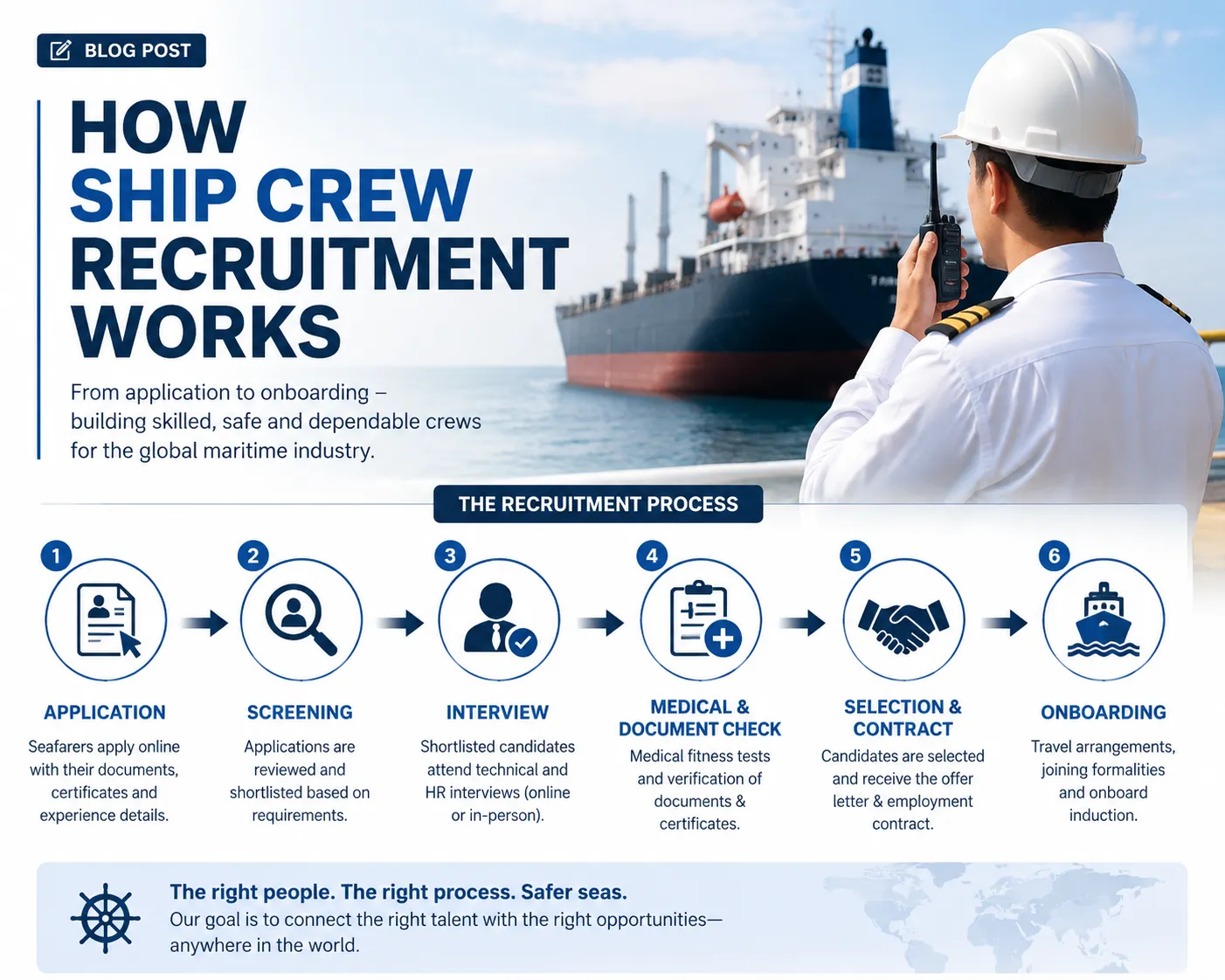
Every compliant hire follows the same skeleton, whether sourced through an agency, a platform, or your internal pipeline. The bones don't change. Shortcuts in any step turn a routine crew change into a detention risk.
1. Manpower Requisition. The vessel manager defines the rank, required endorsements, contract length, and any charterer-specific requirements. A vague requisition is the root cause of bad hires.
2. Candidate Sourcing. Activate the right channel for the role. Agency for urgent senior fills.
Database or academy for planned rotations. Platform for niche technical roles.
3. Document Collection. Collect digital copies of STCW certificates, flag endorsements, medical certificate, passport, seaman's book, and sea service records.
4. Verification. This is the gate. Cross-check every certificate against flag-state databases.
Confirm endorsement scope covers the vessel type. Verify medical validity with at least a 90-day buffer beyond contract end. Check sea service against discharge book entries and references.
5. Seafarer Employment Agreement. Issue a compliant SEA under MLC 2006 before the seafarer travels. The agreement must state wages, leave, repatriation rights, and the shipowner's identity.
6. Flag Endorsement. If the seafarer's license lacks the required flag endorsement, apply now. Processing times range from three days to a month.
Never book a flight without confirmation.
7. Pre-Embarkation Checks. Arrange travel, visa, and joining instructions. Run a final medical or drug screening if the charter requires it.
8. Onboard Familiarization. The hire is not complete until the seafarer signs off on the vessel's familiarization checklist. Safety, muster station, equipment specific to the ship all logged.
The time between requisition and embarkation shrinks under pressure. The steps that get skipped first are verification and endorsement confirmation. Those are also the steps that port state inspectors request first.
The detailed recruitment workflow that keeps those steps inviolable is what separates a detention-free fleet from one that lives on luck.
The Compliance Killers: Why Most Crew Documentation Fails
Documentation failures are never dramatic. They are slow, administrative, and deadly. An expired tanker endorsement looked valid because the expiry date was still six months away, but the endorsement didn't cover the specific cargo the vessel was carrying.
That gap was invisible to a quick check. It was not invisible to the inspector.
Endorsement Scope, Not Just Validity
A certificate of competency can be in date and still wrong for the job. The STCW endorsement must match the vessel type, trading area, and any special cargo. A second mate's tanker familiarization does not cover an IGF Code gas carrier.
Check the scope, not just the date.
Medical Certificate Expiry Windows
An ENG1 medical certificate valid for two years might expire three weeks before the contract ends. If the next port has no approved medical examiner, the seafarer cannot legally serve. Build in a buffer.
Ninety days is the practical minimum.
Missing Digital Backup
A seafarer loses a physical certificate in transit. Without a verified digital copy in the vessel's crew folder, the inspector has nothing to review. Detention follows.
Keep every verified document in a secure cloud backup accessible from the vessel.
Agency Verification Without Spot Checks
Agencies under pressure to fill roles fast can skip the cross-reference against the flag database. A spot check by your team on 10 percent of agency-sourced crew documents catches the pattern before it becomes a detention. No spot check means blind trust.
Port state control does not accept blind trust.
Vessel operators who understand what makes crew documentation fully compliant know that verification is not a one-time event. It is a continuous cycle of checking, rechecking, and tracking expiries.
What a Detention-Ready Recruitment Process Costs
A single port state detention can cost a shipowner $50,000 to $150,000 in direct costs: port dues, surveyor fees, off-hire, cargo delay claims. That figure does not count the ripple of an expanded inspection at the next port or the damage to a charterer relationship. Against that baseline, a proper verification step costs almost nothing.
Agencies charge placement fees of one to two months' salary. An in-house crewing manager's salary is a fixed cost spread across every hire. A digital document tracking system runs a few hundred dollars a month.
These numbers are not noise. They are cheap insurance against a detention event that wipes out an entire quarter's crewing budget.
The real cost driver in recruitment is not the channel you choose. It is the oversight you skip. Pay for the verification.
Pay for the system that tracks certificate expiries. The detention that never happens is the return on that spend.
Expert Tips: How to Verify a Seafarer's Documents Like a Port State Inspector
Cross-check every certificate against the flag administration's online database. Confirm endorsement scope matches the vessel type, trading area, and cargo. Verify the medical certificate's issuing authority appears on the flag's approved list.
Keep a 90-day buffer on all expiries.
Never accept a scanned certificate without a live database check. Spot-check 10 percent of agency-sourced files yourself. Store verified images in a cloud folder accessible from the vessel so the inspector can review them even if the physical copy goes missing.
Building a Repeatable Crew Recruitment System That Scales
Standardize document packs per rank. Every AB gets the same medical, STCW, and endorsement set. Use a single crewing management platform that sends expiry alerts and holds every seafarer, no matter which channel brought them in.
Quarterly spot-checks catch agency drift. Set a calendar reminder to pull five random crew files and re-verify everything. Automation handles the tracking.
Human checks catch the gaps.
A streamlined crew workflow pays for itself the first time you catch an expired medical three months before the seafarer was due to join.
Your Next Hire: A Decision Map That Won't Let You Down
Map three variables: urgency, endorsement complexity, and hiring volume. Senior officers with multi-endorsement requirements route through in-house verification. High-volume ratings flow through a vetted agency with a standardized document pack.
Emergency fills demand speed but still get your spot-check. The decision map keeps the channel aligned with the compliance load so no hire lands in the gap between speed and verification.
Frequently Asked Questions
How long does the crew recruitment process take?
A routine officer hire takes two to four weeks through an agency. Direct recruitment for a new pipeline takes four to eight weeks, then shortens. Emergency fills can deploy within 48 hours if documents are current.
What documents must a seafarer provide before joining?
STCW certificates, flag-state endorsement, medical fitness certificate, passport, seaman's book, and sea service records. All must be verified against the flag database and carry a validity buffer beyond the contract end date.
Can a manning agency handle all compliance checks?
A good agency pre-vets documents, but the shipowner bears ultimate responsibility. Spot-checking 10 percent of agency files and cross-referencing flag databases yourself catches gaps that port state inspectors will find.
What happens if a crew member's certificate expires mid-voyage?
The vessel risks detention if the seafarer cannot produce a valid certificate. Build a 90-day buffer into every contract and track expiry dates across the full crew roster to prevent this.
How do I hire crew for a vessel under a new flag state?
Use a manning agent with direct experience in that flag's endorsement process. Internal teams unfamiliar with the administration's quirks can delay applications by weeks and leave the vessel short-handed at sail.
For more common questions, see the crew recruitment FAQ.