 Ship Crew Agency
Maritime Editorial Team
In This Article
- Check the manning agency Guideline
- What is MLC 2006 manning agency compliance?
- Why compliance matters for ship managers
- Compliance matters for several reasons:
- What Regulation 1.4 requires from recruitment and placement services
- Complete MLC 2006 compliance checklist
- Documents every compliant manning agency should provide
- Red flags indicating poor compliance
- How ship managers should audit a manning agency
- Benefits of partnering with an MLC-compliant crew agency
- Frequently Asked Questions
- What is MLC 2006?
- What is MLC 2006 manning agency compliance?
- Who enforces MLC 2006?
- Does every crew agency need MLC certification?
- What is Regulation 1.4 of MLC 2006?
- What documents should a compliant manning agency provide?
- Can PSC detain ships over MLC deficiencies?
- Are ships under 500 GT exempt from MLC 2006?
- What is a Seafarer Employment Agreement?
- What happens if a crew agency violates MLC?
- How do ship managers verify crew recruitment compliance?
- What is the difference between MLC, STCW, SOLAS, ISM, and ISPS?
- Final Checklist for Ship Managers
- Conclusion: Use MLC 2006 manning agency compliance as a procurement standard
MLC 2006 manning agency compliance is now a core risk-control issue for ship managers, ship owners, crewing managers, marine HR departments, and maritime compliance officers. A manning agency is not just a crew supplier. It is a compliance partner whose recruitment process, document verification, contract handling, welfare support, payroll coordination, and complaint procedures can directly affect vessel operations.
The Maritime Labour Convention, 2006, commonly called MLC 2006, was adopted by the International Labour Organization (ILO) to consolidate global maritime labour standards into one framework. It covers seafarer employment agreements, wages, hours of work and rest, repatriation, medical care, accommodation, food, welfare, recruitment and placement services, and complaint procedures. (ilo.org)
For ship managers, this means a crew manning agency must do much more than send CVs. It must prove that seafarers are recruited fairly, properly documented, medically fit, trained, certified, contractually protected, and supported before, during, and after deployment.
This guide explains what an MLC-compliant manning agency must deliver, how ship managers should verify compliance, what documents to request, which red flags to watch for, and how to audit a crewing partner before deficiencies become Port State Control problems.
Check the manning agency Guideline
What is MLC 2006 manning agency compliance?
MLC 2006 manning agency compliance means a crew recruitment and placement service can prove it follows the Maritime Labour Convention requirements for fair recruitment, verified crew documentation, legal employment agreements, welfare protection, and complaint handling. For ship managers, it is the control system that prevents recruitment failures from becoming flag State, Port State Control, or operational risks.
In practical terms, a compliant maritime recruitment agency must operate under a recognized licensing, certification, or regulatory system where required by national law. It must not exploit seafarers, charge illegal recruitment fees, use blacklists, hide contract terms, or deploy crew without verified qualifications.
The agency should also maintain proper records, verify STCW certification, confirm medical fitness, support visa and travel arrangements, explain employment terms, provide access to complaint procedures, and coordinate with the ship owner or ship manager on insurance, repatriation, payroll administration, and welfare matters.
The ILO’s Regulation 1.4 states that seafarers should have access to an efficient, adequate, and accountable recruitment and placement system without charge to the seafarer. It also requires recruitment and placement services in MLC Member States to conform to the Convention’s Code.
Key takeaway: A compliant manning agency is not measured by how fast it fills vacancies. It is measured by whether every seafarer is legally, medically, professionally, and ethically fit for deployment.
Why compliance matters for ship managers
MLC 2006 compliance matters because the ship manager remains exposed when a manning agency fails. Poor recruitment controls can create expired certificates, invalid Seafarer Employment Agreements, wage disputes, repatriation issues, fatigue problems, complaints, PSC deficiencies, detentions, insurance complications, and reputational damage for the vessel, owner, manager, and fleet.
A weak crewing process does not stay inside the agency’s office. It follows the vessel.
During a Port State Control (PSC) inspection, officers may review crew documentation, employment agreements, work/rest records, medical certificates, payroll evidence, complaint procedures, and financial security documents. The International Maritime Organization (IMO) describes PSC as inspection of foreign ships in national ports to verify compliance with international regulations and whether ships are properly manned and operated. (International Maritime Organization)

Compliance matters for several reasons:
Legal protection: Ship managers must show that recruitment, contracts, documentation, and welfare arrangements meet applicable MLC, flag State, and labour-supplying country requirements.
PSC inspection readiness: Incomplete or false crew documentation can trigger a more detailed inspection. Paris MoU guidance says clear grounds may include missing, invalid, falsely maintained, or incomplete MLC documents. (Paris MoU)
Flag State audits: The Flag State Administration and any Recognized Organization (RO) may assess whether the vessel’s procedures match the Declaration of Maritime Labour Compliance (DMLC).
Operational continuity: A crew member with an invalid medical certificate, expired visa, missing STCW endorsement, or disputed employment agreement can delay joining, cause off-signing disruption, or affect minimum safe manning.
Crew welfare: MLC is not paperwork theatre. It protects seafarers’ working and living conditions, including wages, repatriation, health protection, social protection, welfare, and complaint rights.
Reputation and commercial trust: Charterers, insurers, owners, and procurement teams increasingly expect transparent crew management services. A ship crewing company with weak MLC controls can become a commercial liability.
Insurance implications: Missing financial security, unclear employer responsibility, or disputed contracts may complicate claims, repatriation, abandonment response, or liability handling.
Key takeaway: The manning agency’s compliance quality directly affects the ship manager’s operational risk, PSC exposure, crew welfare outcomes, and commercial credibility.
What Regulation 1.4 requires from recruitment and placement services
Regulation 1.4 requires seafarer recruitment and placement services to operate through an efficient, accountable, and well-regulated system. It focuses on fair recruitment, licensing or certification where applicable, no recruitment fees charged to seafarers, verified qualifications, proper employment agreements, complaint handling, and protection against monetary loss.
For ship managers, Regulation 1.4 of MLC 2006 is the most important rule when evaluating a manning agency. It sets the foundation for ethical seafarer recruitment and protects both the crew member and the ship operator.
A compliant recruitment and placement service should be able to demonstrate:
valid license, certification, or government approval where required;
recruiters with maritime labour knowledge and operational competence;
no blacklisting or unfair barriers to employment;
no recruitment or placement fees charged directly or indirectly to seafarers, except limited personal document costs allowed under MLC;
transparent job information before engagement;
opportunity for seafarers to review the Seafarer Employment Agreement (SEA) before signing;
verification of seafarer qualifications and documents;
confirmation that employment agreements comply with applicable law and collective bargaining agreements where relevant;
a complaint-handling procedure;
insurance or equivalent protection for monetary loss caused by agency or shipowner failure.
The MLC text specifically addresses blacklisting, recruitment fees, seafarer registers, employment agreement review, verification of qualifications and documents, complaint handling, and protection against monetary loss.
The 2022 MLC amendments, which entered into force on 23 December 2024, further strengthened recruitment and placement obligations by requiring seafarers to be informed of their rights under financial protection systems established by private recruitment and placement agencies. (ilo.org)
Important compliance tip: Do not accept “we are MLC compliant” as proof. Ask for the license, audit records, documented recruitment procedure, sample SEA workflow, complaint procedure, and evidence of how seafarers are informed of their rights.
Key takeaway: Regulation 1.4 turns crew recruitment from a simple staffing service into a regulated compliance function.

Complete MLC 2006 compliance checklist
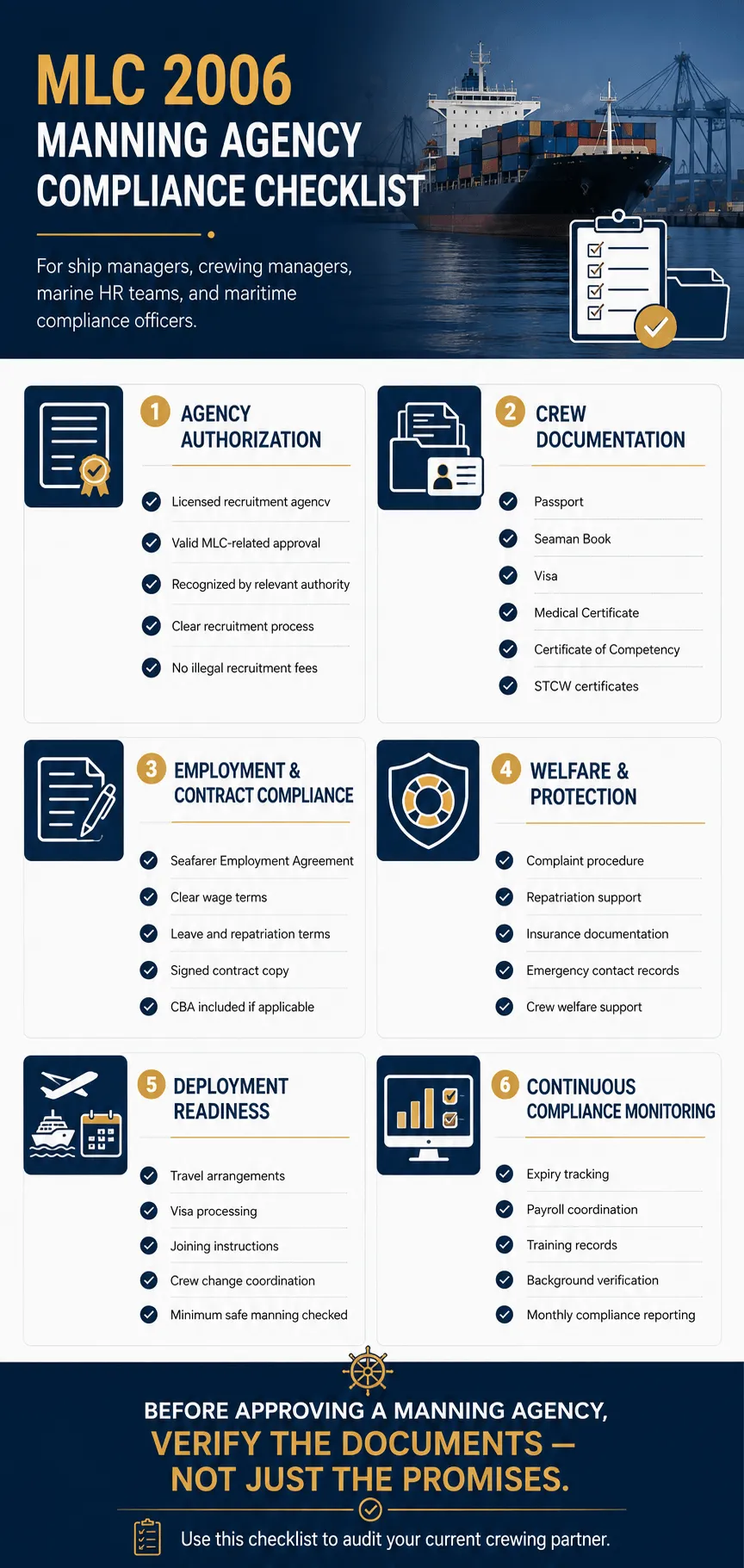
A complete MLC 2006 compliance checklist should test whether the manning agency can lawfully recruit, verify, document, deploy, support, and monitor seafarers throughout the employment cycle. Ship managers should check not only documents, but also procedures, accountability, communication, recordkeeping, and evidence of continuous compliance monitoring.
| Requirement | Why it matters | Documents | Agency responsibility | Ship manager verification |
|---|---|---|---|---|
| ✔ Licensed recruitment | Confirms the agency is legally permitted to provide seafarer recruitment and placement services | License, certification, government approval | Maintain valid authorization | Check expiry date, issuing authority, scope, and country coverage |
| ✔ Qualified recruiters | Reduces errors in STCW, SEA, medical, visa, and flag requirements | Recruiter training records, SOPs | Use trained maritime recruitment staff | Ask who verifies rank-specific requirements |
| ✔ STCW verification | Ensures crew competency and legal eligibility for rank | Certificate of Competency, endorsements, STCW certificates | Verify authenticity and validity | Cross-check with issuing authority or approved verification system |
| ✔ Medical fitness | Confirms seafarer is medically fit for assigned duties | Medical Certificate | Verify validity before joining | Check issuing doctor, expiry, restrictions, and flag requirements |
| ✔ Identity documents | Prevents joining delays and immigration issues | Passport, Seaman Book, national ID | Verify identity and validity | Confirm name consistency across all documents |
| ✔ Employment contracts | Protects seafarer rights and manager/owner obligations | Seafarer Employment Agreement, CBA if applicable | Ensure SEA is reviewed, signed, and copied | Check wage, leave, repatriation, duration, position, and governing terms |
| ✔ Insurance | Supports repatriation, compensation, injury, abandonment, and liability response | P&I evidence, financial security certificates, agency insurance where applicable | Coordinate required coverage evidence | Confirm financial security documents are vessel-specific and valid |
| ✔ Payroll | Prevents wage disputes and PSC issues | Wage scale, allotment records, payroll schedule | Coordinate accurate crew payroll data | Review payment timelines, deductions, and seafarer wage statements |
| ✔ Complaint procedure | Required for grievance handling and seafarer welfare | Complaint procedure, escalation contacts | Inform seafarers before deployment | Verify crew knows how to raise complaints without retaliation |
| ✔ Repatriation | Protects seafarers and prevents abandonment risk | Repatriation policy, financial security evidence | Arrange support if contract ends or emergency occurs | Confirm responsibility, contact route, and cost handling |
| ✔ Travel | Prevents joining/off-signing disruption | Flight details, joining instructions, port agent contacts | Arrange travel and joining logistics | Confirm travel matches vessel schedule and port requirements |
| ✔ Visa | Avoids immigration non-compliance | Visa, permits, immigration approvals | Process or coordinate visa requirements | Check destination, transit, and flag/port requirements |
| ✔ Crew records | Enables audit readiness and traceability | Crew database, document register | Maintain complete up-to-date crew files | Request sample anonymized file structure |
| ✔ Drug & alcohol policy | Supports safety culture and owner/charterer requirements | Policy, test records where applicable | Communicate policy before deployment | Confirm testing rules and disciplinary process |
| ✔ Background verification | Reduces fraud, misconduct, and competency risks | Employment references, sea service records | Verify experience and references | Spot-check prior employers and rank history |
| ✔ Training records | Confirms mandatory and client-specific training | STCW, safety, security, vessel-specific training | Track training completion | Check training matrix by vessel type |
| ✔ Welfare support | Supports retention and MLC welfare obligations | Welfare contacts, family support process | Provide accessible support | Check 24/7 emergency contact availability |
| ✔ Data privacy | Protects sensitive crew personal and medical data | Privacy policy, consent forms | Securely process seafarer data | Confirm access control and retention policy |
| ✔ Emergency contact | Enables crisis response | Next-of-kin records, emergency contact list | Maintain accurate emergency data | Test update process before joining |
| ✔ Continuous compliance monitoring | Prevents expiry-related deficiencies | Expiry tracker, audit logs, compliance dashboard | Monitor documents and regulatory changes | Review monthly compliance reports |
This checklist aligns with the MLC’s recruitment and placement controls, including document verification, seafarer registers, employment agreement review, complaint handling, and protection systems. It also reflects PSC expectations around certificates, DMLC, medical certificates, work/rest records, and financial security documentation.
Key takeaway: A strong manning agency should be able to prove each checklist item with documents, procedures, responsible staff, and auditable records.
Documents every compliant manning agency should provide
A compliant manning agency should provide verified crew documents, recruitment records, employment agreement evidence, medical fitness records, travel and visa documentation, insurance or financial security evidence, payroll coordination details, and welfare support contacts. Ship managers should request these before deployment, not after an inspector, owner, or charterer asks for them.
| Document | Purpose | What to verify | Compliance risk if missing |
|---|---|---|---|
| Maritime Labour Certificate | Shows MLC certification for applicable vessels | Validity, vessel name, flag, RO/authority | PSC deficiency or certificate challenge |
| DMLC Part I | Shows flag State requirements implementing MLC | Issued by competent authority | Wrong national standard applied |
| DMLC Part II | Shows shipowner’s onboard compliance measures | Certified and aligned with actual procedures | Audit non-conformity |
| Seafarer Employment Agreement | Sets legally enforceable employment terms | Signed copies, wage, leave, position, duration | Wage disputes, PSC issue, crew complaint |
| Certificate of Competency | Confirms rank qualification | Validity, endorsement, issuing authority | Unsafe manning or illegal deployment |
| STCW certificates | Confirms mandatory training | Course validity and rank relevance | Competency and safety deficiency |
| Medical Certificate | Confirms medical fitness | Validity, restrictions, approved doctor | Unfit crew deployment |
| Passport | Identity and travel | Validity, name consistency, blank pages | Travel delay or immigration refusal |
| Seaman Book | Seafarer identity and service record | Validity, issuing authority | Port/flag processing delay |
| Visa | Entry, transit, joining/off-signing | Correct country, dates, conditions | Detention, denied boarding, repatriation delay |
| Crew list | Official onboard crew record | Rank, nationality, document numbers | Port clearance issue |
| Minimum Safe Manning evidence | Confirms crew number/rank adequacy | Rank matching and certificates | Safety and SOLAS/ISM concern |
| Insurance documentation | Supports liability, repatriation, injury, abandonment | Financial security certificates | Serious MLC risk |
| Payroll records | Shows wage payment and allotments | Accuracy, timing, deductions | Wage complaint or PSC deficiency |
| Work/rest records | Shows fatigue management | Accurate entries, MLC/STCW consistency | Fatigue-related deficiency |
| Complaint procedure | Enables grievance reporting | Crew access and non-retaliation | Unresolved crew complaint |
| Emergency contact records | Supports crisis response | Updated next-of-kin | Delayed family notification |
| Training matrix | Tracks training by rank and vessel | Completed and current courses | Crew competency gaps |
| Drug and alcohol policy | Supports safety management | Crew acknowledgement | Safety and disciplinary uncertainty |
| Data privacy consent | Protects personal data | Signed consent, retention policy | Legal and ethical risk |
Under Paris MoU MLC guidance, PSC officers may examine the Maritime Labour Certificate, DMLC Parts I and II, valid medical certificates, shipboard working arrangements, records of hours of work or rest, and financial security evidence for repatriation and shipowner liability. (Paris MoU)
Key takeaway: Document collection is not enough. Ship managers need document verification, expiry control, version control, and evidence that crew actually understand their rights and duties.
Red flags indicating poor compliance
Red flags include missing licenses, expired medical certificates, unclear employment agreements, fake or unverifiable certificates, non-transparent recruitment fees, weak complaint procedures, poor communication, incomplete payroll records, and no evidence of welfare or repatriation support. These warning signs suggest the manning agency may create operational, legal, and PSC exposure.
Watch carefully for these issues:
the agency cannot provide a valid recruitment license or equivalent authorization;
recruiters avoid answering questions about MLC, SEA, STCW, or flag State requirements;
crew documents arrive late, incomplete, or in inconsistent formats;
certificates cannot be verified with the issuing authority;
medical certificates are expired or issued by questionable providers;
employment contracts are vague, unsigned, or not shared with seafarers before joining;
seafarers report paying recruitment fees;
visa and travel arrangements are reactive rather than planned;
payroll deductions are unclear;
complaints are handled informally with no written process;
there is no 24/7 emergency contact;
the agency cannot explain repatriation procedures;
crew records are stored casually with weak data privacy controls;
the agency promises “any rank, any time” without discussing competency and vessel-specific requirements.
A particularly serious red flag is any sign of forged or falsely maintained documentation. Paris MoU guidance identifies missing, invalid, falsely maintained, or incomplete MLC documents as possible clear grounds for a more detailed inspection. (Paris MoU)
Compliance tip: If an agency is careless before contract signing, expect worse after deployment. The sea has enough surprises already; your crew files should not be one of them.
Key takeaway: Poor compliance usually shows up early through weak documentation, vague answers, delayed communication, and pressure to “trust the process.”
How ship managers should audit a manning agency
Ship managers should audit a manning agency by reviewing its license, recruitment procedure, document verification process, SEA workflow, STCW checks, medical screening, payroll coordination, complaint handling, insurance support, data privacy controls, and compliance monitoring system. The audit should test evidence, not promises, before crew deployment begins.
Use this step-by-step audit process.
Step 1: Confirm legal status
Request the agency’s recruitment license, MLC-related certificate, government approval, or equivalent authorization. Check the issuing authority, expiry date, country scope, and whether the approval covers seafarer recruitment and placement services.
Step 2: Review recruitment procedures
Ask for the agency’s standard operating procedure for candidate sourcing, screening, interview, document collection, background verification, SEA briefing, deployment, and post-deployment support.
Step 3: Test STCW and competency verification
Select sample crew files and check Certificate of Competency, flag endorsement, STCW training, sea service, rank experience, vessel type experience, and any client-specific training.
MLC Regulation 1.3 requires seafarers to be trained, certified as competent, or otherwise qualified for their duties, and recognizes training and certification under mandatory IMO instruments as meeting those requirements.
Step 4: Review medical fitness controls
Check how the agency verifies medical certificates, approved clinics, expiry dates, restrictions, vaccination requirements, and vessel-specific medical standards.
Step 5: Audit the SEA process
Confirm that seafarers receive the Seafarer Employment Agreement before signing, understand the terms, receive copies, and are not pressured into unclear contractual arrangements.
MLC Regulation 2.1 requires seafarer employment terms to be set out or referred to in a clear written legally enforceable agreement, with the seafarer given an opportunity to review and seek advice before signing.
Step 6: Check payroll and wage controls
Review wage scales, allotment handling, payment timelines, deductions, overtime rules, leave pay, final settlement process, and records available for inspection.
Step 7: Verify complaint and grievance mechanisms
Ask how seafarers can complain about recruitment, contract terms, wage issues, discrimination, harassment, welfare, repatriation, or onboard conditions. Check whether unresolved complaints are escalated to the competent authority.
Step 8: Review repatriation and emergency response
Confirm who arranges flights, who pays, who authorizes emergency repatriation, how abandonment risk is handled, and how families are contacted.
Step 9: Inspect data privacy practices
Crew files contain sensitive personal, medical, travel, and financial data. Confirm consent, access control, retention period, secure storage, and sharing protocols.
Step 10: Request compliance reporting
A strong crew supply agency should provide expiry trackers, joining reports, missing-document alerts, crew change status, incident reports, complaint logs, and monthly compliance summaries.
Step 11: Conduct seafarer feedback checks
Interview recently deployed seafarers. Ask whether they paid fees, received contracts in advance, understood their rights, received joining instructions, and had a reliable agency contact.
Step 12: Document corrective actions
If gaps appear, issue a corrective action plan with deadlines. Do not deploy crew from the agency until high-risk gaps are closed.
Key takeaway: A proper manning agency audit should feel like a mini maritime audit, not a sales call with a brochure attached.
Benefits of partnering with an MLC-compliant crew agency
An MLC-compliant crew agency reduces recruitment risk, improves crew quality, supports PSC readiness, strengthens welfare outcomes, improves retention, protects the ship manager’s reputation, and creates smoother crew deployment. The right partner helps transform crewing from emergency staffing into controlled maritime compliance and workforce planning.
The main benefits include:
Lower PSC deficiency risk: Proper documents, valid certificates, accurate SEAs, and financial security evidence reduce inspection surprises.
Better crew retention: Seafarers who are recruited fairly, paid clearly, and supported properly are more likely to return.
Higher operational efficiency: Reliable visa, travel, and joining coordination reduce crew change disruption.
Improved safety culture: Verified competency, medical fitness, training, and fatigue awareness support safer vessel operations.
Stronger ISM alignment: The International Safety Management (ISM) Code focuses on safe management and pollution prevention. Crew competency and proper procedures support that wider safety management system.
Better security readiness: The International Ship and Port Facility Security (ISPS) Code depends on trained personnel and secure operational processes. Proper crew screening supports vessel security.
Commercial confidence: Procurement teams, ship owners, charterers, and technical managers prefer crew management services that can prove compliance.
Stronger welfare outcomes: Complaint handling, repatriation support, family communication, and emergency contacts help protect seafarers in real-world situations.
The Paris MoU and Tokyo MoU 2024 Concentrated Inspection Campaign focused on crew wages and SEAs, showing that seafarer employment conditions remain a live PSC priority across major inspection regimes. (Paris MoU)
Key takeaway: The cheapest manning agency can become the most expensive supplier if weak compliance leads to delayed crew changes, wage claims, PSC findings, or reputation damage.
Frequently Asked Questions
The most common MLC 2006 manning agency compliance questions focus on who enforces the Convention, what Regulation 1.4 requires, whether agencies need certification, what documents ship managers should request, and whether PSC can detain vessels for MLC deficiencies. The answers below are written for practical crewing and compliance decisions.
What is MLC 2006?
MLC 2006 is the Maritime Labour Convention, 2006, adopted by the International Labour Organization. It sets international maritime labour standards for seafarers, including employment agreements, wages, working hours, rest hours, repatriation, medical care, accommodation, food, welfare, recruitment, and complaint procedures.
What is MLC 2006 manning agency compliance?
MLC 2006 manning agency compliance means a crew recruitment agency follows the Maritime Labour Convention rules for fair recruitment, no illegal recruitment fees, verified documents, proper employment agreements, complaint handling, and seafarer protection. It proves the agency can support ship manager compliance before and during deployment.
Who enforces MLC 2006?
MLC 2006 is enforced mainly through Flag State Administrations, labour-supplying states, Port State Control, and national competent authorities. Recognized Organizations may also conduct inspections or certification work when authorized by the flag State.
Does every crew agency need MLC certification?
Not always in the same form. MLC requires private seafarer recruitment and placement services in Member territories to operate under a standardized licensing, certification, or other regulatory system where such services exist. Ship managers should verify the specific national requirement in the agency’s operating country.
What is Regulation 1.4 of MLC 2006?
Regulation 1.4 covers seafarer recruitment and placement. Its purpose is to ensure seafarers have access to an efficient, adequate, accountable, and well-regulated recruitment system without charge to the seafarer. It also sets expectations for licensing, fair recruitment, document checks, complaint handling, and protection systems.
What documents should a compliant manning agency provide?
A compliant manning agency should provide recruitment authorization, crew documents, STCW certificates, Certificate of Competency, medical certificate, passport, Seaman Book, visa, Seafarer Employment Agreement, payroll details, insurance or financial security evidence, complaint procedure, travel documents, training records, and emergency contact information.
Can PSC detain ships over MLC deficiencies?
Yes. PSC may detain a ship where MLC deficiencies are serious, repeated, or hazardous to seafarers’ safety, health, or security. Paris MoU guidance states that where such serious or repeated MLC breaches exist, the PSCO shall ensure the ship does not proceed to sea until appropriate action is taken. (Paris MoU)
Are ships under 500 GT exempt from MLC 2006?
No, not automatically. Paris MoU guidance states that ships under 500 GT are required to comply with MLC 2006, although they are not required to carry a Maritime Labour Certificate and DMLC. PSCOs may seek evidence that the flag State has inspected the ship for MLC compliance. (Paris MoU)
What is a Seafarer Employment Agreement?
A Seafarer Employment Agreement, or SEA, is the written legally enforceable agreement setting out a seafarer’s employment terms. It should include position, wages, leave, repatriation rights, duration, termination terms, benefits, and applicable collective bargaining agreement where relevant.
What happens if a crew agency violates MLC?
Consequences may include complaints to competent authorities, loss of license, contractual claims, crew deployment disruption, wage disputes, PSC findings, flag State scrutiny, reputational damage, and removal from approved supplier lists. Serious failures may also affect the ship manager’s compliance record.
How do ship managers verify crew recruitment compliance?
Ship managers should review the agency’s license, audit its recruitment procedure, test crew files, verify STCW and medical documents, review SEA handling, check payroll coordination, inspect complaint records, confirm no-fee recruitment, and request ongoing compliance reports.
What is the difference between MLC, STCW, SOLAS, ISM, and ISPS?
MLC covers seafarer labour and welfare standards. STCW covers training, certification, and watchkeeping competence. SOLAS focuses on safety of life at sea. ISM covers safe management systems. ISPS covers ship and port security. A reliable manning agency should understand how crew documentation supports all of these frameworks.
Final Checklist for Ship Managers
Before appointing or renewing a manning agency, ship managers should verify legal authorization, recruitment ethics, document controls, SEA handling, medical fitness checks, STCW verification, payroll coordination, complaint procedures, repatriation support, welfare arrangements, and compliance reporting. This final checklist can be used during procurement, audit, or annual supplier review.
Use this quick checklist before approving a crew manning agency:
Agency license, certification, or national authorization verified
MLC 2006 Regulation 1.4 procedure reviewed
No recruitment fee policy confirmed
Recruiter competence and maritime compliance training checked
STCW certification verification process tested
Certificate of Competency verification completed
Medical certificate process confirmed
Passport, Seaman Book, and visa workflow reviewed
Seafarer Employment Agreement process audited
Payroll and allotment coordination reviewed
Insurance and financial security evidence confirmed
Repatriation procedure documented
Travel and crew deployment process checked
Complaint and grievance mechanism reviewed
Crew welfare and family contact support confirmed
Drug and alcohol policy communicated
Background and reference checks tested
Crew records and expiry tracking reviewed
Data privacy and consent controls checked
Emergency contact system tested
Monthly compliance reporting agreed
Corrective action process included in service agreement
Agency included in annual maritime audit schedule
Procurement note: If two agencies offer similar rates, choose the one with stronger compliance evidence. In crewing, “cheap but undocumented” is not a saving. It is a future incident report wearing a discount sticker.
Conclusion: Use MLC 2006 manning agency compliance as a procurement standard
MLC 2006 manning agency compliance should be treated as a mandatory procurement and operational standard, not a marketing claim. Ship managers should expect verified recruitment controls, complete crew documentation, fair employment agreements, welfare support, complaint handling, payroll coordination, and continuous compliance monitoring from every serious maritime staffing partner.
A compliant manning agency protects the seafarer, the vessel, the ship owner, the technical manager, the ISM system, and the company’s reputation. It also helps reduce PSC deficiencies, support flag State audits, improve crew retention, and create more predictable crew deployment.
The best approach is simple: evaluate your current manning agency against the checklist above. If the agency cannot provide evidence for licensing, Regulation 1.4 compliance, document verification, SEA handling, payroll support, insurance, repatriation, and welfare systems, it is time to ask harder questions.
For ship managers and marine HR teams reviewing crewing partners, ShipCrewAgency.com can support compliant crew recruitment, international crew documentation, deployment coordination, and marine HR solutions aligned with MLC 2006 expectations.
Final takeaway: A good manning agency fills vacancies. A great manning agency protects your vessel before the crew even boards.
Need Reliable officers, engineers, or ratings from Bangladesh? Request a Crew Proposal from ShipCrewAgency.com and receive a customised candidate list within 24–48 hours Hire Bangladesh Sefarers