 Ship Crew Agency
Maritime Editorial Team
In This Article
- At a Glance: Key Takeaways
- Why Singapore Shipping Companies Need Reliable International Crew
- Why Bangladesh Seafarers Deliver Outstanding Value
- Practical Strengths of Bangladesh Seafarers
- International Certifications Singapore Employers Expect
- Core Documents
- Rank-Specific Certificates
- Why Compliance Matters More Than Low Crew Cost
- Compliance Areas a Manning Agency Must Control
- Comparing Bangladesh with Other Asian Crew Supply Countries
- Asia Crew Supply Comparison for Singapore Employers
- Types of Seafarers Available from Bangladesh
- Deck Department
- Engine Department
- Catering Department
- Electrical and Specialist Roles
- Vessel Types Commonly Crewed
- Bulk Carrier Crew
- Tanker Crew Recruitment
- Container Ship Crew
- Offshore Vessel Crew
- Other Vessel Types
- How a Professional Bangladesh Manning Agency Supports Singapore Shipowners
- 1. Recruitment and Candidate Sourcing
- 2. Technical Vetting
- 3. Certificate Verification
- 4. Interview Coordination
- 5. Medical and Fitness Management
- 6. Visa, Travel, and Joining Logistics
- 7. Payroll and Contract Support
- 8. Relief Planning and Rotation Management
- 9. Emergency Replacement
- 10. Welfare and Retention Follow-Up
- Cost Benefits Without Sacrificing Quality
- Example 1: Lower Turnover Savings
- Example 2: Officer Retention ROI
- Example 3: Avoided Delay Cost
- Where Bangladesh Can Create Savings
- Questions Singapore Shipowners Should Ask Before Choosing a Manning Agency
- Agency Compliance Checklist
- Certificate Verification Checklist
- Crew Quality Checklist
- Operational Support Checklist
- Commercial Checklist
- Red Flags
- Expert Checklist for Singapore Maritime HR Teams
- Compliance
- Competence
- Cost Control
- Continuity
- Welfare
- Risk Management
- Frequently Asked Questions
- 1. Why recruit Bangladesh seafarers?
- 2. Are Bangladesh officers STCW certified?
- 3. Is Bangladesh recognized internationally for seafarer supply?
- 4. What certificates are required for Singapore ship crew recruitment?
- 5. How does MLC compliance help shipowners?
- 6. Can Bangladesh agencies supply mixed crews?
- 7. How long does recruitment take?
- 8. What vessel types can Bangladesh seafarers support?
- 9. What is crew replacement time?
- 10. How are certificates verified?
- 11. Are Bangladesh officers English speaking?
- 12. Why choose a Bangladesh manning agency for Singapore?
- 13. Can Bangladesh supply tanker crew?
- 14. Are Bangladesh ratings suitable for bulk carriers?
- 15. What makes a manning agency MLC compliant?
- Conclusion
For Singapore shipowners, ship managers, offshore operators, and maritime HR teams, crew sourcing is no longer a simple “find available crew” function. It is part of vessel risk management. The right crew manning agency Singapore companies choose must understand certification, medical fitness, flag requirements, Port State Control expectations, MLC 2006 obligations, crew welfare, rotation planning, payroll coordination, and emergency replacement.
Singapore’s position explains why the crewing decision matters so much. The Maritime and Port Authority of Singapore states that MPA’s mission is to develop Singapore as a global hub port and international maritime centre, and Singapore’s maritime ecosystem includes shipowners, managers, financiers, insurers, brokers, classification societies, bunker suppliers, and marine service providers. In 2025, Singapore recorded 3.22 billion gross tonnage of vessel arrivals, 44.66 million TEUs of container throughput, and 56.77 million tonnes of marine fuel sales, according to MPA. That scale creates constant demand for qualified officers, ratings, engineers, cooks, and specialist crew.
At the same time, the global seafarer market is tightening. BIMCO and the International Chamber of Shipping estimated in 2026 that 2.57 million seafarers serve 85,148 merchant ships worldwide, while the industry faces a shortage of 39,100 STCW-certified officers. For Singapore shipping companies, the message is blunt: the best crewing strategy is not the cheapest one. It is the one that secures competent, document-ready, welfare-protected, retention-friendly crew at a sustainable total cost.
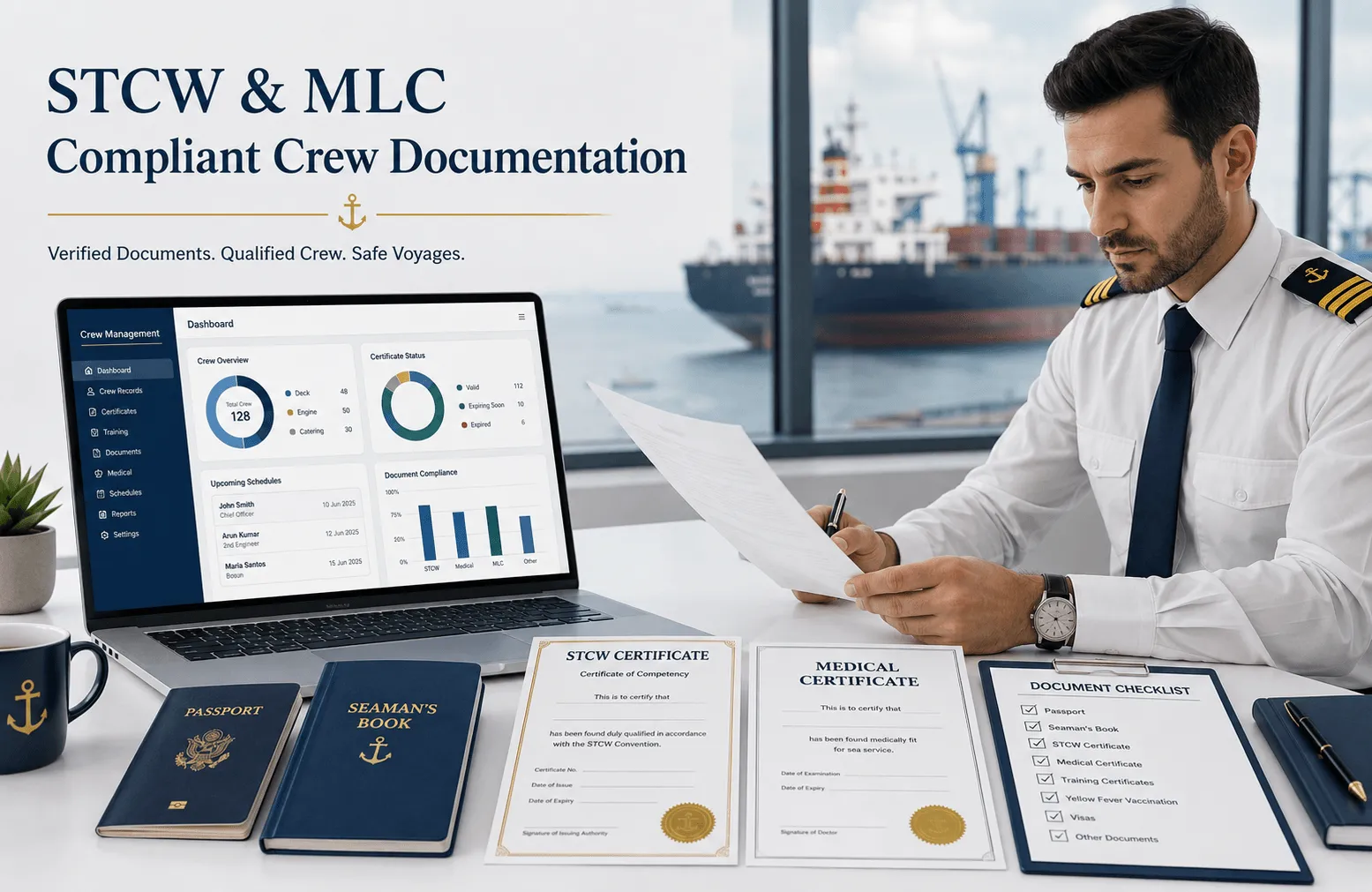
image: STCW and MLC compliant crew documentation for Bangladesh seafarer recruitment
At a Glance: Key Takeaways
Singapore needs dependable international crew supply because vessel operations, inspections, and chartering schedules leave little room for crewing delays.
Bangladesh seafarers offer strong value through competitive wage expectations, English working ability, discipline, adaptability, and growing international exposure.
Compliance is the real cost-control tool. MLC 2006, STCW, ISM Code, SOLAS, MARPOL, flag requirements, and PSC readiness reduce operational risk.
A professional Bangladesh crew manning agency should verify certificates, screen sea service, manage medicals, support visas, coordinate reliefs, and prepare audit-ready documentation.
The best-value choice is not “low wage crew.” It is cost-effective seafarers with verified competence, proper welfare, low turnover, and reliable crew rotation.
Singapore ship crew recruitment teams should evaluate agencies by license, compliance systems, emergency response, certificate verification, retention data, and vessel-type experience.
Why Singapore Shipping Companies Need Reliable International Crew
Singapore shipping companies need reliable international crew because vessel schedules, charter commitments, port calls, inspections, and safety obligations depend on qualified people being onboard at the right time. Crew shortages, rising employment costs, and stricter compliance expectations make professional international crew sourcing essential for shipowners, ship managers, and offshore operators.
Singapore is not simply a port. It is a command centre for Asian and global shipping. Many Singapore shipping companies manage vessels that rarely stay in Singapore waters but depend on Singapore-based crewing, technical, commercial, and marine HR decisions.
This is where crew recruitment Singapore teams feel the pressure. A delayed Chief Engineer, an unavailable Master, an expired medical certificate, or a mismatched tanker endorsement can disrupt the entire voyage plan. Crewing departments deal with practical risks every day:
Short-notice crew changes after resignation, illness, or family emergency
Flag-state certificate endorsement delays
Visa and joining port complications
Contract completion and relief planning pressure
PSC observations linked to documentation or rest-hour records
Crew fatigue, morale, and retention issues
Higher wage competition for senior officers
Charterer vetting pressure, especially for tankers and bulk carriers
The pressure is not theoretical. BIMCO and ICS now warn of a measurable officer shortage in the global merchant fleet, which means experienced Masters, Chief Engineers, ETOs, and senior watchkeeping officers are becoming harder to secure. For Singapore ship managers, this creates a strategic need for diversified crew sources beyond the most saturated markets.
A professional seafarer recruitment agency Singapore companies work with should therefore be more than a CV supplier. It should function as a maritime HR partner, connecting vessel requirements with compliant, medically fit, certified, and culturally adaptable seafarers.
Singapore’s maritime strength also raises the standard. MPA’s official port statistics show the scale and complexity of Singapore’s port activity, while the Ministry of Transport highlights Singapore’s connectivity to more than 600 ports globally and its range of maritime services, including bunkering, pilotage, towage, crew changes, and ship supplies. In such an environment, crewing mistakes are expensive. A reliable international crew pipeline is not optional; it is part of operational resilience.
Why Bangladesh Seafarers Deliver Outstanding Value
Bangladesh seafarers deliver outstanding value because they combine competitive employment costs with STCW-based training, English communication, strong discipline, adaptability, and growing experience on international vessels. For Singapore shipowners, Bangladesh offers a practical balance between cost control and operational reliability when recruitment is handled by a compliant manning agency.
The phrase “best-value” needs careful handling. It should never mean “cheap crew.” In maritime HR, cheap crew can become expensive very quickly if documentation is weak, retention is poor, safety culture is low, or communication fails onboard.
Bangladesh seafarers are valuable because they can support Singapore ship crew recruitment goals across three priorities: cost efficiency, compliance, and continuity. Many Bangladesh officers and ratings are willing to work in multinational environments, adapt to vessel routines, and complete full contract periods when employment terms are clear and welfare standards are respected.
Bangladesh also has a long-standing maritime training base. Bangladesh Marine Academy, Chattogram is described as an officer training institute for Merchant Marine and Merchant Navy cadets, preparing Marine Cadets, Marine Officers, and Marine Engineers for national and foreign-flagged ships engaged in international voyages. Bangladesh Department of Shipping systems also provide online verification routes for Certificate of Competency and Certificate of Proficiency, which is important for foreign employers checking credentials.
Practical Strengths of Bangladesh Seafarers
| Value Factor | Why It Matters for Singapore Employers | Bangladesh Seafarer Advantage |
|---|---|---|
| English communication | Bridge, engine-room, safety drills, toolbox meetings, and multinational crew coordination require working English. | Many officers and cadets are trained in English-medium maritime environments and adapt well to international commands. |
| Technical competence | Shipowners need crew who understand machinery, navigation, maintenance, cargo operations, and emergency procedures. | Bangladesh deck officers, engine officers, ETOs, and ratings are increasingly exposed to foreign-flagged vessels. |
| Competitive cost | Singapore operators must manage OPEX without compromising compliance. | Wage expectations are often more cost-effective than mature crew markets, depending on rank and vessel type. |
| Contract stability | Frequent crew changes increase travel, agency, training, and handover costs. | Many Bangladesh seafarers value stable contracts and long-term employer relationships. |
| Adaptability | Modern ships often operate with mixed-nationality crews. | Bangladesh crew are generally adaptable in multinational onboard environments. |
| Availability | Officer shortages increase hiring competition. | Bangladesh provides a growing maritime workforce for deck, engine, catering, ETO, and rating roles. |
| Compliance potential | PSC, flag, class, and charterer vetting require clean documentation. | Professional agencies can verify CoC, CoP, CDC, medicals, endorsements, and sea service before deployment. |
Bangladesh marine recruitment works best when the agency follows a strict vetting process. That means validating sea service, checking references, matching rank experience to vessel type, confirming STCW certificates, verifying medical fitness, and ensuring that the crew member understands the Safety Management System expectations of the vessel.
For Singapore maritime HR teams, the benefit is not just wage savings. The real benefit is a stable crew pipeline that reduces repeated hiring cycles, late replacements, and onboard adjustment problems.
International Certifications Singapore Employers Expect
Singapore employers expect seafarers to hold valid STCW certificates, medical fitness documents, CDC or seaman book, passport, security training, rank-specific competency documents, and vessel-specific endorsements. Tanker, gas carrier, GMDSS, ETO, bridge, and engine-room roles require additional certificates depending on rank, flag, trade, and vessel type.
The STCW Convention is the central global framework for seafarer training, certification, and watchkeeping. IMO explains that the 1978 STCW Convention was the first to establish basic international requirements for seafarer training, certification, and watchkeeping. The STCW Code includes mandatory provisions, which makes it essential for crew recruitment Singapore teams to evaluate certificates carefully before deployment.
A compliant Bangladesh crew manning agency should normally verify the following before proposing crew to Singapore shipowners:
Core Documents
Valid passport
Must cover contract duration plus reasonable buffer.Continuous Discharge Certificate / Seaman Book
Required to record sea service and identify the seafarer.Certificate of Competency or Certificate of Proficiency
Must match rank, department, tonnage, propulsion power, voyage type, and watchkeeping duty.STCW basic training certificates
Includes personal survival, fire prevention and firefighting, elementary first aid, and personal safety/social responsibilities.Medical fitness certificate
Must be valid and issued by an approved medical practitioner under applicable maritime requirements.Security awareness or designated security duties
Required depending on shipboard role.Flag-state endorsement
Needed when the flag administration requires recognition or endorsement of the seafarer’s certificate.Yellow fever or vaccination records
Relevant for certain trading areas.
Rank-Specific Certificates
Deck officers may need:
Officer in Charge of Navigational Watch certificate
Chief Mate or Master certificate
GMDSS General Operator Certificate
ECDIS training
ARPA / radar training
Bridge Resource Management
Advanced fire-fighting
Medical care or medical first aid
Ship security officer, where applicable
Engine officers may need:
Officer in Charge of Engineering Watch certificate
Second Engineer or Chief Engineer certificate
Engine-room resource management
High voltage training, where applicable
Advanced fire-fighting
Marine diesel, auxiliary machinery, and planned maintenance experience
Type-specific experience for specialized vessels
Basic oil and chemical tanker cargo operations
Advanced oil tanker cargo operations
Advanced chemical tanker cargo operations
Basic or advanced liquefied gas tanker training
IGF Code-related training for relevant vessels
Familiarity with OCIMF SIRE 2.0 expectations for tanker operations
OCIMF’s SIRE 2.0 inspection framework covers areas such as certification, crew management, navigation, communication, safety management, pollution prevention, and maritime security. For tanker crew recruitment, paper compliance alone is not enough. Officers must understand practical cargo, safety, and vetting expectations.
Why Compliance Matters More Than Low Crew Cost
Compliance matters more than low crew cost because a low wage rate cannot compensate for invalid documents, poor rest-hour control, weak training records, or failed inspections. MLC, STCW, ISM, SOLAS, MARPOL, PSC, flag-state, class, and charterer requirements directly affect vessel safety, insurability, commercial acceptance, and operational continuity.
A vessel’s crew cost is visible in the monthly budget. Non-compliance cost is often hidden until something goes wrong. A PSC deficiency, detention risk, failed vetting inspection, insurance complication, injury claim, or missed charter window can erase any savings from low-cost recruitment.
The Maritime Labour Convention, 2006 is especially important. The ILO describes MLC 2006 as a single instrument covering seafarers’ working and living conditions, including employment agreements, hours of work and rest, wages, repatriation, medical care, recruitment and placement services, accommodation, food, health and safety protection, and complaint procedures. The Convention also requires member states to exercise jurisdiction and control over seafarer recruitment and placement services established in their territory.
For Singapore shipowners, this means the manning agency must be able to show a controlled process, not just a database of candidates.
Compliance Areas a Manning Agency Must Control
Valid and verified STCW certificates
Verified sea service and rank history
Valid medical fitness certificates
Accurate Seafarer Employment Agreements
Transparent wage and allotment records
Crew rest-hour awareness and fatigue control
MLC-compliant recruitment and placement practices
Pre-joining familiarization
PPE, joining instructions, and travel coordination
Flag-state endorsement tracking
Emergency contact and repatriation procedures
Complaint handling and welfare support
The ISM Code also matters because crew performance directly affects the vessel’s Safety Management System. IMO states that the ISM Code provides an international standard for the safe management and operation of ships and pollution prevention. Similarly, SOLAS sets minimum standards for the construction, equipment, and operation of ships, while MARPOL is the main convention for preventing pollution from ships.
Port State Control officers generally verify valid certificates and relevant documentation when inspecting foreign ships. A well-managed Bangladesh crew manning agency should therefore prepare crew files as if the vessel will be inspected tomorrow. That is the mindset Singapore ship managers should demand.
Comparing Bangladesh with Other Asian Crew Supply Countries
Bangladesh compares strongly with other Asian crew supply countries when Singapore employers need cost-effective seafarers, improving availability, English working ability, and long-term retention. The Philippines, India, Indonesia, Myanmar, and Vietnam remain important crew markets, but Bangladesh offers a compelling value mix when compliance and vetting are handled professionally.
No serious maritime HR consultant should claim that one nationality is always superior. Vessel performance depends on training, company culture, leadership, safety systems, welfare, and individual competence. However, crew supply markets do have patterns, and Singapore shipowners can use those patterns to build a smarter sourcing strategy.
Asia Crew Supply Comparison for Singapore Employers
| Country | Cost Level | English Communication | Officer Experience | Ratings Availability | Certification Maturity | Retention Potential | Best Fit |
|---|---|---|---|---|---|---|---|
| Bangladesh | Low to medium | Good, especially officers | Growing | Good | Improving with formal verification | Strong when contracts are fair | Cost-effective officers, ratings, engine crew, mixed fleets |
| Philippines | Medium to high | Strong | Very mature | Strong | Highly mature | Good, but competitive market | Global fleets, cruise, tankers, offshore, senior officers |
| India | Medium | Strong | Mature | Medium | Mature | Good | Senior officers, engineers, technical roles |
| Indonesia | Low to medium | Variable | Moderate | Strong | Moderate to mature | Good | Ratings, offshore, regional trades |
| Myanmar | Low | Variable | Developing | Good | Developing | Variable | Cost-sensitive ratings recruitment |
| Vietnam | Low to medium | Variable | Developing | Moderate | Developing | Good | Ratings, regional and specialized growth markets |
Bangladesh’s advantage is strongest when a Singapore ship manager wants to reduce total crewing cost without dropping standards. This is especially relevant for bulk carriers, general cargo vessels, container ships, offshore support vessels, and mixed-nationality fleets where the operator needs reliable ratings, junior officers, engine-room support, and gradually developing senior officers.
The Philippines remains a global maritime powerhouse. India remains strong for technical and senior engineering roles. Indonesia has large manpower depth. Vietnam and Myanmar can be useful for specific categories. Bangladesh’s value proposition is the balance: cost-effective seafarers, disciplined working culture, growing maritime education, and improving access to official document verification.
A smart crew management Singapore strategy does not replace one country with another blindly. It builds a diversified crew matrix. Bangladesh can be the best-value source for selected ranks and vessel types, while still allowing Singapore operators to use mixed crews where charterer, flag, and operational requirements call for it.
Types of Seafarers Available from Bangladesh
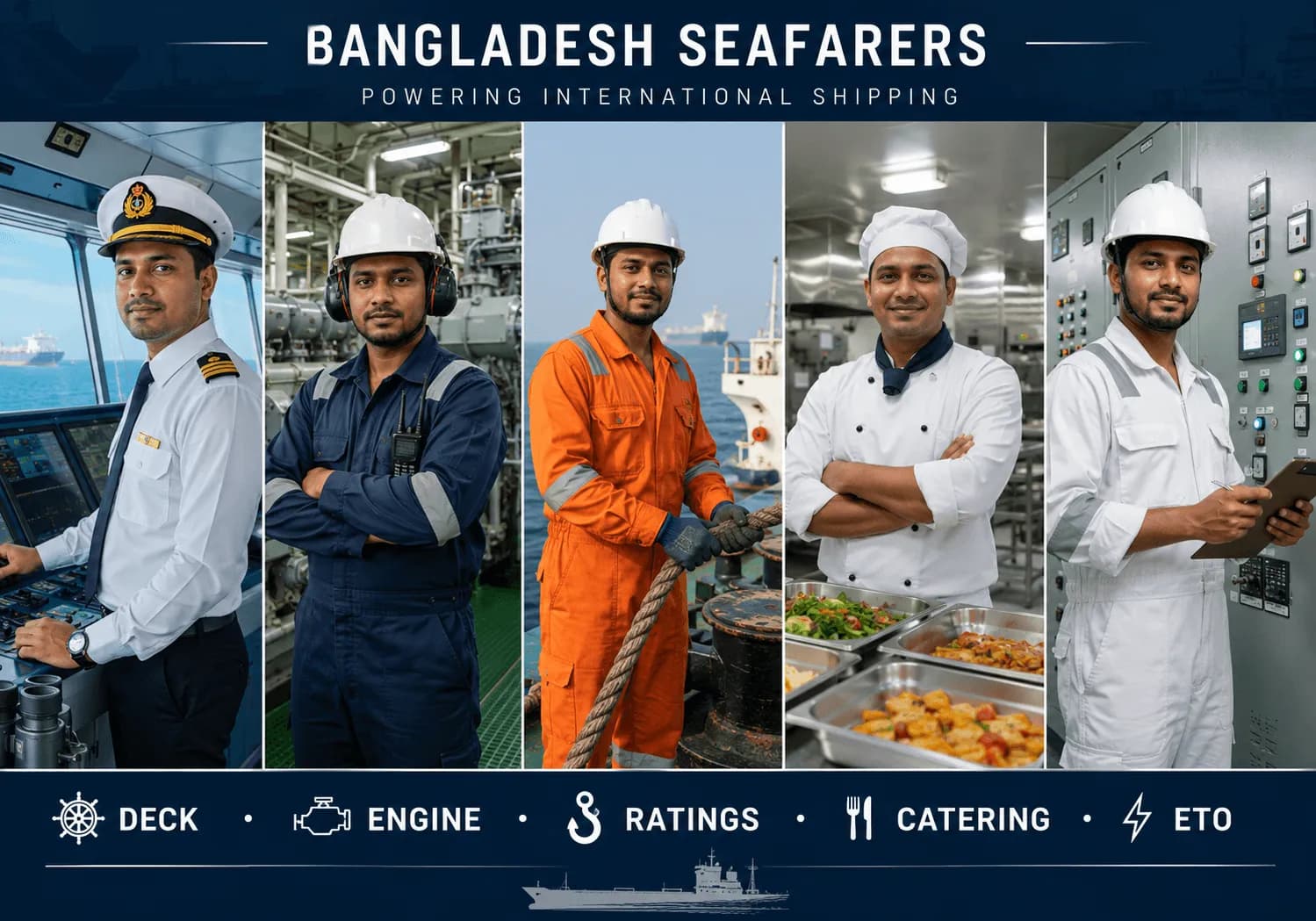
Bangladesh can supply deck officers, engine officers, ratings, catering crew, ETOs, and cadets for international shipping. Availability depends on rank, vessel type, trading area, salary package, and notice period. A reliable Bangladesh crew manning agency should maintain a screened database across departments and verify every candidate before nomination.
Bangladesh crew supply is not limited to junior ratings. The country’s maritime workforce includes officers and ratings across the deck, engine, catering, and electrical departments. Singapore shipowners should match recruitment criteria to vessel risk, not only rank title.
Deck Department
Master
Responsible for command, safety, navigation, cargo responsibility, compliance, crew discipline, and communication with owners, charterers, agents, and authorities. Singapore employers should check vessel-type command history, PSC record, English communication, bridge team leadership, and incident handling.
Chief Officer
Responsible for cargo operations, stability, deck maintenance, safety equipment, mooring operations, and deck crew management. For tankers, cargo and vetting history are critical.
Second Officer
Usually responsible for voyage planning, navigational publications, chart corrections, and bridge watchkeeping. ECDIS competence is essential.
Third Officer
Typically supports safety equipment, bridge watchkeeping, and navigational duties. Good mentoring helps third officers develop into reliable senior officers.
Bosun
Leads deck ratings, maintenance, mooring, painting, rigging, and deck work planning. A strong Bosun can improve daily productivity significantly.
Able Seafarer Deck / AB
Supports watchkeeping, mooring, cargo operations, deck maintenance, and safety routines.
Ordinary Seaman / OS
Entry-level deck crew supporting maintenance and supervised operations.
Engine Department
Chief Engineer
Responsible for machinery, planned maintenance, fuel systems, spare parts, engine-room safety, pollution prevention, and technical reporting.
Second Engineer
Manages daily engine-room operations, maintenance planning, watch systems, and junior engineers.
Third Engineer
Handles assigned machinery, watchkeeping, maintenance tasks, and technical records.
Fourth Engineer
Supports watchkeeping, maintenance, purifier operations, pumps, generators, and daily machinery checks.
Motorman
Assists engineers with engine-room maintenance, watchkeeping support, cleaning, lubrication, and machinery checks.
Oiler
Supports lubrication, maintenance, and engine-room housekeeping.
Wiper
Entry-level engine rating assisting under supervision.
Catering Department
Cook
MLC compliance makes food quality more important than some owners realize. A good ship’s cook supports morale, nutrition, and crew welfare.
Steward
Supports galley service, accommodation cleaning, stores handling, and crew welfare routines.
Electrical and Specialist Roles
Electro-Technical Officer / ETO
Increasingly important because modern vessels depend on automation, sensors, alarms, electrical control systems, navigation electronics, and power management.
Cadets
Bangladesh cadets can support long-term workforce planning. Cadet programs are not just a CSR exercise; they are how shipowners build future officers and reduce senior officer scarcity over time.
Vessel Types Commonly Crewed
Bangladesh seafarers can serve on bulk carriers, tankers, container ships, offshore vessels, general cargo vessels, Ro-Ro ships, heavy-lift vessels, tugs, LPG/LNG carriers, and support vessels when they hold the correct certificates and vessel experience. The manning agency must match rank, endorsement, sea service, and operational exposure to each vessel type.
Different vessel types require different risk checks. A good Bangladesh marine recruitment process should never treat “Chief Officer available” as enough information. A Chief Officer for a handy bulk carrier and a Chief Officer for an oil tanker under strict vetting requirements may both be competent, but the documentary and operational expectations are different.
Bulk Carrier Crew
Bulk carriers require strong cargo hold preparation, hatch cover awareness, ballast operations, enclosed-space safety, crane or grab interface awareness, and maintenance discipline. Right Ship inspections evaluate vessel condition, Safety Management System implementation, industry practices, and seafarer health and well-being. That makes crew training and documentation commercially important, not just operationally useful.
Tanker Crew Recruitment
Tanker crew recruitment requires additional caution. Oil, chemical, and gas tankers need appropriate tanker endorsements, cargo operation competence, enclosed-space discipline, pollution prevention awareness, and vetting readiness. OCIMF’s role in bringing the maritime energy industry together around safety reinforces why tanker crew must be screened beyond basic certificates.
Container Ship Crew
Container ships demand fast port turnaround, lashing awareness, reefer monitoring, bridge precision, planned maintenance discipline, and strong watchkeeping. Crew must adapt to tight schedules and high administrative workload.
Offshore Vessel Crew
Offshore vessel crew may need DP awareness, offshore safety courses, anchor-handling or supply experience, client-specific induction, and strong safety culture. Offshore companies in Singapore should check previous offshore exposure carefully.
Other Vessel Types
Bangladesh seafarers may also support:
General cargo vessels
Multipurpose vessels
Heavy-lift vessels
Ro-Ro vessels
Tugs and harbor craft
LPG and LNG carriers with correct endorsements
Crew boats and offshore support vessels
The safest approach is competency mapping. Match the candidate to the vessel, trading pattern, cargo risk, charterer requirements, flag requirements, and company SMS.
How a Professional Bangladesh Manning Agency Supports Singapore Shipowners
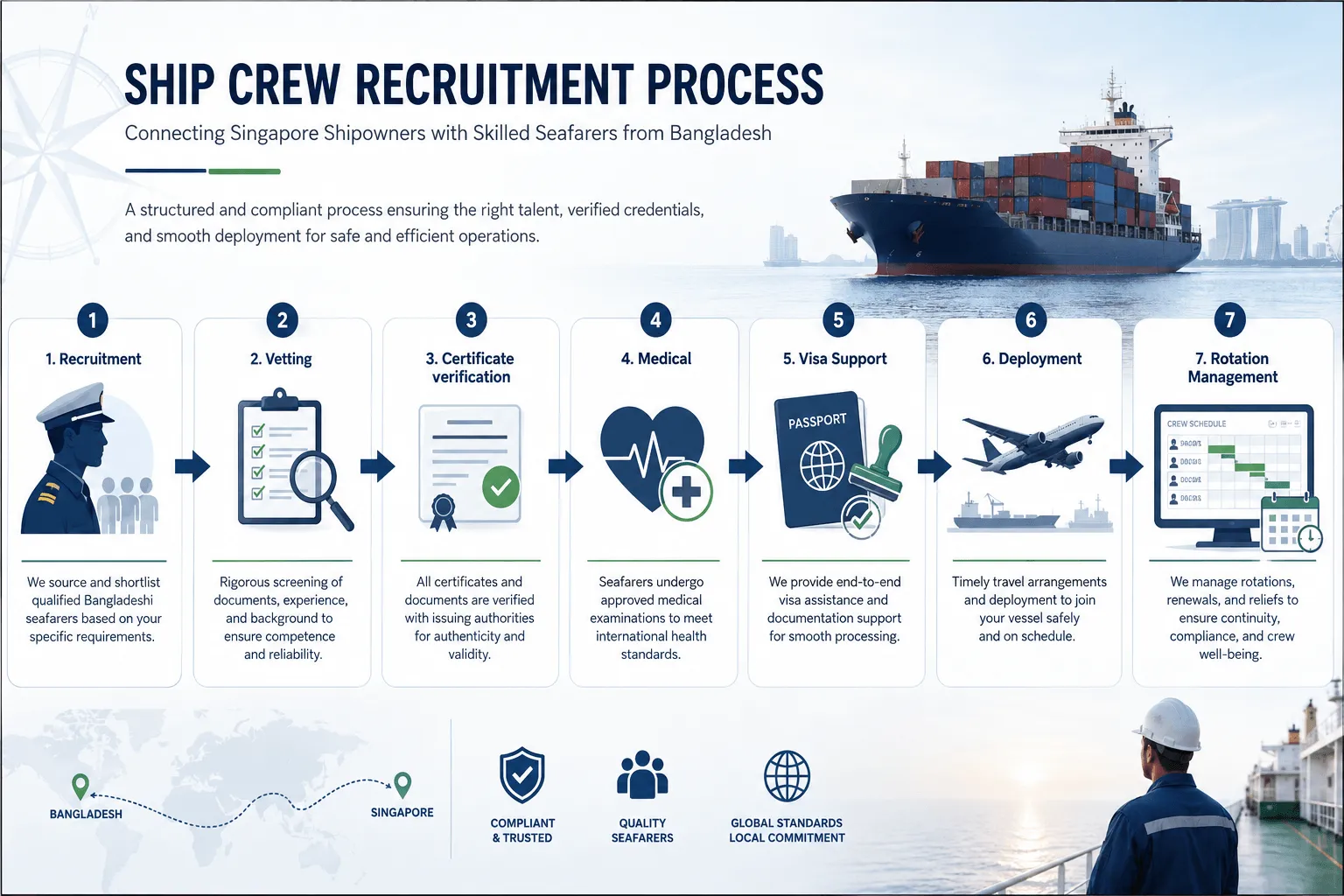
A professional Bangladesh manning agency supports Singapore shipowners by managing the full crew cycle: recruitment, screening, certificate verification, interviews, medicals, flag documentation, visas, travel, joining logistics, payroll coordination, relief planning, rotation management, welfare follow-up, emergency replacement, and audit-ready crew documentation.
For Singapore ship managers, the agency’s operational discipline matters as much as the crew database. The agency should reduce administrative friction, not create another layer of risk.
1. Recruitment and Candidate Sourcing
The agency should maintain an active database of Bangladesh seafarers by rank, vessel type, certificate status, salary expectation, availability date, and previous employer history. For urgent crew outsourcing Singapore requests, this database must be searchable and current.
2. Technical Vetting
Initial CV screening is not enough. The agency should verify:
Last vessel type
Rank actually served
Engine type or tonnage experience
Cargo experience
Trading area
Contract completion record
Appraisal history
Reason for leaving previous vessel
English communication level
3. Certificate Verification
Bangladesh has official online verification options for CoC and CoP, which helps employers confirm candidate documentation before mobilization. Agencies should also check passport validity, CDC records, medical certificate validity, flag endorsements, and tanker certificates.
4. Interview Coordination
The agency should arrange structured interviews with technical superintendents, fleet managers, marine HR teams, or vessel Masters. Interview notes should be documented and stored.
5. Medical and Fitness Management
Pre-employment medical examinations reduce the risk of failed joining, repatriation, or onboard health incidents. For demanding vessel types, medical review should be completed before ticketing.
6. Visa, Travel, and Joining Logistics
Crew logistics can be a silent killer of efficiency. The agency should coordinate joining instructions, visa documents, OK-to-board requirements, flights, local transport, agent contact, and emergency communication.
7. Payroll and Contract Support
Maritime payroll must align with Seafarer Employment Agreements, allotments, overtime terms, leave pay, and MLC expectations. Payroll errors damage trust and retention quickly.
8. Relief Planning and Rotation Management
A strong agency tracks sign-on dates, contract completion, relief readiness, documentation expiry, and overlap requirements. This helps avoid last-minute panic recruitment.
9. Emergency Replacement
Ships do not wait politely while HR has a bad week. A dependable agency should offer emergency replacement support for sickness, family emergencies, disciplinary cases, or failed joining.
10. Welfare and Retention Follow-Up
Crew retention improves when seafarers feel treated fairly. Agencies should maintain contact with crew, support families where appropriate, resolve payment concerns quickly, and identify early warning signs before resignation.
Cost Benefits Without Sacrificing Quality
Bangladesh seafarers can reduce total crewing cost when lower wage expectations are combined with verified competence, stable contracts, good retention, and fewer replacement disruptions. The real cost benefit comes from total crew lifecycle savings: recruitment efficiency, reduced turnover, lower travel waste, fewer delays, and stronger onboard productivity.
The simplest mistake in crew outsourcing Singapore decisions is comparing only monthly wages. A better calculation looks at total crewing cost per completed contract.
Example 1: Lower Turnover Savings
Assume a shipowner hires an AB at a competitive monthly wage but replaces the crew member twice due to poor screening.
Extra cost may include:
Agency fee for replacement
Additional airfare
Port agent handling
Visa processing
Medical examination
Administration time
Handover inefficiency
Master and superintendent involvement
If one failed deployment costs USD 1,500–3,000 in direct and indirect cost, a slightly higher-quality candidate with a better completion probability is cheaper over the contract.
Example 2: Officer Retention ROI
Assume a Second Engineer completes three consecutive contracts with the same Singapore ship manager. The second and third deployments usually require less onboarding time because the officer already understands:
Company reporting system
PMS routines
Superintendent expectations
Spare parts process
Safety culture
Vessel class and flag expectations
Common machinery issues
That continuity can reduce errors, speed up handovers, and improve maintenance discipline. In practical crew management, familiar competent officers are gold dust — not glamorous, but very good for blood pressure.
Example 3: Avoided Delay Cost
If a vessel’s joining crew arrives without a correct flag endorsement or medical certificate, the ship may face delay or emergency replacement. Even a small delay can cost more than several months of wage savings.
This is why a professional Bangladesh crew manning agency must not sell “low-cost crew” as the main promise. The correct promise is controlled cost with controlled risk.
Where Bangladesh Can Create Savings
Competitive wage structures
Good retention when employment terms are clear
Lower repeated recruitment costs
Reduced emergency replacement frequency
Stronger long-term crew pool development
Cadet-to-officer pipeline opportunities
Reliable ratings for deck and engine departments
Flexible mixed-crew deployment
For Singapore shipping companies, the commercial sweet spot is not paying the least. It is paying fairly for crew who complete contracts, pass inspections, follow procedures, communicate clearly, and return for future rotations.
Questions Singapore Shipowners Should Ask Before Choosing a Manning Agency
Singapore shipowners should choose a manning agency only after checking license status, MLC compliance, certificate verification methods, crew database quality, emergency support, retention performance, vessel-type experience, documentation controls, payroll transparency, and client references. A weak agency can create compliance, safety, and operational risks even when candidates look good on paper.
Use this checklist before appointing a Bangladesh crew manning agency or seafarer recruitment agency Singapore partner.
Agency Compliance Checklist
Is the agency licensed or approved by the relevant national authority?
Is the agency familiar with MLC 2006 recruitment and placement expectations?
Does the agency issue transparent employment terms?
Are recruitment fees charged to seafarers in a prohibited or unethical way?
Are crew complaints recorded and resolved?
Can the agency support audit requests from owners, flag, class, or clients?
Bangladesh’s Department of Shipping publishes approved seafarer recruiting agents, which is a useful starting point for checking agency legitimacy.
Certificate Verification Checklist
Does the agency verify CoC and CoP through official channels?
Are STCW certificates checked for validity and relevance?
Are tanker endorsements verified before nomination?
Are medical certificates issued by approved doctors?
Are flag endorsements tracked?
Are document expiry dates monitored before joining?
Crew Quality Checklist
How many active seafarers are in the database by rank?
What is the average contract completion rate?
What is the repeat deployment rate?
Can the agency provide previous employer references?
Are English interviews conducted?
Are technical interviews recorded?
Does the agency screen for disciplinary history?
Operational Support Checklist
Can the agency provide emergency replacement?
How quickly can shortlisted candidates be proposed?
Does the agency support visa and travel documentation?
Who handles after-hours emergencies?
Is there a designated account manager?
Can the agency handle crew change coordination in multiple ports?
Commercial Checklist
Is the fee structure transparent?
Are wages benchmarked by rank and vessel type?
Are payroll responsibilities clearly defined?
Are replacement terms written into the agreement?
Are repatriation responsibilities clear?
Are hidden costs avoided?
Red Flags
Avoid agencies that:
Promise unrealistically low wages
Cannot verify certificates
Avoid MLC questions
Have no clear complaint process
Push candidates without interviews
Cannot explain flag endorsement requirements
Provide incomplete crew documentation
Hide replacement policies
Treat welfare as “not our problem”
In maritime recruitment, boring documentation is beautiful. If the paperwork is clean, current, and easy to audit, your crewing life gets much less dramatic.
Expert Checklist for Singapore Maritime HR Teams
Singapore maritime HR teams should evaluate Bangladesh seafarer recruitment through a structured checklist covering compliance, competence, cost, continuity, welfare, and emergency readiness. The strongest manning partnerships are built on verified documentation, rank-specific screening, transparent contracts, measurable retention, and a shared commitment to safe vessel operations.
Use this expert checklist when building or reviewing a Bangladesh-to-Singapore crew pipeline.
Compliance
Confirm agency approval or licensing status.
Verify MLC 2006 recruitment and placement procedures.
Confirm STCW certificate validity.
Check flag-state endorsement requirements.
Keep digital crew files audit-ready.
Track document expiry dates automatically.
Confirm Seafarer Employment Agreements before joining.
Competence
Match experience to vessel type.
Conduct English communication checks.
Use structured technical interviews.
Review appraisal records.
Check incident and disciplinary history.
Confirm cargo-specific competence for tankers, gas carriers, and bulk carriers.
Validate engine type or machinery experience for engineers.
Cost Control
Compare total contract cost, not just wage.
Track replacement frequency.
Measure contract completion rates.
Review travel and visa cost efficiency.
Evaluate repeat deployment savings.
Build preferred crew pools for repeat rotations.
Continuity
Create rank-wise succession planning.
Develop cadets for future officer roles.
Keep standby crew for key ranks.
Maintain crew rotation calendars.
Plan reliefs at least 60–90 days ahead where possible.
Track family emergency and leave patterns respectfully.
Welfare
Ensure fair wage payment.
Monitor food and accommodation feedback.
Maintain complaint channels.
Support repatriation rights.
Keep emergency family contact records.
Follow up after sign-off.
Risk Management
Prepare for PSC inspections.
Align crew briefing with SMS requirements.
Maintain rest-hour awareness.
Check fatigue risk before joining.
Review vessel-specific hazards.
Keep emergency replacement candidates pre-screened.
Frequently Asked Questions
The most common questions about Bangladesh seafarers and Singapore crew recruitment focus on certification, compliance, timing, vessel fit, English ability, and agency reliability. Singapore employers should use these answers as a practical starting point, then verify details based on vessel type, flag, rank, trading area, and company requirements.
1. Why recruit Bangladesh seafarers?
Bangladesh seafarers are a strong option for Singapore shipowners because they offer competitive employment costs, English working ability, discipline, adaptability, and growing international vessel experience. When recruited through a compliant agency, they can support safe, cost-effective operations across deck, engine, catering, and rating roles.
2. Are Bangladesh officers STCW certified?
Many Bangladesh officers hold STCW-based certificates issued under national maritime authority systems. Singapore employers should verify each officer’s CoC, CoP, sea service, medical fitness, and flag endorsement requirements before deployment. STCW certification must always match rank, vessel type, trading area, and onboard responsibility.
3. Is Bangladesh recognized internationally for seafarer supply?
Bangladesh is a growing seafarer supply country with maritime training institutions, national certification systems, and seafarers serving on national and foreign-flagged vessels. Employers should work with approved agencies and verify documents through official channels before mobilizing any Bangladesh maritime workforce candidate.
4. What certificates are required for Singapore ship crew recruitment?
Typical requirements include passport, CDC or seaman book, STCW certificates, CoC or CoP, medical fitness certificate, security training, flag endorsement, and rank-specific documents. Tankers, gas carriers, ETO roles, and GMDSS duties require additional specialized certificates based on vessel and flag requirements.
5. How does MLC compliance help shipowners?
MLC compliance protects shipowners by reducing labor disputes, wage issues, welfare complaints, repatriation problems, and inspection risks. It also supports crew retention because seafarers are more likely to complete contracts when employment terms, payment, rest, medical care, and complaint procedures are properly managed.
6. Can Bangladesh agencies supply mixed crews?
Yes, a professional Bangladesh crew manning agency can support mixed-crew operations where Bangladesh officers or ratings work alongside other nationalities. Mixed crews are common in international shipping, but the agency should assess English communication, cultural adaptability, leadership style, and previous multinational crew experience.
7. How long does recruitment take?
Recruitment timing depends on rank, vessel type, certificate requirements, notice period, medicals, visa needs, and joining port. Ratings may be available faster, while senior officers, tanker officers, ETOs, and specialized offshore crew usually require more lead time and deeper verification.
8. What vessel types can Bangladesh seafarers support?
Bangladesh seafarers can support bulk carriers, tankers, container ships, offshore vessels, general cargo ships, tugs, Ro-Ro vessels, heavy-lift ships, and gas carriers when they have the required certificates and experience. Vessel-specific vetting is essential before nomination.
9. What is crew replacement time?
Crew replacement time depends on candidate availability, rank, document readiness, travel route, visa requirements, and joining port. A well-managed agency should maintain pre-screened standby candidates for common ranks and provide realistic mobilization timelines instead of making risky promises.
10. How are certificates verified?
Certificates should be verified through issuing authority systems, official online verification portals, direct authority checks where needed, and document consistency reviews. Employers should compare certificate details with CDC records, sea service, passport identity, medical certificates, and rank requirements before approval.
11. Are Bangladesh officers English speaking?
Many Bangladesh officers use English as their working language in maritime training and international shipboard operations. However, English ability should still be tested during interviews, especially for Masters, Chief Officers, Chief Engineers, Second Engineers, ETOs, and bridge watchkeeping officers.
12. Why choose a Bangladesh manning agency for Singapore?
A Bangladesh manning agency can help Singapore shipowners access cost-effective seafarers, verified certificates, stable contract completion, and a growing maritime workforce. The best agencies combine recruitment, compliance, logistics, welfare, payroll coordination, and emergency replacement support under one accountable process.
13. Can Bangladesh supply tanker crew?
Yes, Bangladesh can supply tanker crew when candidates hold the correct oil, chemical, or gas tanker endorsements and have relevant cargo experience. Tanker recruitment should include additional vetting for cargo operations, safety culture, enclosed-space procedures, pollution prevention, and OCIMF-style inspection readiness.
14. Are Bangladesh ratings suitable for bulk carriers?
Bangladesh ratings can be a good fit for bulk carriers when they have relevant deck or engine experience, valid STCW documents, medical fitness, and strong work discipline. Employers should check cargo hold cleaning experience, mooring skills, maintenance ability, and safety awareness before selection.
15. What makes a manning agency MLC compliant?
An MLC compliant manning agency follows fair recruitment practices, transparent employment agreements, proper wage handling, complaint procedures, repatriation support, medical documentation, and crew welfare standards. It should maintain records that can support owner audits, flag checks, and labor compliance reviews.
Conclusion
Bangladesh seafarers are a strategic choice for Singapore shipping companies that want cost-effective, compliant, and reliable crew supply. The strongest results come when shipowners work with a professional Bangladesh crew manning agency that verifies documents, screens competence, supports welfare, manages logistics, and treats compliance as a core operational function.
A good crew manning agency Singapore shipowners can trust should not compete only on price. It should compete on documentation quality, candidate fit, speed of support, retention performance, emergency readiness, and practical understanding of ship operations.
Bangladesh offers Singapore shipowners an increasingly attractive maritime workforce: deck officers, engine officers, ratings, cooks, ETOs, cadets, and vessel-specific crew for bulk carriers, tankers, container ships, offshore vessels, and general cargo ships. The value is especially strong when cost-effective seafarers are paired with proper STCW certification, MLC-aligned recruitment, ISM Code awareness, medical readiness, and transparent employment practices.
For Singapore shipowners, ship managers, operators, offshore companies, and maritime HR departments, the decision is simple in principle but important in execution: choose crew partners that reduce operational risk, not just monthly payroll. A professional Bangladesh crew manning agency can help build that advantage by supplying capable seafarers who support safe, efficient, and commercially sustainable vessel operations.
If your company is evaluating Bangladesh seafarers for Singapore ship crew recruitment, start with a structured crew requirement review: vessel type, rank, certificate needs, flag requirements, joining port, contract duration, salary range, and replacement timeline. From there, the right agency can shortlist qualified candidates, verify documents, and support your crewing team with a clean, compliant recruitment process.
📋 Looking to source crew now? Request Crew on WhatsApp and receive a customised candidate list within 24–48 hours.