 Ship Crew Agency
Maritime Editorial Team
In This Article
- Bangladesh vs Philippines Seafarers: Quick Comparison
- Market Context: Philippines Is Mature, Bangladesh Is Emerging
- Crew Cost Comparison Bangladesh Philippines
- Seafarer Salary Comparison 2026
- Master Salary Comparison
- Chief Officer Salary Comparison
- Able Seaman Salary Comparison
- Why Shipowners Are Increasingly Hiring Bangladeshi Seafarers
- STCW Compliance: Bangladesh vs Philippines
- English Communication Skills Comparison
- Port State Control Performance Comparison
- Retention and Loyalty: Bangladesh vs Philippines
- Officer Availability and Rank Strength
- Long-Term ROI for Shipowners
- Global Crew Sourcing Trends
- Are Filipino Seafarers Still the Best?
- Is Bangladesh Becoming a Major Maritime Labor Supplier?
- Which Nationality Offers Better Value for Money?
- Key Takeaways for Shipowners
- FAQs
- 1. Bangladesh vs Philippines seafarers: which is better?
- 2. Are Bangladeshi seafarers cheaper?
- 3. Are Bangladeshi officers STCW certified?
- 4. Why are shipowners recruiting from Bangladesh?
- 5. What is the salary difference between Bangladeshi and Filipino seafarers?
- 6. Do Bangladeshi seafarers work on international vessels?
- 7. Are Filipino seafarers still in demand?
- 8. Is Bangladesh a good source for ship crew?
- 9. Which country has better English-speaking seafarers?
- 10. Do both countries follow STCW standards?
- 11. Which nationality has better PSC performance?
- 12. Why diversify crew sourcing beyond the Philippines?
- 13. Are Bangladeshi seafarers suitable for tankers?
- 14. Which country offers better long-term ROI?
- 15. Should shipowners hire Bangladeshi or Filipino seafarers in 2026?
- Looking for Qualified Bangladeshi Seafarers?
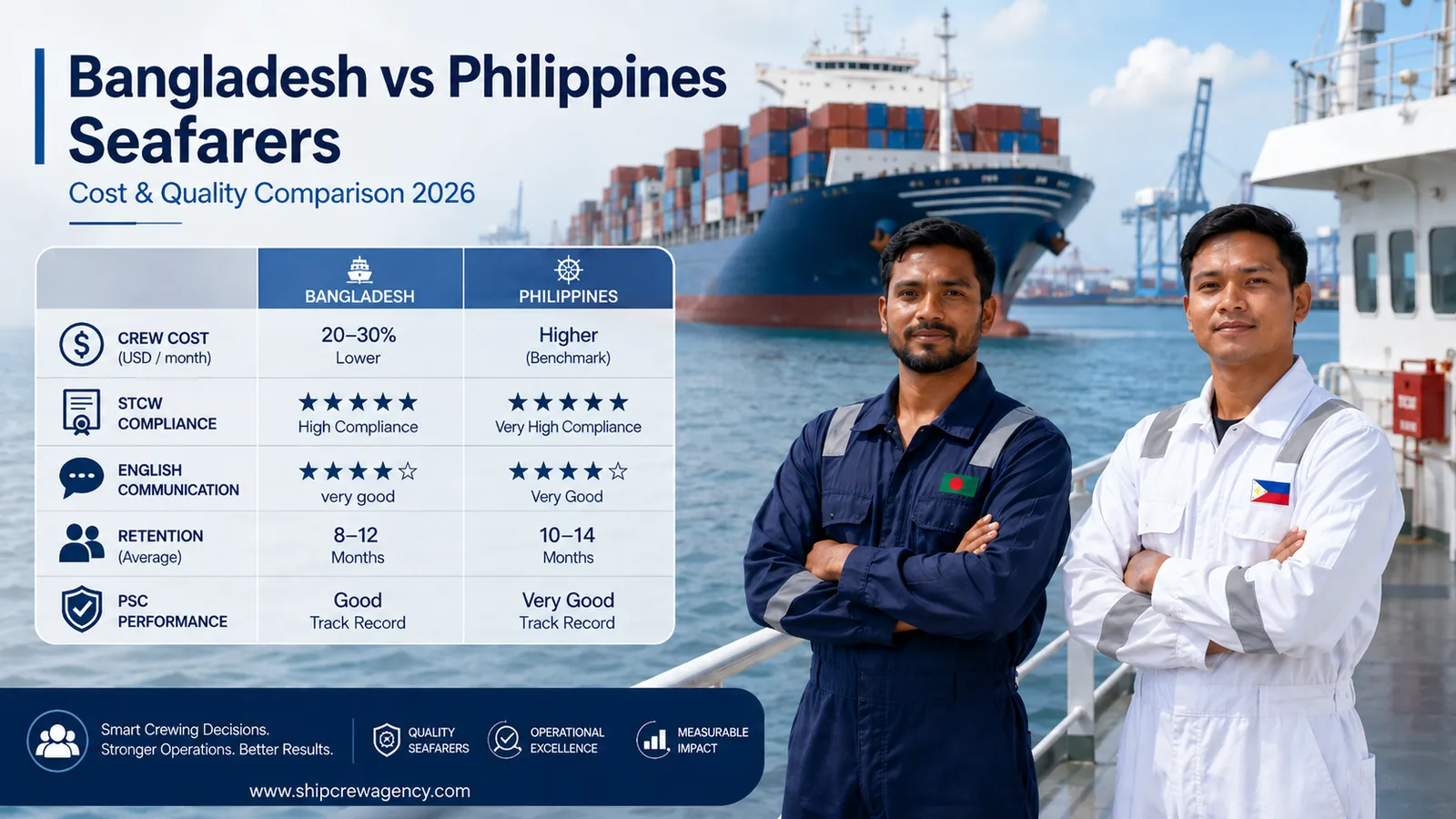
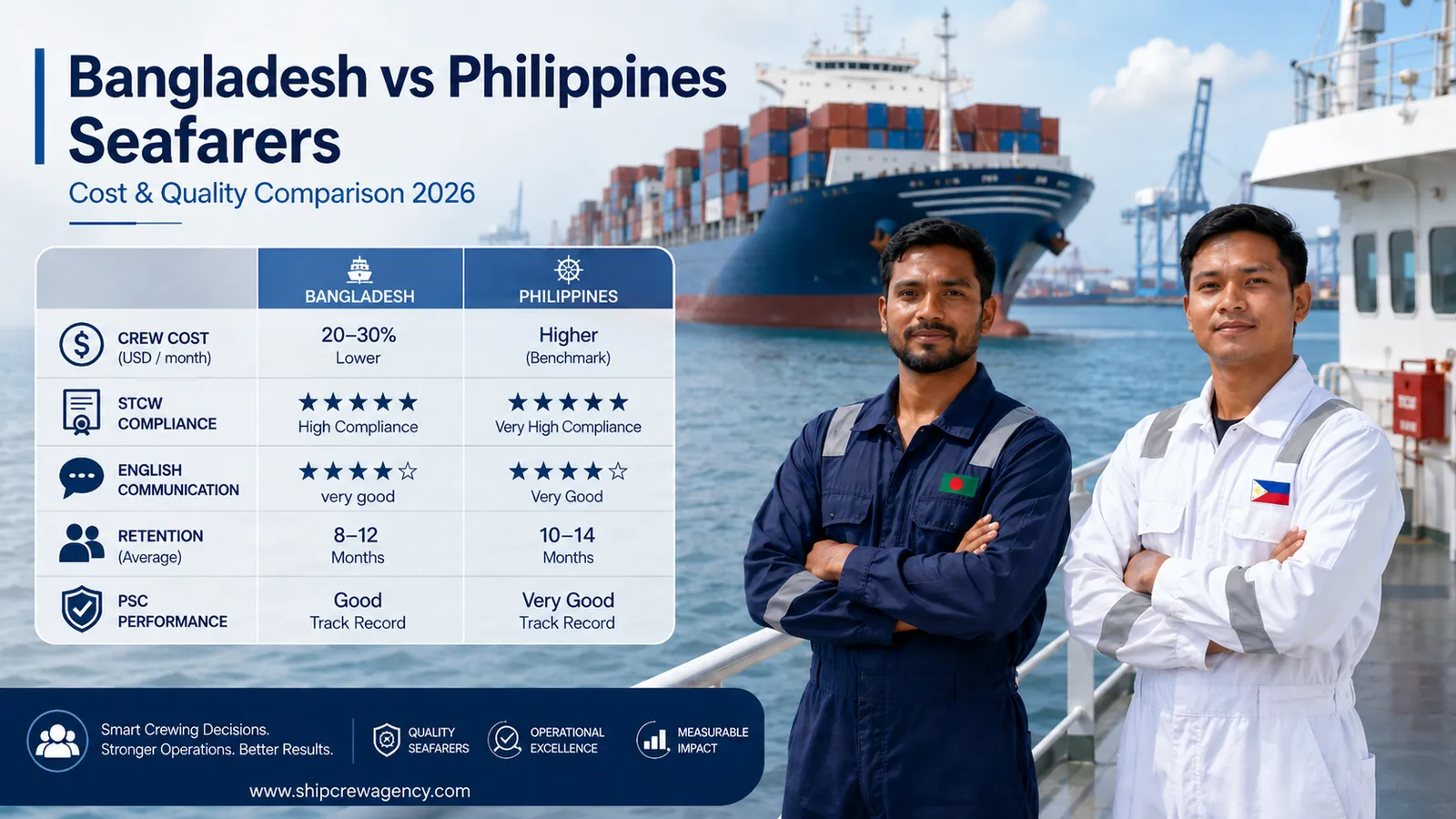
The debate around bangladesh vs philippines seafarers is becoming more important for shipowners, ship managers, and crewing managers in 2026. For decades, the Philippines has been the default crew sourcing hub for global shipping. Filipino officers and ratings are familiar to shipowners in Singapore, Greece, Norway, Japan, and the United Kingdom. Their reputation is built on scale, English communication, and global deployment experience.
But the crew market is changing. Global ship management companies are facing officer shortages, higher wage expectations, stricter compliance requirements, and more pressure to control vessel operating costs. As a result, shipowners are diversifying beyond traditional maritime manpower Philippines pipelines and looking at emerging seafarer markets.
Bangladesh is one of those markets. The country has a long maritime tradition, growing maritime academy output, STCW certification Bangladesh infrastructure, and a cost base that appeals to operators managing bulk carriers, tankers, container vessels, offshore support vessels, and general cargo ships.
This article compares Bangladeshi seafarers vs Filipino seafarers across crew cost, wage levels, STCW compliance, English proficiency, PSC performance, retention, recruitment cost, and long-term return on investment.
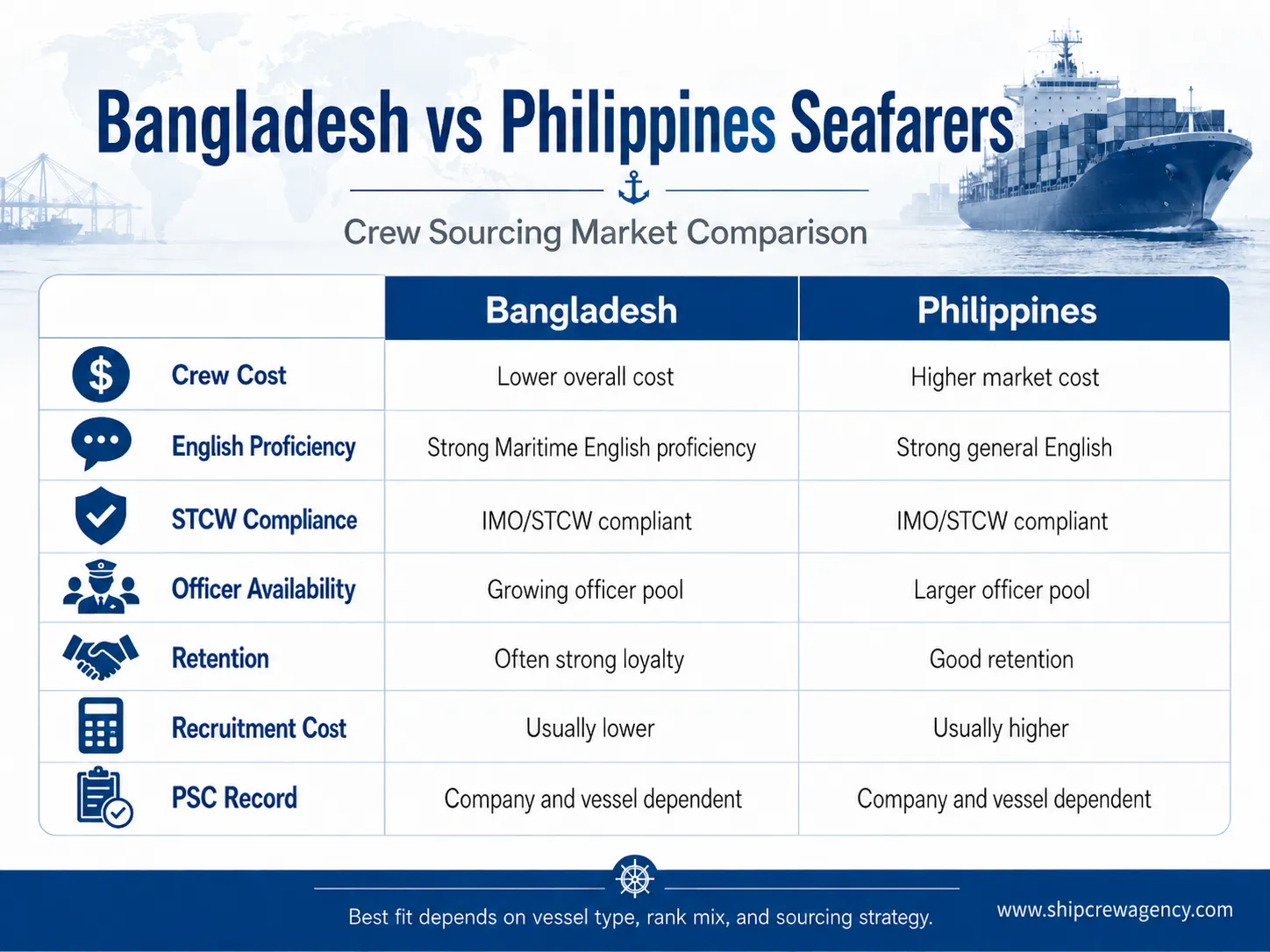
Bangladesh vs Philippines Seafarers: Quick Comparison
Factor | Bangladesh | Philippines |
Crew Cost | Lower overall crew cost; strong value in ratings and junior officers | Higher average cost due to global demand and mature manning market |
English Proficiency | Strong Maritime English proficiency, effective onboard communication, and extensive experience on multinational vessels | Strong Maritime English proficiency and extensive experience working in multinational crew environments |
STCW Compliance | STCW-compliant training and certification framework | STCW-compliant and globally established certification system |
Officer Availability | Growing officer pool; smaller than Philippines | Large senior and junior officer pool |
Retention Rate | Often strong loyalty and lower turnover in stable placements | Good retention, but high demand can increase mobility |
Crew Supply Growth | Emerging and expanding maritime labor market | Mature, large-scale global seafarer supplier |
Recruitment Cost | Usually lower agency and mobilization cost | Often higher due to competition and established wage expectations |
PSC Record | Vessel/company dependent; no reliable nationality-only PSC ranking | Vessel/company dependent; strong global familiarity |
Overall Value | Strong cost-to-quality option for diversified crew sourcing | Strong premium option for scale, English, and proven global deployment |
Executive summary:
For 2026 crew sourcing, the Philippines remains the world’s most established seafarer supplier, especially for senior officers, English communication, and large-scale deployment. Bangladesh is not yet equal in scale, but it is becoming a serious alternative for shipowners seeking cost efficiency, loyal crews, lower recruitment expenses, and STCW-compliant marine personnel. The best strategy is not either-or; it is smart crew diversification by vessel type, trading area, and rank.
Market Context: Philippines Is Mature, Bangladesh Is Emerging
The Philippines is a global maritime manpower giant. It has a deep seafaring culture, a large number of licensed manning agencies, strong government support through maritime agencies, and decades of experience supplying officers and ratings to international vessels. For shipowners hiring Filipino seafarers, the biggest advantage is predictability. The market is mature, documented, and familiar.
Bangladesh is smaller, but its advantage is different. It offers an emerging pool of marine personnel at competitive salary levels. Shipowners hiring Bangladeshi seafarers often focus on cost efficiency, long-term loyalty, and building stable manning pipelines before the market becomes saturated.
This matters because the shipping industry is not simply buying labor. It is buying operational reliability. A cheap crew that creates detention risk, communication failure, or high turnover is not cost-effective. Likewise, an expensive crew that performs well but strains operating budgets may not be the best fit for every vessel segment.
The real question is: which nationality gives better total crew value for a specific fleet?
Crew Cost Comparison Bangladesh Philippines
For most shipowners, crew cost is the first comparison point. Crew expenses are among the largest recurring operating costs in vessel operations. They include monthly wages, overtime, leave pay, social contributions, agency fees, visa processing, training, documentation, travel, joining expenses, replacement costs, and repatriation.
In many cases, Bangladeshi seafarers provide lower total crew employment costs than Filipino seafarers. This is especially visible in ratings, junior officers, and mixed-crew arrangements.
Cost Area | Bangladesh | Philippines | Practical Impact |
Basic wage expectation | Generally lower | Generally higher | Bangladesh can reduce monthly crew wage cost |
Agency/manning fees | Often lower | Often higher in established channels | Bangladesh can reduce recruitment overhead |
Mobilization cost | Competitive | Moderate to high depending on port and contract | Bangladesh may lower joining cost in Asia routes |
Replacement cost | Lower if retention is strong | Can be higher in competitive rank categories | Bangladesh may reduce repeat recruitment expense |
Senior officer premium | Growing but still competitive | Higher for experienced senior officers | Philippines remains strong but costly |
Training/documentation | Competitive | Mature but can be more expensive | Depends on agency and flag requirements |
The Philippines is not “overpriced.” It is a mature market where demand is strong, and experienced seafarers know their value. Filipino crews are widely trusted, so shipowners often pay a premium for speed, availability, and familiarity.
Bangladesh, by contrast, offers cost leverage. For owners operating cost-sensitive fleets, especially in dry bulk, general cargo, small tankers, feeder vessels, and mixed nationality crews, Bangladesh can offer attractive crew manning economics.
Seafarer Salary Comparison 2026
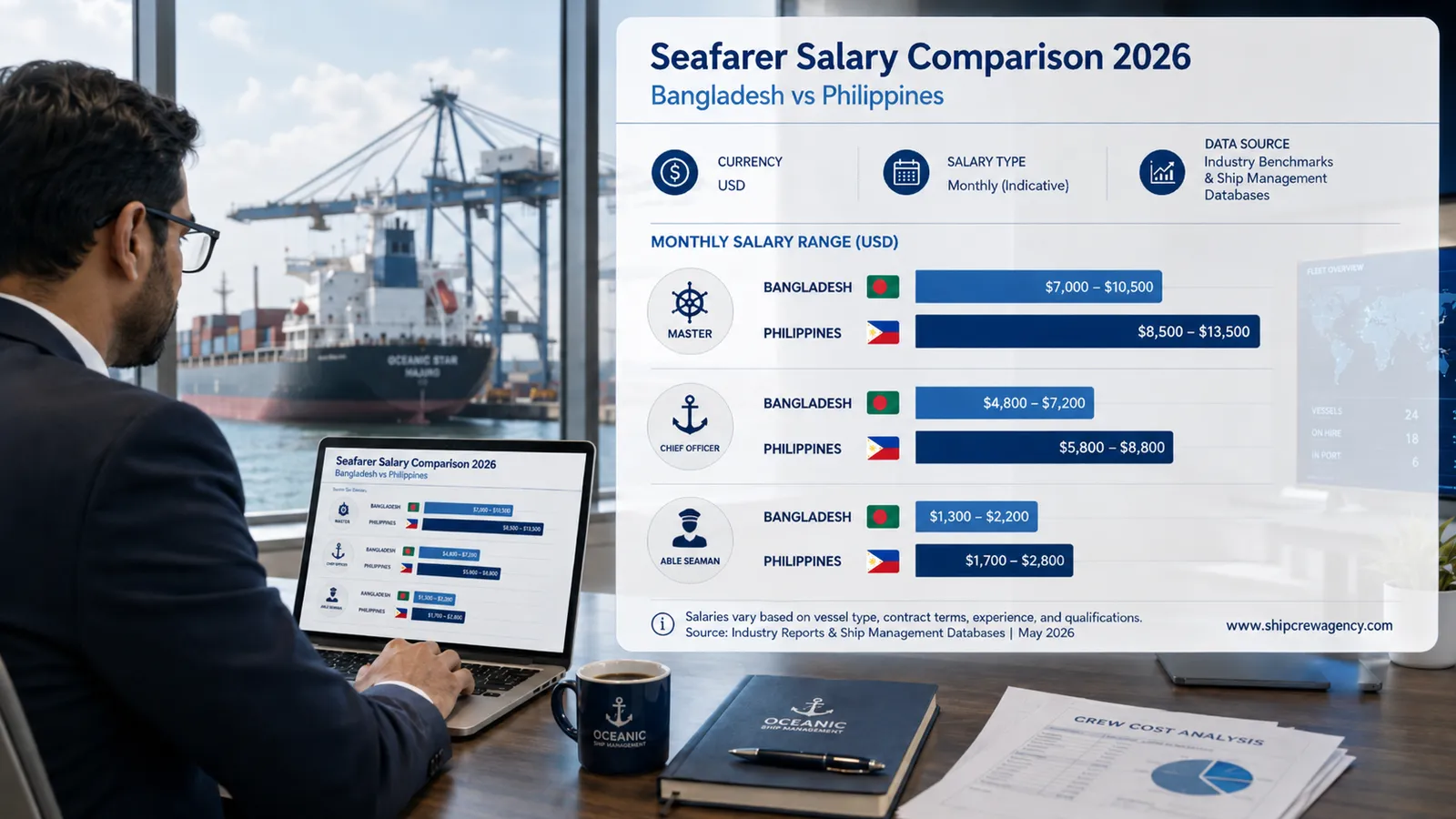
Seafarer salary comparison 2026 should be treated carefully. There is no single universal wage for a Bangladeshi Master or Filipino AB. Pay depends on vessel type, flag, CBA, ITF coverage, trading area, rank, seniority, tanker endorsement, DP certification, LNG experience, and employer reputation.
The following tables show indicative 2026 monthly salary ranges in USD for international merchant vessels. They are useful for planning, not final contract negotiation.
Master Salary Comparison
Rank | Bangladesh | Philippines |
Master | $7,000–$10,500 | $8,500–$13,500 |
Masters command the highest nationality premium because the role affects safety, charterer confidence, cargo performance, inspections, crew discipline, and emergency response. Filipino Masters often command higher wages due to larger international experience pools and long-standing market demand. Bangladeshi Masters can be more cost-effective, especially where the owner has already built trust with a maritime recruitment agency Bangladesh or a reliable crew manning agency Bangladesh.
Chief Officer Salary Comparison
Rank | Bangladesh | Philippines |
Chief Officer | $4,800–$7,200 | $5,800–$8,800 |
Chief Officers are critical for cargo operations, deck maintenance, safety drills, ISM implementation, and bridge team performance. Filipino Chief Officers are often preferred for multinational communication and proven cargo experience, especially on tankers and container vessels. Bangladeshi Chief Officers can deliver strong value when properly screened for vessel type, cargo background, and English communication.
Able Seaman Salary Comparison
Rank | Bangladesh | Philippines |
AB | $1,300–$2,200 | $1,700–$2,800 |
Able Seamen show one of the clearest cost differences. The ILO/ITF global minimum basic wage benchmark for ABs provides a floor, but actual total monthly earnings often include overtime, leave pay, fixed allowances, and contract-specific benefits. Filipino ABs usually command higher total wages due to global demand and established deployment channels. Bangladeshi ABs can be a strong cost-efficient option for ship crew sourcing Bangladesh strategies.
Why Shipowners Are Increasingly Hiring Bangladeshi Seafarers
Shipowners are increasingly hiring Bangladeshi seafarers because Bangladesh offers a combination of lower labor costs, expanding officer supply, STCW-compliant training, and strong loyalty. This does not mean Bangladesh replaces the Philippines. It means Bangladesh is becoming a strategic alternative for crew sourcing diversification.
The first driver is cost. Many shipowners are under pressure from fuel volatility, insurance premiums, dry-docking costs, environmental compliance, and freight market uncertainty. When crew costs rise, owners look for new labor markets that can maintain safety without inflating operating expenditure.
The second driver is retention. Bangladeshi seafarers are often viewed as loyal when placed with serious employers offering fair wages, timely payment, transparent contracts, and career progression. For ship managers, retention matters because every crew change creates cost, administrative work, and operational risk.
The third driver is training output. Bangladesh has maritime training institutions, a maritime university, and academy-based training infrastructure. The country is producing officers and ratings who can join international vessels when documentation, flag endorsement, and recruitment screening are handled correctly.
The fourth driver is recruitment cost. A reliable maritime recruitment agency Bangladesh can often mobilize Bangladeshi officers and ratings at lower overall recruitment cost than more saturated markets.
The fifth driver is diversification. Overdependence on one seafarer nationality creates risk. Visa disruption, wage inflation, geopolitical issues, medical restrictions, or sudden deployment bottlenecks can affect crew rotation. Bangladesh gives shipowners another source of marine personnel.
Recommendation for shipowners:
Use Bangladesh as part of a structured crew diversification strategy. Start with selected ranks, evaluate vessel performance, monitor retention, measure PSC outcomes, and then scale gradually. The smartest approach is not replacing Filipino seafarers overnight. It is building a balanced pool across Bangladesh, Philippines, India, Indonesia, and other qualified crew market.
📋 Shipowners hiring Bangladeshi seafarers for cost-effective crew sourcing? Request a Crew Proposal from Request Crew on WhatsApp and receive a customised candidate list within 24–48 hours.
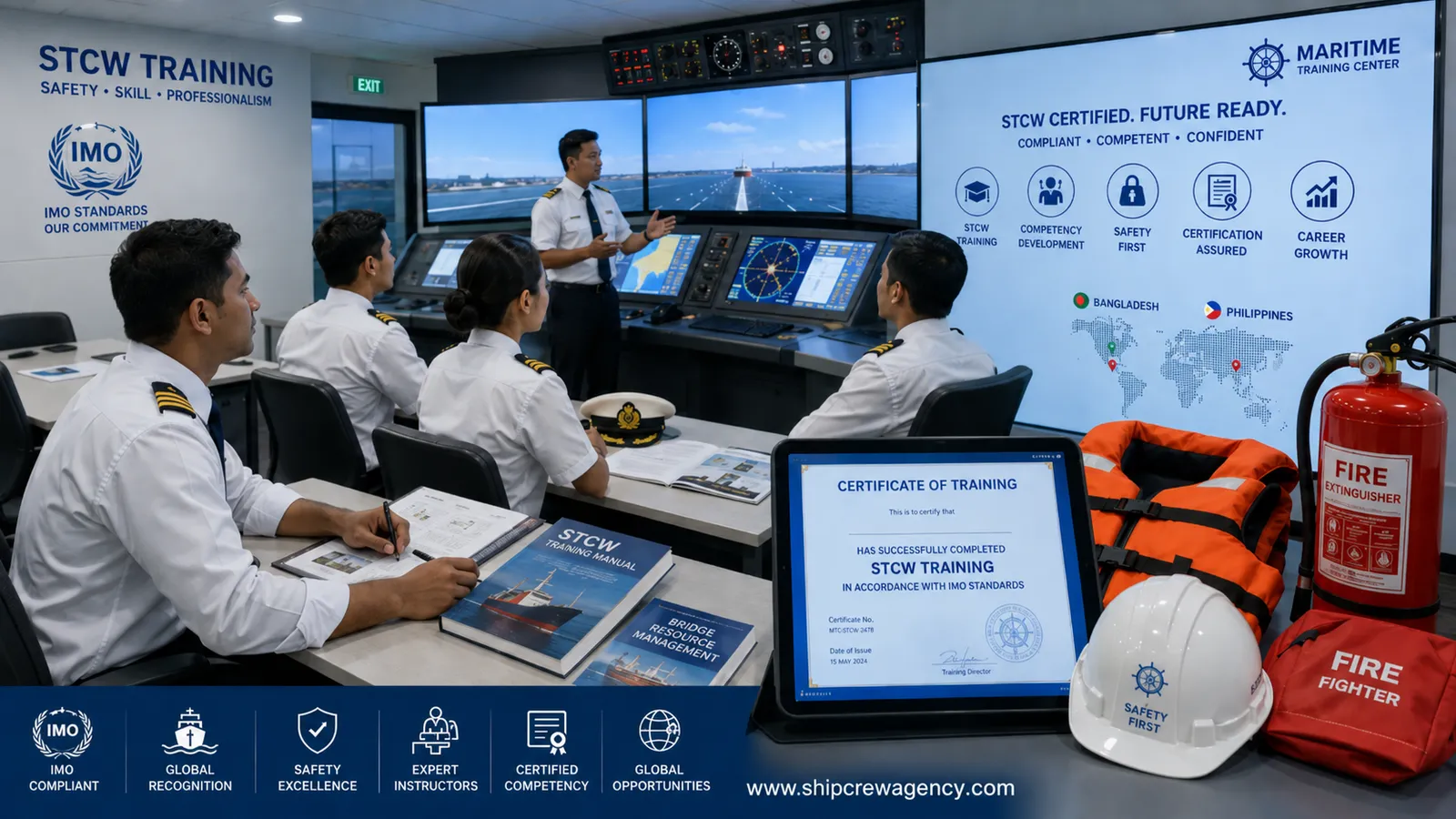
STCW Compliance: Bangladesh vs Philippines
STCW compliance is one of the most important questions in any maritime recruitment Bangladesh or maritime manpower Philippines comparison. The STCW Convention sets global standards for training, certification, and watchkeeping. It is the baseline for safe vessel operations.
Both Bangladesh and the Philippines operate within the STCW framework. That means seafarers must receive approved training, hold valid certificates, meet medical fitness requirements, and comply with watchkeeping standards.
STCW Factor | Bangladesh | Philippines |
STCW Convention alignment | Yes | Yes |
IMO White List relevance | Recognized through IMO STCW compliance process | Confirmed and widely recognized |
Training institutions | Growing network of maritime academies and institutes | Large mature network of maritime schools and training centers |
Certificate verification | Available through national systems | Available through MARINA and related systems |
Flag state acceptance | Depends on flag endorsement and documentation | Broad global familiarity and acceptance |
International recognition | Growing | Very strong |
The Philippines has the advantage of global familiarity. Many shipowners, charterers, P&I clubs, and technical managers already understand Filipino certification pathways. That lowers perceived risk.
Bangladesh’s advantage is improving capacity. Its training framework is aligned with STCW, and Bangladeshi seafarers can be deployed internationally when agencies manage documentation, certificate verification, flag endorsement, medicals, and visa requirements properly.
For shipowners, the practical question is not simply whether STCW certification Philippines is stronger than STCW certification Bangladesh. The practical question is whether each candidate’s certificate, sea time, rank experience, endorsement, and vessel-type experience match the job.
English Communication Skills Comparison
English communication is a major reason Filipino seafarers became so dominant in global shipping. The Philippines generally has stronger English proficiency, more everyday English exposure, and decades of experience working in multinational crews. For bridge communication, safety drills, port coordination, and reporting, this is a clear advantage.
Bangladeshi seafarers also speak English and receive Maritime English training. In practice, the quality varies by academy, rank, sea time, and international exposure. Senior Bangladeshi officers with international experience can communicate effectively. Junior ratings may need stronger screening for spoken English, especially on vessels with multinational crews.
Communication Area | Bangladesh | Philippines |
Maritime English training | Yes | Yes |
General English exposure | Moderate | High |
Bridge communication | Good among trained officers; screen carefully | Usually strong |
Engine room communication | Generally functional | Strong and familiar |
Customer-facing roles | Suitable with screening | Strong for cruise/passenger/hospitality roles |
Multinational integration | Improving | Highly established |
For shipowners, English should not be judged only by nationality. It should be tested during recruitment. A short Maritime English interview, SMCP-based communication test, and scenario-based bridge/engine room question can reveal more than a passport.
Filipino crews generally win on English communication. Bangladeshi crews can still perform well when the manning agency screens communication, ranks, vessel background, and emergency response language properly.
Port State Control Performance Comparison
Port State Control performance is often misunderstood. There is no reliable global PSC performance by nationality ranking that proves Bangladeshi or Filipino seafarers are safer as a group. PSC regimes such as Paris MoU, Tokyo MoU, and Indian Ocean MoU primarily inspect vessels, flag states, recognized organizations, ISM performance, documentation, safety equipment, working conditions, pollution prevention, and crew certification.
A ship may be detained because of defective fire doors, expired certificates, poor maintenance, unpaid wages, unsafe working conditions, missing drills, ISM failure, or MLC 2006 non-compliance. Those are usually company, vessel, flag, and management issues — not simply nationality issues.
PSC Factor | Main Driver | Nationality Role |
Certification deficiencies | Documentation control, flag endorsement, agency checks | Nationality matters only if documents are poorly verified |
MLC wage issues | Owner/operator payment practices | Not nationality-specific |
Fire safety deficiencies | Vessel maintenance and drills | Crew training matters, but management is key |
ISM deficiencies | Company safety management system | Crew execution matters, but company system leads |
Watchkeeping/rest hours | Manning level and voyage pressure | Crew discipline matters, but schedule control is critical |
Pollution prevention | Maintenance, training, procedures | Crew competence matters across all nationalities |
Tokyo MoU, Paris MoU, and Indian Ocean MoU reports are valuable for understanding detention trends, but shipowners should avoid simplistic claims like “this nationality has better PSC performance.” A well-managed Bangladeshi crew on a maintained vessel will outperform a poorly managed Filipino crew on a substandard vessel. The reverse is also true.
The strongest PSC strategy is proper recruitment, valid certification, vessel familiarization, rest-hour compliance, internal audits, and company-level safety culture.
Retention and Loyalty: Bangladesh vs Philippines
Retention is one of Bangladesh’s strongest commercial arguments. In many manning discussions, Bangladeshi seafarers are considered loyal when employers provide fair wages, proper contracts, safe working conditions, timely payment, and repeat deployment opportunities.
The Philippines also has strong seafarer retention, but the market is highly competitive. Experienced Filipino officers are in demand globally. That gives them more options, especially in tanker, LNG, offshore, cruise, and container sectors. Higher mobility can increase replacement pressure for ship managers.
Retention Factor | Bangladesh | Philippines |
Loyalty to employer | Often strong with fair treatment | Strong, but market competition is high |
Availability for repeat contracts | Good if relationship is managed well | Good, but senior officers may have many offers |
Wage pressure | Lower to moderate | Moderate to high |
Replacement risk | Lower in stable crew pools | Higher in high-demand ranks |
Long-term crew pipeline | Strong potential | Established but competitive |
Retention affects ROI. A crew that returns every contract reduces recruitment work, document processing, familiarization time, and vessel-specific training. That is why lower wage is not the only Bangladesh advantage. Lower replacement cost can be just as valuable.
Officer Availability and Rank Strength
The Philippines has a clear advantage in officer availability. It has a large officer pool and a long history of supplying Masters, Chief Engineers, Chief Officers, Second Engineers, ETOs, and specialized tanker officers. For urgent mobilization of senior ranks, the Philippines remains one of the safest sourcing markets.
Bangladesh’s officer pool is expanding but smaller. This means shipowners should plan ahead rather than expect instant replacement for every rank. Bangladesh is particularly attractive for ratings, cadets, junior officers, and selected senior officers with verified international experience.
Rank Category | Bangladesh Fit | Philippines Fit |
Master | Good with careful screening | Very strong |
Chief Engineer | Good but smaller pool | Very strong |
Chief Officer | Good value | Strong availability |
Second Officer | Good | Strong |
Third Officer | Strong growth area | Strong |
AB/Oiler/Ratings | Cost-effective | Experienced and widely available |
Cadets | Strong long-term pipeline | Strong mature pipeline |
For shipowners, the smart model is phased integration. Start with ratings and junior officers, add proven senior officers, then build a vessel-specific Bangladeshi pool over 12–24 months.
Long-Term ROI for Shipowners
Long-term ROI in crew sourcing is not only about monthly wage. It includes operational stability, inspection performance, accident prevention, crew morale, turnover, travel cost, agency reliability, and repeat deployment.
Bangladesh often provides better ROI for cost-sensitive shipowners that can invest in onboarding and long-term crew development. The Philippines provides better ROI for owners that need rapid deployment, strong English communication, and mature senior officer availability.
ROI Area | Bangladesh Advantage | Philippines Advantage |
Wage efficiency | Strong | Moderate |
Senior rank availability | Moderate | Strong |
English communication | Moderate | Strong |
Retention potential | Strong | Strong but competitive |
Recruitment cost | Strong | Moderate |
Deployment familiarity | Growing | Very strong |
Long-term pipeline | Strong if developed early | Strong but expensive |
The best ROI often comes from blended crew sourcing. For example, a shipowner may use Filipino senior officers on complex vessels while building Bangladeshi junior officer and rating pipelines. Over time, Bangladeshi officers can move up through the fleet, reducing dependency on high-cost markets.
Global Crew Sourcing Trends
The global crew sourcing market in 2026 is shaped by several trends.
First, officer shortage remains a major concern. BIMCO and the International Chamber of Shipping have warned about the need for more STCW-certified officers. This creates strong competition for senior ranks.
Second, Filipino wage costs are rising. This is not a weakness of Filipino seafarers. It is a result of high demand, proven performance, and a mature global market.
Third, shipowners are diversifying. Relying too heavily on one nationality can create rotation risk. More companies are considering Bangladesh, India, Indonesia, Myanmar, Sri Lanka, and Eastern European markets.
Fourth, compliance is becoming more important. STCW, MLC 2006, rest-hour rules, certification verification, and PSC readiness matter more than ever.
Fifth, digital and green shipping skills are changing recruitment. Seafarers need ECDIS familiarity, cyber awareness, alternative fuel training, energy efficiency awareness, and stronger reporting discipline.
For Bangladesh, this is an opportunity. The country can become a stronger maritime staffing supplier if it keeps improving training quality, English communication, simulator-based training, cadet sea-time access, and agency professionalism.
Are Filipino Seafarers Still the Best?
Filipino seafarers remain among the best and most trusted in the world. They are not losing relevance. Their strengths are scale, English proficiency, shipboard adaptability, hospitality culture, senior officer depth, and global acceptance.
But “best” depends on the owner’s objective. If the objective is lowest sustainable crew cost, Bangladesh may be better. If the objective is immediate senior officer availability, the Philippines may be better. If the objective is long-term crew diversification, both countries can be used together.
The Philippines is still a premium crew market. Bangladesh is becoming a value-driven growth market.
Is Bangladesh Becoming a Major Maritime Labor Supplier?
Bangladesh is not yet at the same level as the Philippines, but it is becoming more important. Its maritime education system is expanding, its seafarer output is growing, and its cost structure makes it attractive to international shipowners.
Bangladesh has the ingredients of a stronger maritime labor supplier: population, maritime tradition, training institutions, STCW alignment, English education, and a young workforce. The challenge is market perception, consistent quality, cadet placement, senior officer development, and global agency partnerships.
If Bangladesh improves these areas, it can become a stronger crew sourcing destination for shipowners in Singapore, Greece, Norway, Japan, the United Kingdom, and the wider international shipping market.
Which Nationality Offers Better Value for Money?
Bangladesh usually offers better value for money in cost-sensitive crew sourcing. Filipino seafarers usually offer stronger proven value in scale, English, and senior officer deployment.
For a bulk carrier, general cargo vessel, small tanker, or cost-sensitive fleet, Bangladeshi seafarers may provide excellent value. For LNG carriers, cruise vessels, large container ships, and urgent senior officer placements, Filipino crews may still be the safer first choice.
A shipowner should not ask, “Which nationality is cheaper?” The better question is, “Which nationality gives the best operational value for this vessel, route, flag, and rank?”
Key Takeaways for Shipowners
Bangladeshi seafarers generally offer lower employment costs than Filipino crews.
Filipino seafarers remain stronger in global scale and senior officer availability.
Both countries operate within the STCW framework.
Filipino crews usually have stronger general English communication
Bangladeshi crews also strong Maritime English Now a Days.
PSC performance depends mainly on vessel management, flag, ISM systems, and documentation.
Bangladesh is emerging as a strategic alternative labor source.
The Philippines remains a premium maritime manpower market.
Shipowners can reduce risk by diversifying crew sourcing beyond one nationality.
The best long-term ROI often comes from blended sourcing, not single-country dependency.
FAQs
1. Bangladesh vs Philippines seafarers: which is better?
The Philippines is better for scale, English communication, senior officer availability, and global familiarity. Bangladesh is better for cost efficiency, loyalty, and long-term crew diversification. For most shipowners, the best answer is not choosing one country only. A blended crew sourcing strategy can reduce cost while maintaining operational reliability.
2. Are Bangladeshi seafarers cheaper?
Yes. Bangladeshi seafarers are generally cheaper than Filipino seafarers, especially for ratings and junior officers. The total saving can include lower wages, lower recruitment costs, and reduced replacement expenses. However, shipowners should still screen certificates, experience, English ability, medicals, and vessel-type suitability before hiring.
3. Are Bangladeshi officers STCW certified?
Yes. Bangladeshi officers hold STCW-compliant certificates issued through the national maritime administration and approved training institutions. Shipowners should verify each officer’s Certificate of Competency, endorsements, sea time, medical fitness, and flag acceptance before deployment.
4. Why are shipowners recruiting from Bangladesh?
Shipowners are recruiting from Bangladesh because it offers lower labor costs, growing maritime academy output, STCW-aligned training, loyal seafarers, and lower recruitment costs. Bangladesh also helps owners diversify beyond traditional crew markets such as the Philippines and India.
5. What is the salary difference between Bangladeshi and Filipino seafarers?
The salary difference varies by rank and vessel type. In general, Filipino seafarers command higher wages because of strong global demand, English proficiency, and mature deployment channels. Bangladeshi seafarers often offer lower monthly wages, especially for ABs, oilers, cadets, and junior officers.
6. Do Bangladeshi seafarers work on international vessels?
Yes. Bangladeshi seafarers work on international vessels, including cargo ships, tankers, bulk carriers, and other merchant navy vessels. Deployment depends on valid STCW certification, flag endorsement, medical fitness, visa clearance, and manning agency arrangements.
7. Are Filipino seafarers still in demand?
Yes. Filipino seafarers remain highly demanded worldwide. The Philippines has a mature maritime manpower system, strong English communication, experienced senior officers, and a proven track record across global fleets. Their demand is one reason wage expectations are often higher.
8. Is Bangladesh a good source for ship crew?
Yes. Bangladesh is a good source for ship crew when recruitment is handled professionally. It is especially attractive for shipowners seeking cost-effective ratings, junior officers, and long-term crew retention. Proper screening and documentation control are essential.
9. Which country has better English-speaking seafarers?
The Philippines generally has stronger English-speaking seafarers due to wider English exposure and long experience in multinational crews. Bangladeshi seafarers also receive Maritime English training, but shipowners should test communication skills during recruitment for all.
10. Do both countries follow STCW standards?
Yes. Both Bangladesh and the Philippines follow the STCW Convention framework. However, shipowners must still verify individual certificates, endorsements, refresher training, medical fitness, and flag-state acceptance before deployment.
11. Which nationality has better PSC performance?
PSC performance cannot be judged fairly by nationality alone. Port State Control detentions usually relate to vessel condition, flag performance, company management, ISM compliance, documentation, safety equipment, and MLC issues. Crew quality matters, but nationality is not the main PSC driver.
12. Why diversify crew sourcing beyond the Philippines?
Shipowners diversify beyond the Philippines to control wage inflation, reduce dependency risk, access new labor pools, improve recruitment flexibility, and manage crew shortages. Bangladesh is one of the emerging alternatives for cost-effective crew sourcing.
13. Are Bangladeshi seafarers suitable for tankers?
Yes, Bangladeshi seafarers can be suitable for tankers if they hold the correct tanker familiarization, advanced tanker endorsements, sea time, and vessel-specific experience. Tanker recruitment should always include stricter screening because cargo safety and compliance risk are higher.
14. Which country offers better long-term ROI?
Bangladesh often offers better long-term ROI for cost-sensitive fleets that can invest in crew development and retention. The Philippines offers better ROI for urgent senior officer availability and English-heavy operations. The best ROI often comes from combining both markets strategically.
15. Should shipowners hire Bangladeshi or Filipino seafarers in 2026?
Shipowners should hire based on vessel type, rank, route, budget, and operational risk. Filipino crews remain excellent for scale and communication. Bangladeshi crews are attractive for cost efficiency and loyalty. A balanced manning strategy using both countries can deliver stronger resilience.
Looking for Qualified Bangladeshi Seafarers?
If your fleet is exploring cost-effective, STCW-certified crew sourcing from Bangladesh, ShipCrewAgency.com can help you build a reliable manning pipeline.
ShipCrewAgency.com supports shipowners, ship managers, and fleet personnel teams with qualified Bangladeshi officers and ratings for global deployment. The agency can assist with crew sourcing, documentation coordination, candidate screening, fast mobilization, and cost-effective recruitment.
Why work with ShipCrewAgency.com?
STCW-certified Bangladeshi crew
Officers and ratings available
Global deployment support
Fast crew mobilization
Cost-effective recruitment
Maritime recruitment Bangladesh expertise
Support for long-term crew retention
For shipowners, crewing managers, and fleet HR teams seeking reliable Bangladeshi seafarers in 2026, ShipCrewAgency.com can be a practical partner for building a stronger, more diversified crew supply strategy.
Contact ShipCrewAgency.com today to source qualified Bangladeshi seafarers for your next crew rotationRequest Crew on WhatsApp